

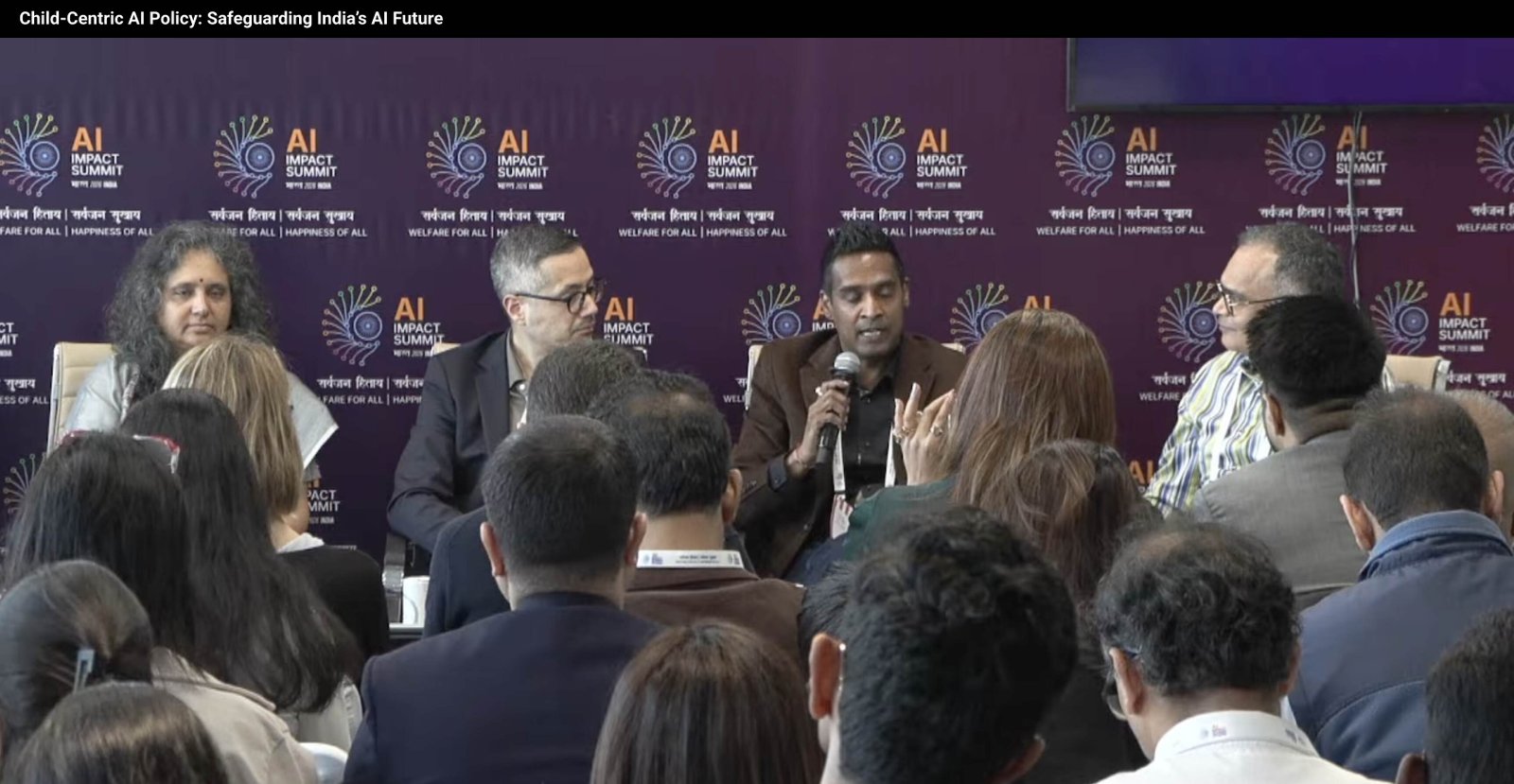
The session titled Safeguarding Children In India’s AI Future: Towards Child Centric AI Policy And Governance convened policy leaders, technology experts, educators, and child safety advocates to examine how India’s evolving AI ecosystem can embed child protection at the core of governance frameworks.
As India advances national artificial intelligence strategies and expands digital adoption, discussions emphasised that children are not passive users of technology but active participants within algorithmic environments that shape learning, behaviour, access, and wellbeing. Speakers highlighted that decisions made today around policy, product design, and governance will influence long term outcomes for child safety, dignity, and equitable development in an AI driven society.
Key Themes Discussed
1. Child Centric Governance As A Policy Imperative
Panellists stressed the need to integrate child rights perspectives into AI policy from the outset rather than treating safety as a downstream compliance issue. Discussions called for governance frameworks that recognise the unique vulnerabilities and developmental needs of children in digital ecosystems.
2. Designing Safe And Responsible AI Ecosystems
The conversation explored how AI systems used in education, social media, and digital engagement must prioritise transparency, accountability, and age appropriate safeguards. Participants noted that responsible design principles and proactive risk mitigation are essential to prevent harm while enabling innovation.
3. Multi Stakeholder Collaboration For Long Term Protection
Speakers highlighted the role of partnerships between government bodies, industry players, educators, and civil society organisations to build consistent standards for child safety. Collaboration across sectors was positioned as critical to balancing innovation with ethical responsibility.
Speaker Perspectives
Akash Pugalia, Teleperformance
Pugalia emphasised operational responsibility within digital platforms, noting that trust and safety functions must evolve alongside AI deployment to ensure children remain protected across increasingly automated environments.
Ashish Jaiman, Nedl Labs
Jaiman highlighted the role of innovation driven solutions in addressing child safety risks, stressing that responsible AI engineering and early design interventions can reduce long term exposure to harm.
Atish Gonsalves, LEGO Education
Gonsalves discussed how education centred AI tools must be developed with age appropriate frameworks, ensuring technology supports creativity and learning while maintaining clear safeguards.
Chitra Iyer and Shireen Vakil, Space2Grow
Both speakers emphasised that child wellbeing should remain central to policy conversations, calling for inclusive frameworks that consider psychological, developmental, and social dimensions when deploying AI systems.
Gaurav Aggarwal, iSPIRT Foundation
Aggarwal highlighted the opportunity for India to lead globally by embedding child centric safeguards into digital public infrastructure and emerging AI governance models.
Maya Shermon, Global Partnership on Artificial Intelligence
Shermon underscored international collaboration and shared governance standards, noting that cross border cooperation will be essential as AI products increasingly operate beyond national boundaries.
N. S. Nappinai, Cyber Saathi
Nappinai stressed legal and ethical accountability, highlighting the need for enforceable safeguards and awareness mechanisms that empower both parents and institutions.
Uthara Ganesh, Snapchat
Ganesh shared industry perspectives on implementing safety by design, focusing on proactive moderation, transparency measures, and continuous adaptation as AI capabilities evolve.
Zoe Lambourne, Childlight
Lambourne highlighted evidence based research as a foundation for policy decisions, stressing that data led insights are essential for identifying risks and shaping effective interventions.
Strategic Takeaways
-
Child centric design must become a foundational principle within India’s AI policy framework.
-
Safety by design and responsible innovation are essential for sustainable digital ecosystems.
-
Cross sector collaboration will be critical to building effective safeguards at scale.
-
India has an opportunity to shape globally relevant models for child focused AI governance.
Closing Note
The session reinforced that safeguarding children in an AI driven future requires proactive governance, collaborative frameworks, and ethical innovation. As India accelerates its AI ambitions, the discussion positioned child centric policy as a strategic priority capable of shaping safer, more inclusive digital outcomes for future generations.