

As artificial intelligence continues to reshape the future of mobility, the focus is rapidly shifting from reactive safety measures to proactive, data-driven accident prevention. At the forefront of this transformation is Cambridge Mobile Telematics (CMT), a global leader in AI-powered telematics and road safety solutions.
Following a significant $350 million investment, the company is accelerating its mission to make roads safer through advanced AI models and connected mobility systems. Central to this vision is DriveWell Atlas, a next-generation foundation model designed to understand the physics of driving in real time, unlocking new capabilities in risk assessment, crash detection, and behavioural insights.
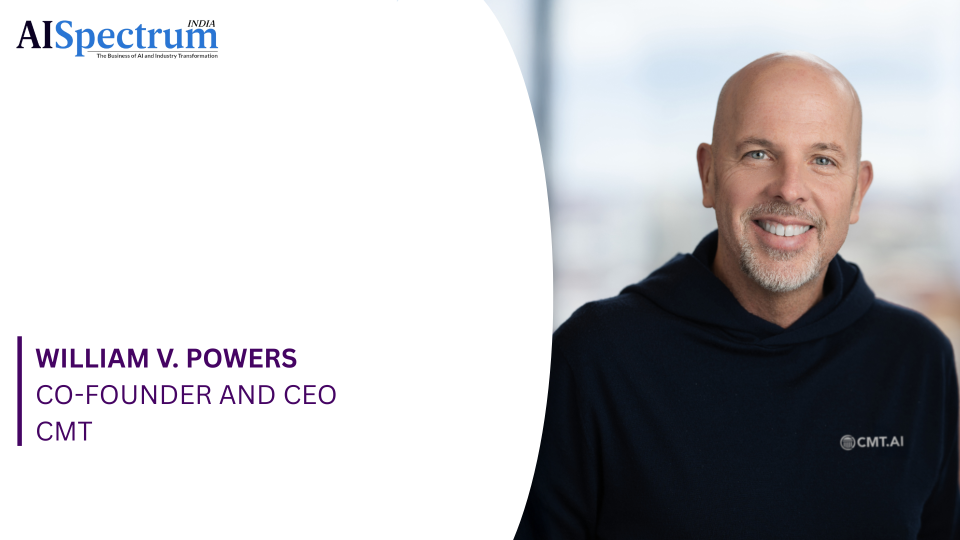
In this exclusive interaction with AI Spectrum, William V. Powers, Co-Founder and CEO, CMT, shares how it is leveraging AI to build a more connected and intelligent mobility ecosystem. From redefining driving risk through a Universal Driving Score to strengthening partnerships with global insurers and mobility players, the company is laying the groundwork for a future where accidents can be anticipated and prevented before they occur.
How will this $350 million investment accelerate CMT’s growth strategy, particularly in scaling your global road safety platform?
At CMT, we’re building AI to make the world’s roads and drivers safer. This is the mission, and it guides everything we do.
This investment accelerates our ability to scale that impact. We have spent more than a decade building the world’s largest applied AI platform for mobility. The next evolution is our foundation model for mobility, DriveWell Atlas, a physics-based model that understands how people move through the world and helps improve safety before, during, and after a drive. We are actively working with our insurance and mobility partners to integrate Atlas into their road safety programs.
We are also expanding our safety programs so more drivers get real-time protection through crash detection and roadside assistance. We are scaling our hardware and mesh-network capabilities so drivers have more options when choosing a safe driving experience.
This investment helps us extend our platform beyond the individual driver. We are bringing the same level of intelligence to commercial fleets and to road infrastructure, which helps agencies identify where crashes are most likely to happen before they occur.
AI makes this possible. It allows us to turn everyday driving into insight, and insight into action. The result is a safer, more connected mobility system that benefits everyone on the road.
How are CMT’s AI models, such as DriveWell Atlas, advancing real-time driving risk assessment and crash detection?
Most telematics models have historically been built to classify specific events. Atlas changes this. It is the first foundation model built specifically for mobility, and it learns the underlying physics of driving: force, motion, and trajectory.
This matters because real-world driving is messy. Sensor quality varies. Devices are different. Context changes constantly. A hard brake, a side swipe, a rear-end collision, or distracted driving behaviour can look different depending on the device, the vehicle, and the road.
Atlas creates shared embeddings that let us understand those patterns more deeply and more consistently across smartphones, Tags, connected vehicles, video, and crash data. A foundation model lets us generalise across those conditions and uncover patterns that aren’t explicitly labelled.
This improves real-time risk assessment by surfacing hidden patterns that older models could miss. It improves crash detection by helping us distinguish what really happened and why. It also speeds up research and deployment because we can adapt models with much less labelled data. We go from building one narrow classifier at a time to building on a common AI foundation that gets smarter across use cases.
This allows us to identify risk earlier, detect crashes with greater accuracy, and respond immediately when drivers need help. It also helps us guide safer behaviour over time, so drivers are not just protected in critical moments but supported every time they get behind the wheel.
What role will your partnerships with Allianz, TPG, and State Farm play in driving innovation for AI-powered telematics and insurance?
Making mobility safer at scale requires collaboration.
Our partners bring reach, expertise, and real-world environments where safety matters every day. Together, we’re applying AI in ways that directly improve outcomes, helping drivers stay safe, helping organisations operate more effectively, and helping entire systems respond better.
These partnerships allow us to move quickly from innovation to impact. They ensure that what we build is grounded in real needs and delivers measurable improvements in safety.
How does the Universal Driving Score differ from existing scoring systems, and what is its projected impact on the insurance ecosystem?
We believe every driver should have a clear and consistent way to understand their driving.
Most existing driving scores are program-specific. They are useful inside one insurer’s ecosystem, but they do not travel well across the market. The Universal Driving Score is a different idea. It is designed to give drivers a portable, understandable measure of driving safety that can be recognised more broadly.
This matters for two reasons. First, it gives consumers more transparency and more agency. Safe drivers should be able to benefit from the driving behaviour they have earned, not start from zero every time they move between programs or insurers. Second, it creates a stronger link between actual driving behaviour and insurance economics. That has the potential to shift the market away from risk proxies and toward behaviour-based understanding.
This has broad implications. It encourages safer habits, supports more informed decision-making, and helps align how different parts of the system understand risk.
How is CMT addressing data privacy and user consent while leveraging large-scale driving data for AI insights?
Trust is fundamental to everything we build. Privacy and consent have to be built into the system from the start.
Our approach is to use data responsibly, transparently, and in ways that deliver clear value back to the driver and our partners. For insurers and drivers, for example, we invest in privacy-centric telematics experiences, including hardware options that reduce friction and give partners more flexibility in how programs are designed. Drivers have to opt in to participate and can turn off the technology at any time. With the public sector, we use aggregated and anonymised driving behaviour data to identify roadway risk.
We build clear consent, strong privacy controls, explainability, and model governance that meet the needs of insurers, regulators, and consumers. We believe the future of AI in mobility will belong to companies that can combine performance with trust. We take both seriously.
How do you see AI shifting the future of mobility from reactive safety to proactive accident prevention?
For most of the last century, mobility systems have been built to respond after something goes wrong. A crash happens, then someone files a claim, dispatches help, studies the roadway, or changes behaviour later.
AI gives us the ability to change that.
When you can understand driving in real time, you can identify risk as it develops, support better decisions, and help prevent incidents before they happen. You can also connect drivers, vehicles, and infrastructure into a system that continuously learns and improves.
We already see pieces of that future today. AI can predict road risk, improve crash detection, spot mechanical failures, personalise coaching, and sustain safer habits through rewards and feedback. Over time, those capabilities will converge. The car, the phone, the roadway, the insurer, and the city will all be part of one connected safety system.
The result is more than just faster response after crashes: it is fewer crashes in the first place. This is the future CMT is building toward.