

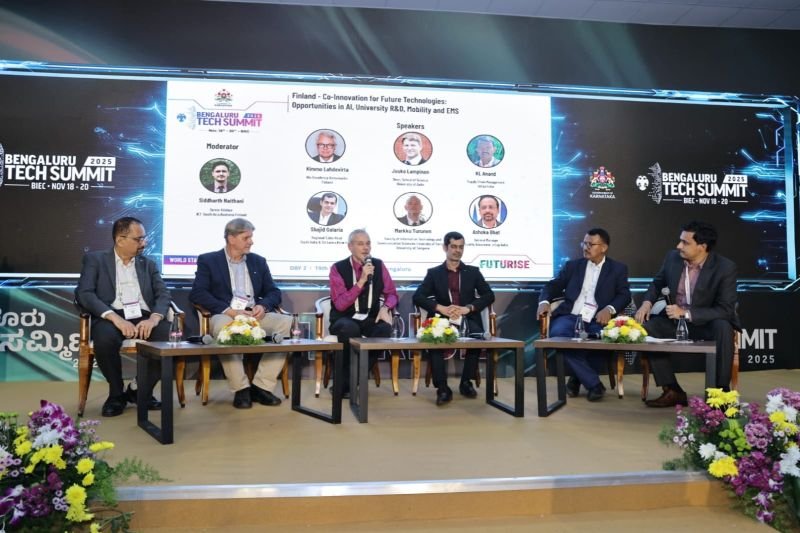
Moderated by Siddharth Mathur, the conversation emphasised how both countries can jointly accelerate innovation through shared expertise, open research ecosystems and complementary industry strengths. The panel explored collaboration opportunities across artificial intelligence, university driven research, intelligent mobility and the rapidly expanding electronics manufacturing sector.
Building a Connected and Collaborative AI Ecosystem
Kimmo Laksoharju opened the discussion by highlighting Finland’s strong foundations in applied AI, particularly in areas such as autonomous systems, sustainable computing and trustworthy machine intelligence. He noted that Indian scale and Finnish precision create a powerful combination for developing globally relevant AI solutions that address real world challenges.
Jussi Lampinen added that cooperation between Finnish research centres and Indian universities could unlock new advances in machine learning research. He emphasised that both countries share a commitment to open innovation and that mobility of researchers and students will be essential to building high impact partnerships.
University R and D as a Growth Engine
Bringing an Indian perspective, R L Anand stressed that universities play a pivotal role in shaping frontier technology development. He pointed out that India’s large pool of young talent combined with Finland’s deep research culture creates a unique opportunity to co develop future ready technologies. Joint centres of excellence and shared test beds were highlighted as potential next steps.
Innovation in Intelligent Mobility
Sajal Garia shifted the conversation towards mobility, noting that both Finland and India are investing heavily in cleaner, smarter and safer transport systems. He emphasised that Finnish strengths in sensor technologies, simulation platforms and urban mobility planning can complement India’s market scale and growing demand for intelligent transport solutions.
Markus Tanskanen added that mobility innovation must be rooted in reliable infrastructure and secure digital systems. He shared examples from Finland’s national mobility frameworks, where public and private sector collaboration has accelerated deployment of new mobility services.
Opportunities in Electronics Manufacturing and EMS
Closing the discussion, Arhun Ilmi highlighted the growing importance of electronics manufacturing services in global technology competitiveness. He observed that India’s expanding EMS ecosystem offers Finnish companies significant market access, while Finland’s engineering capabilities and focus on high quality design can bring added value to Indian manufacturers. The panel agreed that joint innovation in embedded systems, robotics and automation will define the future of the sector.
A Shared Vision for Sustainable and Inclusive Cooperation
The session reinforced that Finland and India are well positioned to build a forward looking partnership grounded in innovation, sustainability and trust. With complementary strengths across AI, research, mobility and electronics manufacturing, both countries can co create solutions that serve global markets and accelerate future technologies.