

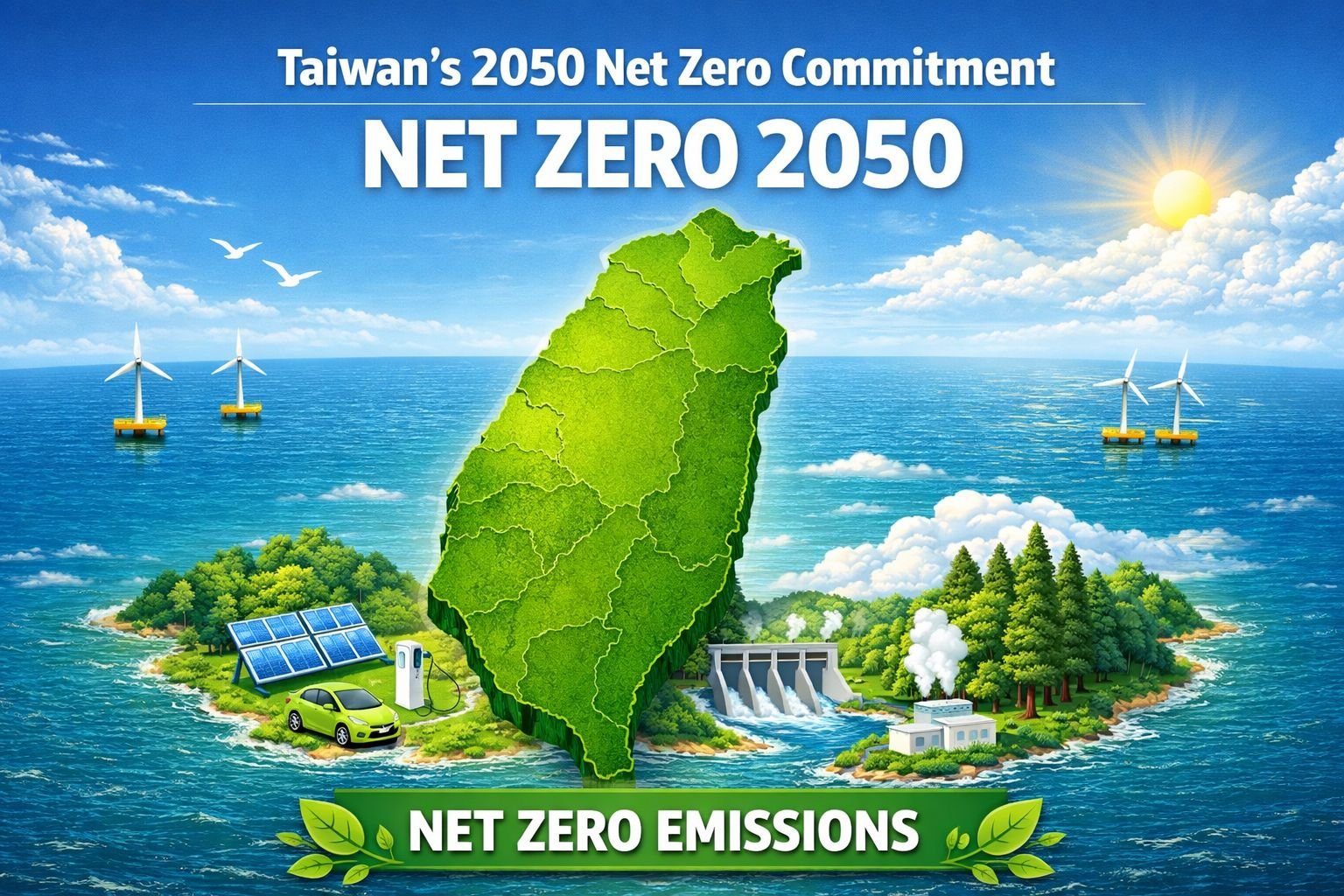
A Political Signal That Triggered Structural Change
Taiwan’s net zero journey gained momentum when Tsai Ing-wen formally articulated the 2050 net zero goal in 2021. While many governments issued similar commitments during this period, Taiwan’s approach quickly evolved beyond rhetoric into institutional action.
The leadership narrative was clear from the outset. Climate action was not positioned as a regulatory burden but as a strategic opportunity to drive industrial investment, job creation, and long term economic resilience. This framing has played a critical role in aligning both public and private stakeholders.
Subsequent national addresses reinforced the urgency of developing a forward looking roadmap, emphasising early risk assessment, international collaboration, and competitiveness in a carbon constrained global economy.
Legislative Backbone: Turning Ambition Into Law
A defining milestone in Taiwan’s journey came with the 2023 revision of the Greenhouse Gas Management Act into the Climate Change Response Act.
This legislative shift represents one of the most comprehensive climate frameworks in Asia.
Key provisions include:
-
Formal incorporation of the 2050 net zero target into law
-
Clear allocation of responsibilities across government agencies
-
Introduction of a carbon fee mechanism with earmarked utilisation
-
Dedicated provisions for just transition
-
Integration of climate adaptation strategies
-
Establishment of carbon footprint and product labelling systems
-
Enhanced transparency and public participation mechanisms
The inclusion of a carbon pricing structure signals Taiwan’s readiness to move towards market based climate governance. At the same time, the emphasis on social equity reflects an understanding that decarbonisation must be inclusive to be sustainable.
This legal foundation ensures that Taiwan’s net zero ambition is not subject to policy volatility, providing long term certainty for industry and investors.
Governance Architecture: Coordinated, Scientific, And Centralised
Taiwan has built a governance model that stands out for its coherence and coordination.
At the core is the Net Zero Pathway Task Force, established under the Executive Yuan in 2021. This is supported by an inter ministerial coordination group composed of deputy ministers, ensuring cross sectoral alignment and policy integration.
Scientific credibility is embedded through collaboration with:
-
Academia Sinica
-
Industrial Technology Research Institute
This structure enables evidence based policymaking while maintaining execution agility.
The result is a tightly integrated system where policy direction, scientific validation, and industrial implementation operate in tandem. Compared to fragmented governance models seen in several economies, Taiwan’s approach significantly reduces implementation gaps.
The Net Zero Framework: Structured For Execution
Taiwan’s 2050 pathway, officially announced in 2022, is notable for its layered and systematic design.
The framework is built on:
Four Core Transitions
-
Energy transition
-
Industrial transition
-
Lifestyle transition
-
Social transition
Two Foundational Pillars
-
Technology research and development
-
Climate legislation
Twelve Key Strategies
These serve as the operational backbone, covering:
-
Renewable energy expansion
-
Hydrogen development
-
Advanced power systems and energy storage
-
Energy efficiency improvements
-
Carbon capture, utilisation and storage
-
Electrification of transport
-
Circular economy initiatives
-
Carbon sink development
-
Promotion of green lifestyles
-
Expansion of green finance
-
Just transition frameworks
-
Integrated system planning
This multi layer structure ensures that the pathway is not only comprehensive but also actionable across sectors.
Energy Transition: Scaling Renewables Amid Structural Constraints
Energy transformation sits at the heart of Taiwan’s net zero strategy.
The roadmap places strong emphasis on offshore wind and solar photovoltaic expansion.
Targets Include:
-
Offshore wind capacity reaching 13.1 GW by 2030 and up to 55 GW by 2050
-
Solar capacity reaching 30 GW by 2030 and up to 80 GW by 2050
Taiwan’s geographical characteristics make offshore wind particularly attractive. The country is already positioning itself as a regional hub for offshore wind development, including floating wind technologies.
Solar deployment, while significant, faces land availability challenges, prompting innovative approaches such as rooftop installations and multi use land strategies.
However, the transition is not without complexity. Grid stability, energy storage integration, and energy security remain critical concerns, particularly given Taiwan’s reliance on imported energy.
Despite these constraints, Taiwan’s strategy reflects a deliberate shift towards energy autonomy and resilience.
Industrial Transition: Decarbonising A Manufacturing Powerhouse
Taiwan’s industrial base, particularly in semiconductors and electronics, is both a strength and a challenge in the net zero journey.
The transition strategy focuses on:
-
Electrification of industrial processes
-
Adoption of low carbon technologies
-
Integration of carbon capture solutions
-
Development of circular manufacturing systems
Taiwan’s advanced manufacturing capabilities provide a strong foundation for this shift. The country’s ability to innovate within high precision industries positions it well to lead in green manufacturing.
At the same time, global supply chain pressures, including carbon border adjustment mechanisms and sustainability standards, are accelerating the need for decarbonisation.
Taiwan’s approach indicates a strategic pivot towards becoming a supplier of low carbon industrial solutions rather than merely complying with environmental regulations.
Technology And Innovation: Building A Green Innovation Engine
Technology is a central enabler of Taiwan’s net zero ambitions.
Key focus areas include:
-
Hydrogen energy systems
-
Advanced battery storage technologies
-
Smart grid infrastructure
-
Carbon capture and utilisation
-
Electrification of mobility
-
Digital optimisation of energy systems
Taiwan’s strong research ecosystem, supported by institutions such as Academia Sinica and ITRI, plays a critical role in advancing these technologies.
There is also a growing intersection between digital transformation and climate strategy. Artificial intelligence, data analytics, and automation are increasingly being integrated into energy management and industrial efficiency systems.
This positions Taiwan not only as a user of green technologies but as a potential exporter of next generation climate solutions.
Green Finance: Aligning Capital With Climate Goals
Taiwan’s roadmap recognises that achieving net zero requires substantial financial mobilisation.
Key mechanisms include:
-
Carbon fee systems with reinvestment into sustainability initiatives
-
Incentives for private sector participation
-
Expansion of sustainable finance instruments
By aligning financial flows with climate objectives, Taiwan is creating an ecosystem where investment naturally gravitates towards low carbon solutions.
This approach also enhances the country’s attractiveness to global investors seeking sustainable opportunities.
Social And Lifestyle Transition: The Human Dimension Of Net Zero
A distinguishing feature of Taiwan’s strategy is its explicit focus on societal transformation.
The inclusion of lifestyle and social transitions acknowledges that technological solutions alone are insufficient.
Key elements include:
-
Behavioural change initiatives
-
Workforce reskilling and job transition programmes
-
Public engagement and awareness
-
Ensuring equitable distribution of transition benefits
The concept of just transition is particularly significant. It reflects a commitment to supporting communities and workers affected by structural changes, thereby reducing resistance and enhancing long term policy stability.
Smart Cities As Execution Platforms
Taiwan’s smart city initiatives provide a tangible demonstration of how net zero strategies are being implemented on the ground.
Urban environments are being leveraged as testbeds for:
-
Smart energy systems
-
Digital governance frameworks
-
Sustainable mobility solutions
-
Low carbon infrastructure
The convergence of digital innovation and sustainability is enabling more efficient resource management and real time monitoring of emissions.
This integration strengthens Taiwan’s broader positioning as a leader in both smart technologies and sustainable development.
Challenges And Strategic Risks
Despite its structured approach, Taiwan faces several challenges.
Energy Security
Dependence on imported energy remains a vulnerability, particularly during the transition phase.
Industrial Competitiveness
Balancing decarbonisation costs with global competitiveness is critical for export driven sectors.
Infrastructure Readiness
Scaling up grid capacity and energy storage systems requires significant investment and coordination.
Geopolitical Dynamics
Regional tensions and supply chain dependencies may impact energy and technology flows.
Addressing these challenges will require sustained policy commitment, technological innovation, and international collaboration.
A Model Of Structured Transition In Asia
Taiwan’s approach to achieving net zero emissions by 2050 is characterised by clarity, coordination, and commitment.
The country has successfully translated political intent into a comprehensive framework supported by legislation, governance mechanisms, and actionable strategies.
More importantly, Taiwan is leveraging the net zero transition as an opportunity to redefine its economic model, strengthen industrial competitiveness, and position itself within the global green economy.
If execution continues at the current pace, Taiwan is well placed to emerge as a leading example of how a technology driven, manufacturing intensive economy can navigate the complexities of decarbonisation while sustaining growth.
Taiwan’s pathway stands out as one that is being actively engineered, implemented, and refined in real time.