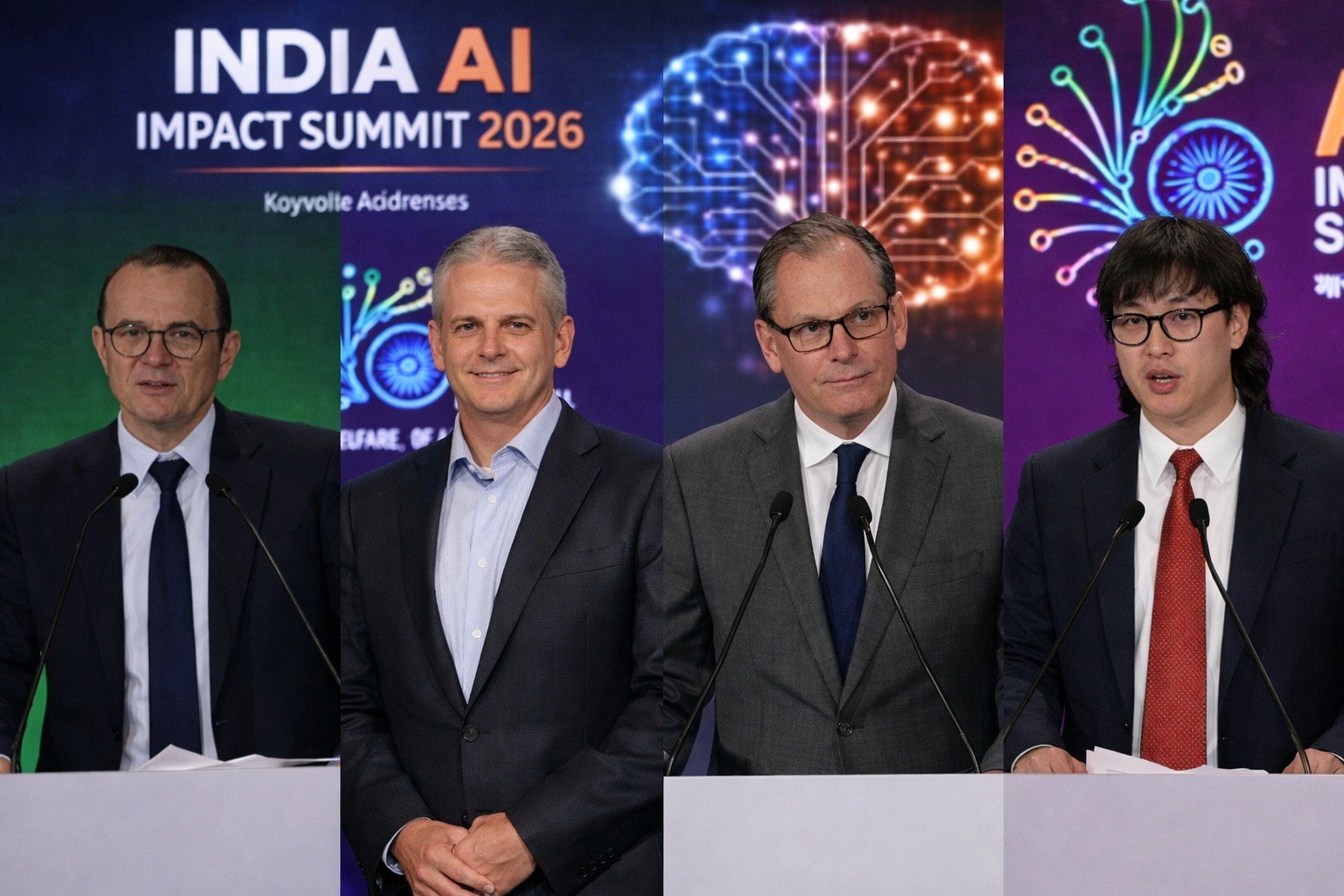
As part of the India AI Impact Summit 2026, keynote addresses by Alexander Wang, Chief AI Officer, Meta; Roy Jakobs, CEO, Philips; Martin Schroeter, Chairman and CEO, Kyndryl; and Olivier Blum, Global CEO, Schneider Electric, explored how artificial intelligence is moving from breakthrough innovation to real-world transformation across society, healthcare, infrastructure, and energy systems.
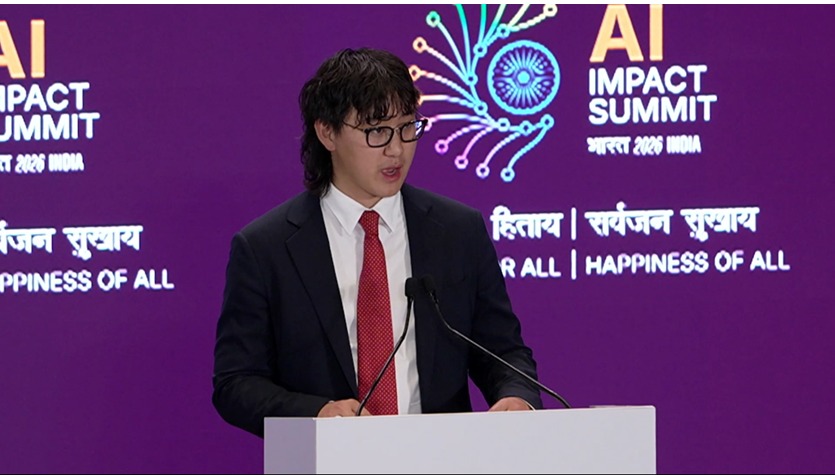
Alexander Wang, Chief AI Officer at Meta, set out a clear view of where AI is heading and why India sits in the middle of that shift. He pointed to AI’s rapid move from novelty to daily utility, arguing that the next chapter will be defined less by raw capability and more by how seamlessly AI supports real people in real contexts, at massive scale.
Anchoring his remarks around Meta’s ambition for “personal superintelligence,” Wang described a future in which AI becomes an always available, deeply contextual assistant, tuned to an individual’s priorities rather than generic prompts. “Our vision is personal superintelligence, AI that knows you, your goals, your interests, and helps you with whatever you’re focused on doing. It serves you, whoever you are, wherever you are.”
He was equally direct about the governance burden that comes with that intimacy. The more personalised the system becomes, the higher the standard for safety, privacy, and accountability. In Wang’s framing, trust is not a communications layer added at the end, it is a product requirement that determines adoption. “Given how intimately your personal AI will know you, people aren’t going to hire us for the job if we’re not doing it responsibly. Trust, transparency and governance must move as fast as the models themselves.”
Taken together, his message positioned India as both a proving ground and a pace setter: a market where scale, diversity, and real world complexity will test whether personal AI can be useful, safe, and broadly accessible, without compromising the very trust it needs to exist.
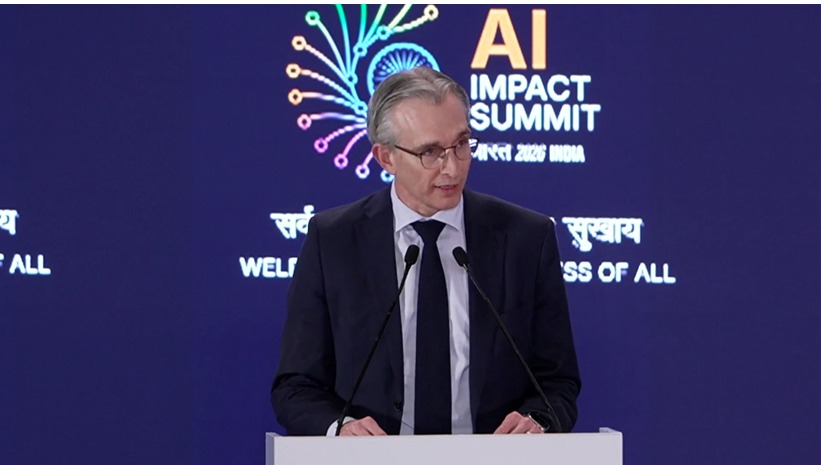
Roy Jakobs, Chief Executive Officer of Philips, positioned healthcare as the arena where artificial intelligence can deliver its most meaningful and measurable human impact. Framing his remarks against the backdrop of rising demand, chronic disease, workforce shortages, and growing patient expectations, he argued that healthcare systems are under structural strain and urgently need intelligent support.
Rather than presenting AI as a disruptive force, Jakobs described it as an enabler embedded quietly within clinical workflows, removing friction and restoring capacity. He emphasised that the real opportunity lies not in automation for its own sake, but in restoring the most precious resource in medicine: time.
“AI is not about replacing clinicians; it is about giving time back to them, time to think, time to connect, time to care.”
He illustrated how AI driven documentation, workflow prioritisation, imaging precision, and predictive monitoring are already reshaping care environments. By reducing administrative burden, filtering noise from clinical data, and elevating true risks earlier, AI can allow physicians and nurses to focus on judgement, empathy, and patient engagement.
Jakobs also challenged the audience to think beyond technical benchmarks. In his view, the long term legacy of AI in healthcare will not be defined by algorithm performance metrics or interface efficiency, but by outcomes at population scale.
“When we look back a decade from now, AI in healthcare will not be remembered for what was optimised on a screen, but for the billions of lives it helped improve.”
His remarks underscored a broader theme: in healthcare, technological progress only matters if it translates into earlier detection, fewer complications, wider access, and stronger trust between patients and providers.
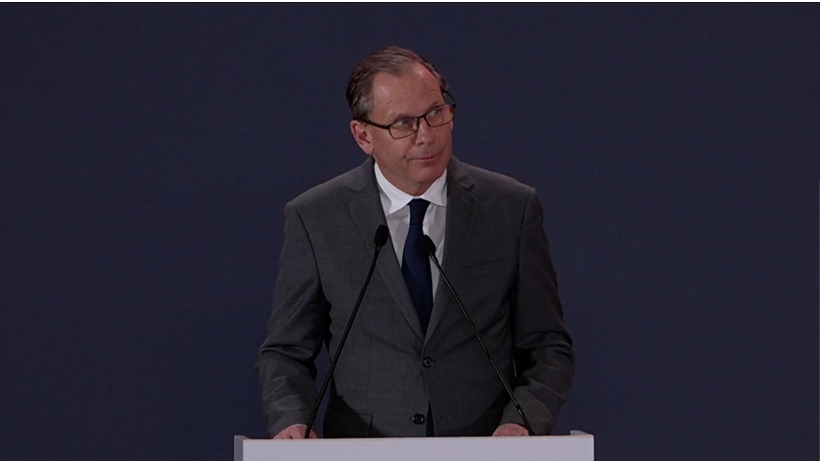
Martin Schroeter, Chairman and Chief Executive Officer of Kyndryl, brought the conversation back to operational reality, arguing that the true test of AI will not be its brilliance in pilots but its reliability in production. While acknowledging the rapid pace of model innovation, he drew a sharp distinction between experimentation and enterprise scale deployment.
In his view, the bottleneck is not imagination but infrastructure. Organisations are running proofs of concept, yet many lack the foundational architecture to sustain AI across mission critical environments. “The innovation is real. The challenge is readiness. AI today is not yet industrialised, infrastructure, data, operations and people must be prepared to support it at scale.”
Schroeter emphasised that industrialising AI demands far more than model selection. It requires resilient cloud and hybrid infrastructure, clean and governed data pipelines, secure operations, workforce capability, and continuous monitoring frameworks. Without those elements aligned, AI risks remaining confined to isolated use cases rather than transforming enterprise systems.
He also underscored that trust will ultimately determine whether AI becomes embedded in the systems society relies upon. For industries such as banking, healthcare, telecommunications, energy, and public services, reliability is non negotiable.
“The future of AI will not be decided in research labs or boardrooms. It will be decided by how reliably and responsibly it is embedded into the systems society depends on every day.”
Schroeter’s message was pragmatic and systemic: AI must move from innovation theatre to operational discipline. Only then can it deliver durable economic value and sustained public trust.
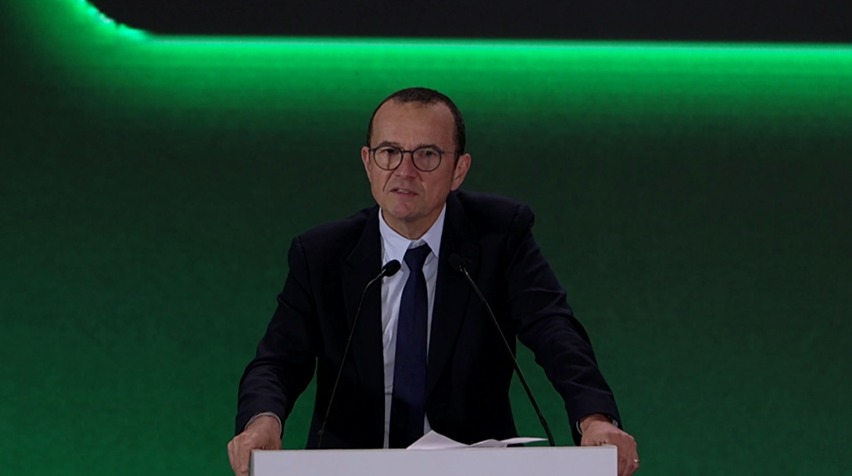
Olivier Blum, Global Chief Executive Officer of Schneider Electric, brought a systems level perspective to the AI conversation, highlighting the inseparable link between artificial intelligence and the global energy transition. His message was clear: AI’s rapid expansion will reshape not only digital ecosystems, but physical infrastructure at planetary scale.
Blum cautioned that the compute demands of advanced AI models are already accelerating global electricity consumption. Data centres, high performance chips, and large scale training workloads are pushing energy systems to their limits. “AI means more compute, and more compute means more energy. We cannot underestimate the pressure this will put on global energy systems.”
Yet his outlook was not cautionary alone. He argued that the same technology driving demand also offers a pathway to optimisation. By embedding intelligence across grids, buildings, industrial systems, and supply chains, AI can dramatically improve how energy is produced, distributed, and consumed.
“For the first time in our history, we can truly connect the physical and digital worlds, making energy systems intelligent and unlocking 10 to 30 percent efficiency gains across applications.”
Blum positioned AI as both stress test and solution, a force that will increase load while simultaneously enabling smarter, cleaner, and more adaptive energy networks. The implication was strategic: sustainability and AI strategy can no longer be developed in isolation.
Taken together, the four global leaders converged on a common imperative. The next phase of AI will not be defined solely by model breakthroughs or parameter counts. It will be determined by how effectively intelligence is embedded into the systems that underpin modern society.
From Meta’s vision of personal superintelligence, to Philips’ predictive and connected healthcare, to Kyndryl’s industrial grade digital backbones, and Schneider Electric’s intelligent energy networks, the direction of travel is unmistakable. AI must scale responsibly, integrate deeply with critical infrastructure, and deliver measurable outcomes.
The benchmark is shifting. Success will not be judged by technical novelty, but by strengthened institutions, resilient infrastructure, improved health, cleaner energy systems, and tangible benefits for people and economies. In that sense, AI’s defining decade will be less about invention and more about disciplined integration at scale.