

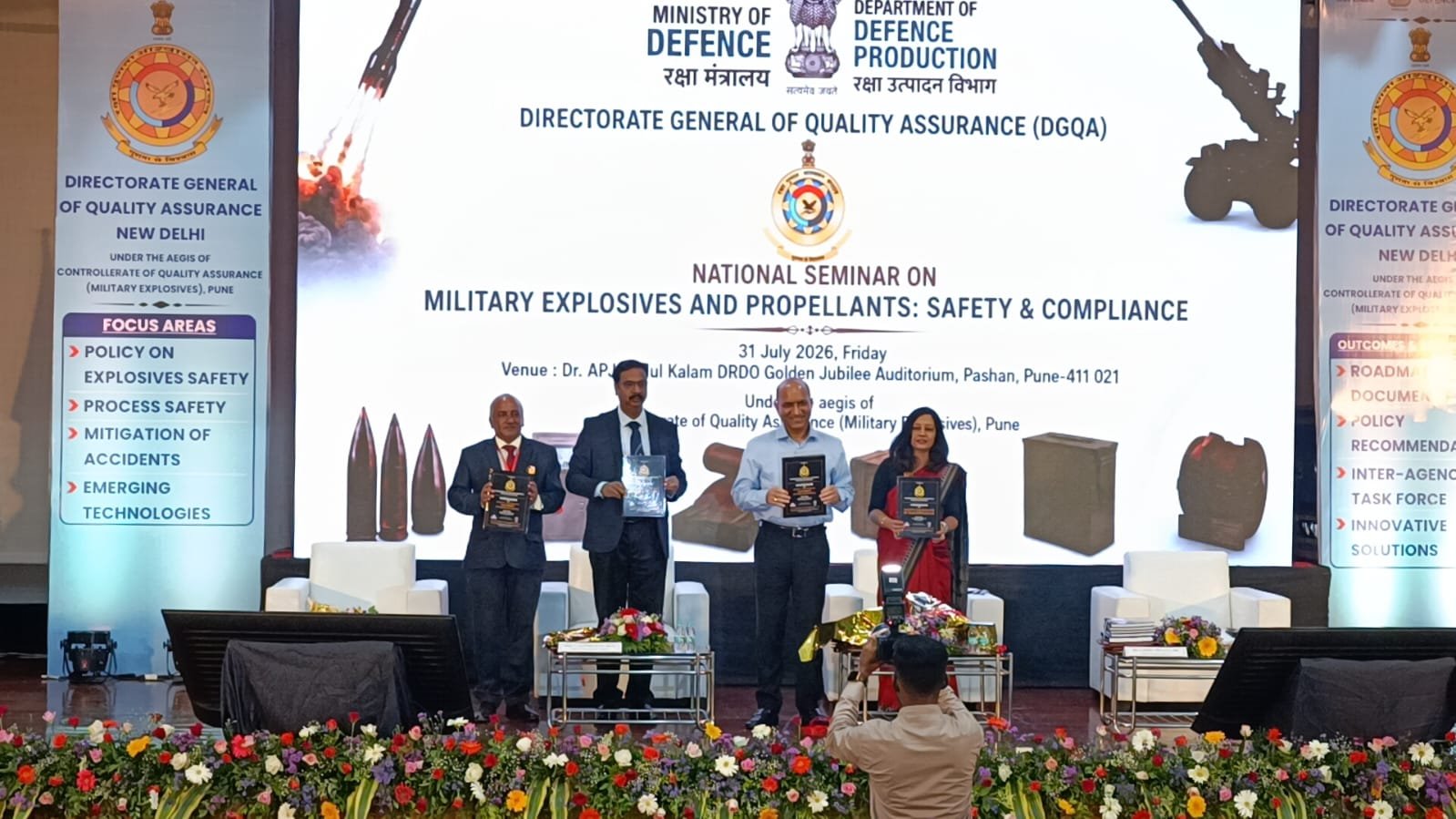
Defence Production Secretary Sanjiv Kumar has called upon India’s defence and explosives industries to adopt advanced digital technologies that can continuously monitor manufacturing processes, analyse operational data and anticipate potential safety risks.
He was speaking at the national seminar organized by the Ministry of Defence on Military Explosives & Propellants – Safety and Compliance and Quality Assurance, Defence Production. N. Manoharan, Director General of Quality Assurance, Ministry of Defence, was also present on the stage.
Kumar stressed that accidents involving explosives, propellants and other high-energy materials must be eliminated, rather than merely reduced or mitigated.
Kumar outlined several applications closely associated with AI, including automated data analysis, predictive safety monitoring, behavioural analysis and real-time process control.
He asked the industry to consider digitally enabling and automating critical processes so that safety protocols could be continuously supervised, controlled and corrected without excessive dependence on human intervention.
Kumar observed that safety standards and safeguards were already available, but their implementation could weaken over time as employees became confident or complacent while handling familiar processes. Technology, he indicated, could provide an additional layer of oversight and reduce the possibility of human error.
He proposed the deployment of CCTV cameras, sensors and connected machines, with data from critical equipment, materials and industrial premises transmitted to a central repository. Automated analysis of this information could help detect deviations and anticipate dangerous situations before they resulted in accidents.
The Secretary also highlighted the potential of emerging technologies to analyse manufacturing processes and human behaviour. Such systems could improve both plant efficiency and workplace safety, particularly in facilities handling hazardous materials.
Kumar said the government’s objective was to bring together public- and private-sector stakeholders to identify mandatory safety measures and explore technologies capable of making defence production facilities safer.
Beyond safety, he highlighted a major global opportunity for Indian manufacturers of ammunition, explosives and propellants. Continuing conflicts and war-like situations had depleted the inventories of several countries, while parts of Europe had dismantled much of their earlier manufacturing infrastructure, he noted.
He urged Indian companies to invest in expanding domestic capacity for basic materials such as propellants instead of focusing only on higher-value ammunition products. A sustainable ammunition manufacturing ecosystem, he said, required a broad and resilient production base.
Kumar also referred to regulatory reforms intended to accelerate investment in defence manufacturing. He said the number of stakeholders consulted by the Department of Defence Production for industrial licensing had been reduced from 19 to three, potentially bringing the department’s processing period down from three to six months to approximately one month.
He suggested that future editions of the seminar could bring together discussions on safety, emerging technologies, manufacturing opportunities, regulations and international participation under a common platform.