

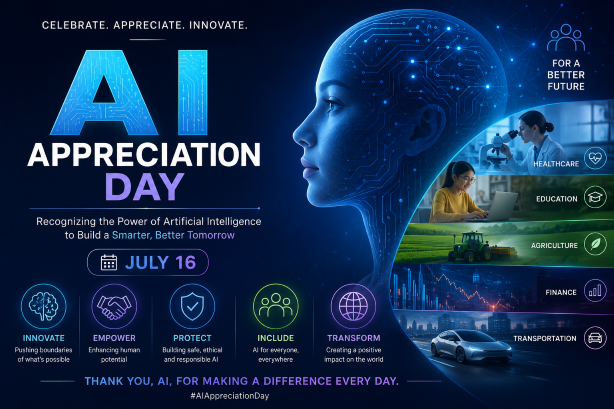
Every year on 16 July, the global technology community marks AI Appreciation Day, an occasion that recognises the transformative role artificial intelligence has come to play across industries and everyday life. More than a celebration of technological progress, the observance has evolved into an opportunity to reflect on how AI is reshaping economies, workplaces, healthcare, education, finance, and public services while reinforcing the need for responsible innovation.
AI Appreciation Day is a community-driven initiative that has steadily gained global recognition since its inception in 2020. As AI adoption accelerates and generative AI becomes increasingly mainstream, this year's observance carries greater significance than ever before, placing equal emphasis on technological advancement, ethical governance, and public trust.
From a Community Initiative to a Global Movement
AI Appreciation Day was established in 2020 by authors and AI educators Tom Taulli and Pete Mack to encourage broader public engagement with artificial intelligence and its growing societal impact. The date 16 July was strategically chosen to coincide with a period of heightened technology activity and industry events in the United States.
With AI now embedded across virtually every economic sector, AI Appreciation Day 2026 reflects not only how far the technology has advanced, but also how essential it has become to modern society.
AI's Growing Impact Across Industries
Artificial intelligence is no longer viewed as a futuristic concept. It has become an integral part of daily life, quietly powering digital services that billions of people rely on every day.
From helping physicians detect diseases earlier and accelerating drug discovery to enabling personalised education platforms, improving agricultural productivity, strengthening cybersecurity, optimising financial services, and delivering round-the-clock customer support, AI is fundamentally changing how organisations operate.
Some of its most significant applications include:
Healthcare: Medical imaging, disease diagnosis, drug discovery, predictive analytics
Education: Adaptive learning platforms, personalised tutoring, automated assessments
Agriculture: Precision farming, crop monitoring, yield prediction
Financial Services: Fraud detection, credit risk assessment, robo-advisory platforms
Transportation: Route optimisation, autonomous mobility, fleet management
Customer Service: AI assistants, multilingual support, intelligent automation
Behind many of these innovations lies a common objective—improving efficiency while augmenting human decision-making rather than replacing it.
AI Brings Greater Precision to Fertility Care
Among healthcare's fastest-evolving applications, artificial intelligence is also transforming fertility treatment by supporting clinicians with more precise diagnostics, embryo selection and treatment planning.
Dr Sandeep Karunakaran, Medical Director, Oval Fertility, said AI should be viewed as an intelligent clinical partner that complements rather than replaces medical expertise.
"Artificial Intelligence is fundamentally redefining fertility care by enabling clinicians to make more informed, precise, and evidence-based decisions throughout the IVF journey. I view AI not as a replacement for clinical expertise, but as a sophisticated digital partner that acts as a powerful enabler. Every recommendation generated by technology must always be interpreted through the lens of a patient's unique medical history, diagnostic findings, and specific treatment goals."
Dr Karunakaran explained that AI is being integrated across multiple stages of the IVF process, beginning with diagnosis and fertility screening. Advanced computer vision algorithms analyse semen samples to assess sperm morphology and motility. At the same time, machine learning models combine anti-Müllerian hormone (AMH) levels, patient age and antral follicle counts to predict ovarian response.
He added that AI-assisted ultrasound imaging can monitor follicular development in real time, enabling clinicians to optimise medication protocols and accurately determine the timing of egg retrieval.
The technology also plays a growing role in embryology laboratories through non-invasive time-lapse imaging that evaluates embryo development and supports embryo selection based on implantation potential while helping identify chromosomal abnormalities that may affect pregnancy outcomes.
"Ultimately, as these technologies continue to evolve, their greatest value lies in supporting specialists with deeper biological insights and improving decision-making consistency. By marrying data-driven precision with human clinical judgment, we enhance our patients' understanding of the process and deliver a more effective, compassionate, and deeply personalised path to building a family."
Responsible AI Takes Centre Stage
As AI systems become increasingly capable, conversations around governance have become just as important as discussions about innovation.
Industry leaders and policymakers now recognise that building trustworthy AI requires more than powerful algorithms. It demands fairness, transparency, privacy, accountability, and inclusivity throughout the AI lifecycle.
Key principles shaping responsible AI include:
Developing models using representative datasets to minimise bias
Making AI decision-making more transparent and explainable
Protecting personal data through privacy-by-design approaches
Holding organisations accountable for AI-driven outcomes
Ensuring AI technologies remain accessible across languages, cultures, and communities
Regulatory frameworks including India's Digital Personal Data Protection (DPDP) Act and the European Union's AI Act are reinforcing these principles, encouraging organisations to innovate responsibly while safeguarding human rights and democratic values.
AI's Critical Role in Fighting Financial Fraud
For India's fintech industry, AI Appreciation Day also highlights the growing importance of artificial intelligence in defending against increasingly sophisticated financial crime.
According to Hariharashudhan V K, Chief Operating Officer, Neokred Technologies, AI must now be viewed as a critical layer of digital security rather than simply another productivity tool.
"AI Appreciation Day should encourage India's fintech sector to focus on one of its biggest challenges digital financial fraud. Indian consumers and institutions have lost an estimated Rs1.25 lakh crore over the past three years, while fraudsters now operate at machine speed. Defending against these threats requires AI systems that can respond just as quickly."
He noted that AI has become indispensable in identity verification, Know Your Customer (KYC) onboarding, and transaction monitoring, where machine learning models analyse behavioural signals, transaction velocity, device fingerprints, and network anomalies in milliseconds far beyond human capability.
"While generative AI often captures the headlines, equal recognition should be given to AI systems working silently behind the scenes to prevent fraud, safeguard privacy, and maintain compliance. AI that respects user consent, supports data minimisation, and creates transparent audit trails while delivering real-time risk decisions represents some of the industry's most important engineering achievements."
Hariharashudhan added that the fintech ecosystem should recognise the teams developing trusted AI infrastructure that enables regulators, banks, and consumers to transact securely without ever noticing the technology working in the background.
Building Voice AI That People Can Trust
The rapid adoption of conversational AI is also transforming how organisations engage with customers, patients, job seekers, and citizens.
Subhash Kalluri, Founder of FreJun, believes the industry's focus should extend beyond automation to ensuring AI strengthens trust during critical human interactions.
"Voice AI now participates in some of the most sensitive conversations businesses have whether a patient booking a medical appointment, a candidate discussing a career opportunity, or a customer resolving a financial issue. AI is no longer simply automating tasks; it has become part of moments that require trust between individuals and institutions."
Kalluri emphasised that AI systems making recommendations or decisions affecting people's lives must be built on strong governance foundations.
"Responsible AI cannot be treated as an afterthought. Data protection, consent management, call auditing, transparency, and clearly defined escalation mechanisms should be embedded into the infrastructure from the beginning rather than added later."
He explained that FreJun has prioritised compliance and governance as core design principles rather than regulatory obligations.
"Our objective has never been automation for its own sake. AI should eliminate repetitive work while allowing recruiters, sales professionals, and customer support teams to focus on situations requiring empathy, judgement, and meaningful human interaction. A human-first AI future is one where technology earns trust because people's interests remain at the centre of every design decision."
AI Adoption Must Be Matched by Stronger Security
As AI adoption accelerates across enterprises, cybersecurity experts warn that governance and security cannot be treated as secondary considerations.
Rajnish Gupta, Managing Director & Country Manager, Tenable India, said AI Appreciation Day should encourage organisations to balance innovation with risk management.
"AI Appreciation Day shouldn't just be a celebration of productivity; it needs to be a reality check for how we manage risk."
Gupta noted that India is among the world's fastest adopters of generative AI, with recent industry data showing that 92 per cent of Indian employees use generative AI weekly, while shadow AI usage has reached 58 per cent, the highest among markets surveyed.
"The defining feature of this era is the sheer velocity of AI adoption, and India sits at the front of that curve. It's created a corporate culture driven by instant gratification, where timelines that used to take days are collapsed into seconds. This is unlocking undeniable innovation, but convenience always wins until the consequences catch up."
He warned that employees are increasingly uploading sensitive corporate information into unapproved large language models, creating significant governance and compliance risks under India's Digital Personal Data Protection (DPDP) Act.
"This isn't an argument against AI; its benefits are real and irreversible. But we are building an exponential future on a fragile foundation."
According to Gupta, organisations should strengthen enterprise AI governance through exposure management platforms, clear policies governing the use of public AI models, and employee training that treats AI security with the same importance as data privacy.
"The fastest to adopt won't win as big as the ones that adopt it safely."
Building AI That Works Fairly for Everyone
Alongside security and governance, ensuring AI systems perform fairly across diverse populations has become a critical priority as AI is increasingly used for identity verification and financial inclusion.
Hariprasad PS, Head of AI, HyperVerge, said AI Appreciation Day should prompt the industry to examine whether AI systems are truly equitable.
"AI Appreciation Day asks a harder question than most calendar observances. While the world is focused on how AI improves productivity, is it really bias-free?"
He explained that AI now makes decisions affecting millions of people every day—from verifying identities and authenticating documents to enabling access to banking and financial services—and these systems must perform reliably across different demographics and environments.
"A model that performs well in a lab won't automatically perform well in a village in India or on a busy street in Vietnam. Lighting varies, paper stock varies, camera quality varies, and network speed varies."
Hariprasad stressed that reducing bias requires continuous investment in diverse training datasets representing different populations, document types and operating conditions, alongside regular auditing of model performance rather than relying solely on aggregate accuracy scores.
He also highlighted the importance of designing AI systems that work effectively on lower-end smartphones and unreliable network connections, particularly across emerging markets.
"This AI Appreciation Day, it's worth celebrating what AI makes possible while being honest about what it demands. Bias-free AI is an ongoing discipline of testing across geography, document type, age, and network condition, because the moment that testing stops, the system starts failing someone worthy."
Protecting Enterprise Knowledge in the AI Era
Beyond governance and compliance, organisations are increasingly recognising that AI's long-term value depends on how effectively they protect and compound their proprietary knowledge.
According to Anand Sampath, EVP and Head of AI Innovation Centre, India, Visionet Systems, enterprises should move beyond viewing AI adoption as a race for speed and instead focus on building sustainable competitive advantage.
"Every prompt, correction, and workflow we feed into AI carries institutional knowledge, judgment, and context that form an enterprise's competitive edge. The critical question is where that learning accumulates and who ultimately benefits from it. Speed alone is no longer enough. The leaders who maximise AI will be those who build a clear trust boundary around their proprietary knowledge, retain control of their learning loop, and keep human judgment in the calls that matter."
Sampath emphasised that organisations should measure AI success by tangible business outcomes rather than the number of AI tools deployed.
"At Visionet, we believe enterprises should not invest in AI tools for the sake of adoption; they should invest in measurable AI outcomes, with architectures that compound their intelligence and competitive advantage within the business. The winners in AI won't be the fastest adopters. They'll be the ones who keep their learning loop intact."
Trusted AI for Critical Infrastructure
As AI becomes deeply embedded in national infrastructure, cybersecurity, aerospace and defence, ensuring trust and human oversight is becoming increasingly important.
Ankur Kanaglekar, Vice President – India, Thales, believes AI Appreciation Day should also serve as a reminder that responsible AI must underpin every mission-critical application.
"As we celebrate AI Appreciation Day, it is important to recognise that AI's true potential will not be measured by how quickly it is adopted, but by how much it can be trusted. Whether helping cyber experts respond to increasingly sophisticated attacks, supporting defence operators in mission-critical decisions, assisting air traffic management or protecting critical infrastructure, AI must deliver more than performance: it must be secure, transparent, resilient and remain under meaningful human oversight."
Kanaglekar noted that trusted AI combines advanced intelligence with strong cybersecurity, data protection and governance frameworks.
"At Thales, we believe the future belongs to AI that empowers people to make faster, better-informed decisions while protecting critical data, systems and operations. This vision is brought to life through cortAIx, Thales' global trusted AI accelerator, which combines advanced AI capabilities with cybersecurity, data protection and human-centric governance to help organisations worldwide deploy AI with confidence across defence, aerospace, cyber and digital identity. With AI embedded in more than 100 products and services and supported by the expertise of over 800 AI specialists, Thales is committed to advancing trusted AI that not only addresses today's challenges but also helps build a more secure, sovereign, and resilient digital future."
Private AI Emerges as the Next Enterprise Imperative
As organisations move from experimenting with generative AI to deploying it across mission-critical business functions, the conversation is increasingly shifting towards private AI where enterprises retain full control over their data, models and institutional knowledge.
Praveer Kochhar, Co-Founder & Chief Product Officer, KOGO AI, believes AI Appreciation Day should recognise not only the capabilities of public AI models but also the growing importance of enterprise-grade private AI.
"AI Appreciation Day must celebrate what private AI delivers, not just what public AI demonstrates. The rollercoaster of AI innovations has demonstrated that when it gets down to brass tacks, businesses need AI platforms that run real operations without exposing proprietary data to third-party vendors. Private AI changes this equation. When AI is private, it lets a company keep its models, data, and institutional knowledge inside its own infrastructure while agents execute actual work."
According to Kochhar, enterprises are increasingly adopting agentic AI systems that can automate complex operational workflows while maintaining governance and data sovereignty.
"This shift is already visible across the industry. Enterprises now deploy agentic systems that read contracts, generate dashboards, and manage cross-team workflows inside infrastructure they control. Analyst work that once took days now finishes in minutes. And all of this can be done privately, which Indian startups have clearly demonstrated."
He added that the next phase of enterprise AI adoption will be defined by trust, governance and operational control rather than model performance alone.
"Public AI proved that large models can reason and generate. Private AI proves that enterprises can trust AI enough to hand it real authority over real processes. That trust depends on control over which models run, how data moves, and the audit trail behind every decision an agent makes."
Kochhar also emphasised that the industry's appreciation should extend to the infrastructure and governance mechanisms that enable responsible enterprise AI.
"This AI Appreciation Day, it's important to celebrate the engineers who build guardrails, the governance layers that let a CFO sleep at night while agents touch financial systems, and the shift from AI as a feature to AI as infrastructure that enterprises actually own."
Enterprise AI Success Starts with Strong Foundations
While the pace of AI innovation continues to accelerate, many industry leaders believe lasting success depends less on adopting the latest models and more on building robust enterprise foundations.
Atul Arya, Founder & CEO, Blackstraw.ai, said AI Appreciation Day offers an opportunity to reflect on how organisations are moving beyond experimentation to large-scale deployment.
"AI Appreciation Day is an opportunity to pause and recognise the transformative role AI has played in helping people and businesses achieve more. Ironically, pausing is something this industry rarely does. Every year, conversations around AI move faster than implementation, and it is within that gap that the most valuable lessons emerge. In my experience, enterprises that once viewed AI as an experiment are now embedding it into their operations, data engineering, and decision-making processes."
Arya noted that the organisations deriving the greatest value from AI are those prioritising strong data strategies and governance over rapid adoption of every new AI capability.
"The organisations seeing the greatest success are not necessarily the ones chasing every new model or AI agent. Instead, they are the ones that have invested in getting the fundamentals right—building strong data foundations, embedding governance into the architecture from the outset, and applying automation where it solves genuine business challenges. That is the real shift defining enterprise AI today."
Looking Beyond Innovation
AI Appreciation Day serves as a reminder that the success of artificial intelligence will not be measured solely by increasingly powerful models or rapid technological breakthroughs.
Its long-term impact will depend on whether organisations can deploy AI responsibly, earn public confidence, protect privacy, reduce bias, and ensure the technology remains transparent, inclusive, and accountable.
As AI becomes more deeply integrated into business and society, appreciation must extend beyond the technology itself to the researchers, engineers, policymakers, and organisations working to ensure AI remains safe, ethical, and beneficial for everyone.
On AI Appreciation Day 2026, the message is increasingly clear: the future of artificial intelligence will be defined not only by what AI can do, but by how responsibly humanity chooses to use it.