

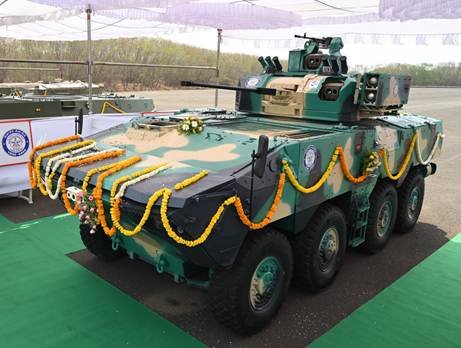
In a major boost to India’s indigenous defence capabilities, the Defence Research and Development Organisation (DRDO) unveiled its Advanced Armoured Platforms (Tracked and Wheeled) at its facility in Ahilyanagar, Maharashtra. The platforms were formally launched by DRDO Chairman and Secretary, Department of Defence R&D, Samir V Kamat, marking a key milestone under the Atmanirbhar Bharat initiative.
Developed by the Vehicle Research and Development Establishment (VRDE), the platforms are designed to address the evolving operational requirements of the Indian Armed Forces. The programme has been executed in collaboration with leading industry partners, Tata Advanced Systems Limited (TASL) and Bharat Forge, and supported by a network of MSMEs, highlighting the growing strength of India’s public-private defence ecosystem.
AI Capabilities: Present Status and Future Vision
While Artificial Intelligence (AI) is central to the platform’s future roadmap, VRDE Director G R M Rao clarified that most AI features are currently in the conceptual and design phase, with phased integration planned in upcoming iterations.
He outlined that AI will play a crucial role in:
Target acquisition and tracking, especially for systems like Anti-Tank Guided Missiles (ATGMs)
Automated weapon selection reduces human reaction time in high-pressure combat scenarios
Mobility optimisation, enabling adaptive navigation across varied and complex terrains
Rao emphasised that these capabilities aim to significantly reduce decision-making time in combat situations, improving operational efficiency. Future upgrades are expected to incorporate advanced propulsion systems, directed-energy weapons, autonomous capabilities, and robust cybersecurity frameworks.
The platforms have been developed in a record time of just three years under the Development-cum-Production Partner (DcPP) model, an approach that integrates private industry from the design stage through to manufacturing. Both tracked and wheeled variants feature an indigenously developed 30 mm crewless turret, enhancing firepower, protection, and mobility.
Speaking at the unveiling, Kamat underscored the strategic importance of self-reliance in defence technologies for India’s long-term growth. He noted that the DcPP model is particularly suited for complex, high-risk systems where industry participation is essential.
However, he also flagged challenges within the model, particularly the issue of companies quoting unsustainably low bids to secure DcPP roles, which can distort the selection process. “The mechanism is still evolving, but we are confident it will mature into a fair and transparent system,” he said.
The platforms have now entered the Development Trial phase and will proceed to User Trials with the Indian Army upon meeting performance benchmarks. Officials expect potential induction within the next three years.
Industry partners TASL and Bharat Forge highlighted that the collaborative approach has significantly reduced development timelines from typical decade-long cycles to a 36-month design-to-realisation process.
The unveiling of these advanced armoured platforms signals India’s steady progress in building next-generation, AI-enabled defence systems domestically. While current versions focus on core combat capabilities, the planned integration of AI and autonomous technologies positions the platform as a future-ready system aligned with global military innovation trends.
As India continues to reduce dependence on foreign defence imports, such initiatives reinforce its ambition to develop a robust, self-reliant, and technologically advanced military-industrial base.