

Artificial intelligence is no longer simply boosting productivity and saving time at work; it is fundamentally reshaping the nature of work, leadership, and employee experience, according to new survey data from Boston Consulting Group (BCG).
Nearly three-quarters (72 per cent) of respondents now say AI has already considerably changed skills expectations in their roles, and nearly half (47 per cent) report spending more time managing and directing AI than doing the work itself. Two-thirds (67 per cent) of regular AI users say it has improved job satisfaction, even as four in ten (41 per cent) report increased cognitive load, creating an "joy paradox" where AI makes work better and harder at the same time.
These are among the findings of BCG's fourth annual AI at Work report, based on a global survey of 11,749 workers across 14 markets and a broad range of industries. The report examines how AI adoption, workforce expectations, leadership, and organisational transformation are evolving as AI is increasingly embedded in day-to-day work.
AI adoption by frontline employees (individual white-collar employees with no managerial responsibilities) has surged ahead, with 74 per cent now regular users, up more than 20 percentage points over the previous two years. Geographically, Global South markets continue to lead the adoption race for frontline employees. India, the Middle East, Brazil, and South Africa all reported levels of regular AI usage above the global average as well as most of their Global North counterparts, with the US, France, and Italy lagging.
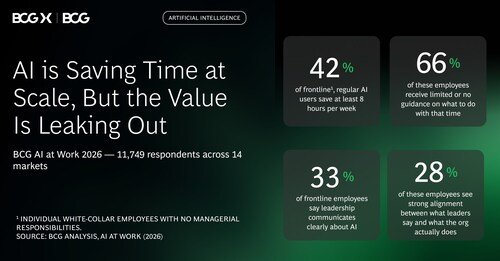
Yet despite widespread usage, many organisations are struggling to convert AI-driven efficiency gains into measurable value. While 42 per cent of regular frontline users report saving at least a full workday through AI per week, 66 per cent report they get limited or no guidance on what to do with that time, and more than half don't redirect it into strategic work. Without proper transformation, time saved leaks out of the organisation.
"The first wave of AI focused on individual productivity. The coming wave will need to transform collective work," said Vinciane Beauchene, a managing director and partner at BCG and coauthor of the report. "Everyone is talking about AI replacing work, but it is in fact, really about rethinking the human value-add inside. This is the role of leaders. Our survey reveals a true managerial revolution in the age of AI. Sixty-five per cent of managers and leaders now believe agents will take over at least half of their job in the next three years and frontline workers see their jobs evolving towards more managing and directing AI."