

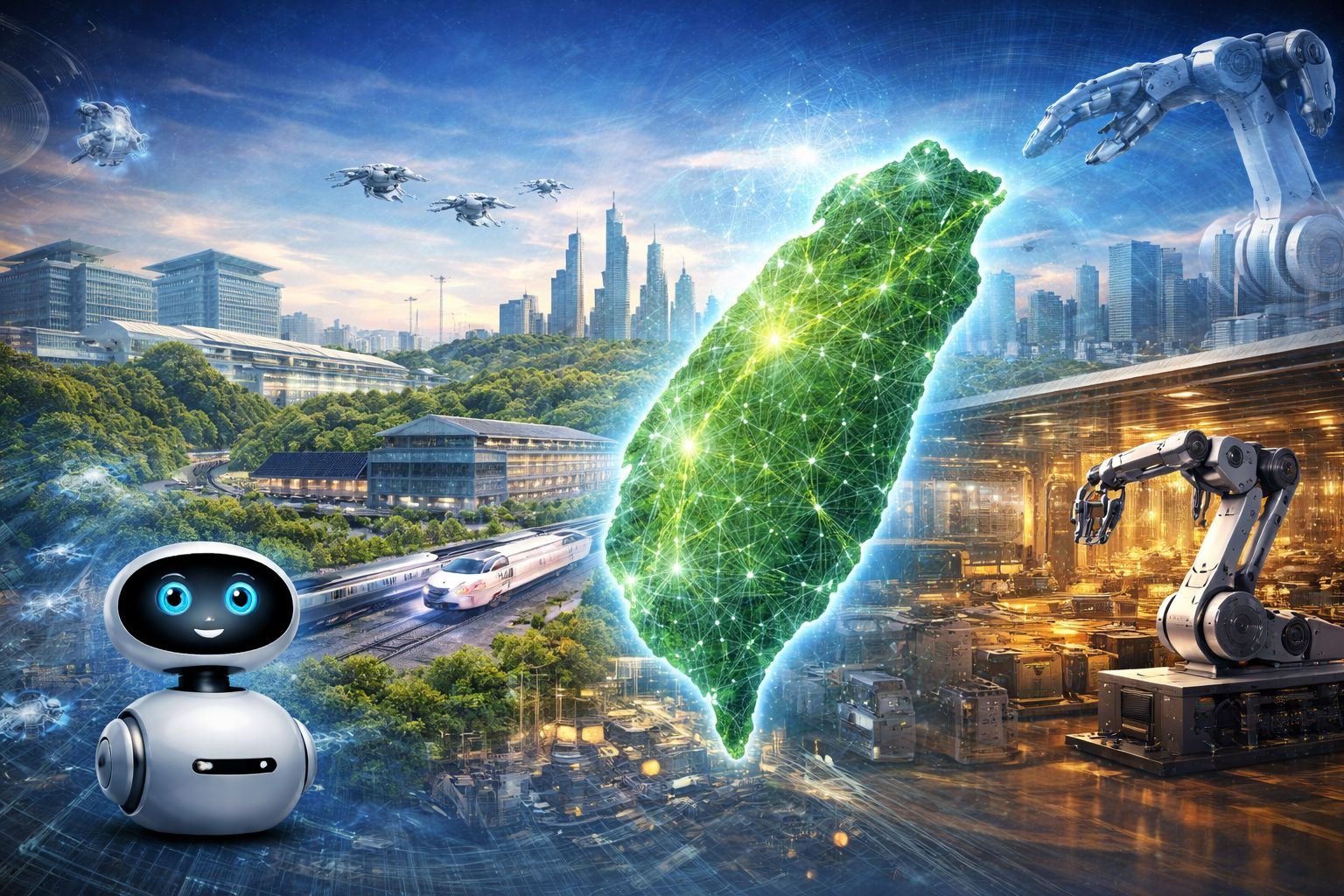
Taiwan has taken a decisive step towards establishing itself as a global leader in artificial intelligence driven robotics with the launch of the Smart Robotics Application Special Interest Group (SIG), anchored by strong cross ministry coordination and a clear national deployment strategy led by the National Science and Technology Council.
At the centre of this initiative is Minister Cheng Wen Wu, who is positioning smart robotics not merely as a technology segment but as a foundational pillar of Taiwan’s next phase of industrial and societal transformation. The strategy reflects a shift from technology development to usage driven deployment, ensuring robotics becomes embedded across everyday environments and critical industries.
National Strategy Anchored In Policy Integration And Regional Balance
The Executive Yuan’s approval of the Smart Robotics Industry Development Plan, aligned with the Greater Southern New Silicon Valley Promotion Plan, signals a coordinated national push that integrates infrastructure, talent, and application ecosystems.
Southern Taiwan, particularly Tainan, has been identified as the launchpad for this transformation. The region is evolving into a high density robotics innovation cluster, supported by:
-
AI Industry Ecosystem Park
-
Taiwan Smart Systems Integration Manufacturing Platform
-
Planned national level robotics research and manufacturing centres
-
Taiwan Chip based Industrial Innovation Program
This regional focus is not incidental. It is designed to reduce development disparities while accelerating high value industrial growth, ensuring that Taiwan’s AI economy expands beyond traditional northern hubs.
The government’s approach is notably practical. Instead of limiting robotics to experimental environments, the plan prioritises deployment across:
-
Healthcare and elderly care systems
-
Education and public service delivery
-
Transportation and logistics networks
-
Industrial automation and manufacturing
By embedding robotics into these sectors, Taiwan aims to address structural challenges such as labour shortages, ageing demographics, and operational inefficiencies.
Smart Robotics As A Response To Labour And Risk Challenges
Taiwan’s smart robotics strategy is rooted in solving real world constraints. AI powered robots are being developed to take on high risk, repetitive, and labour intensive tasks, particularly in sectors facing workforce gaps.
Future applications will extend into:
-
Firefighting and emergency response
-
Construction and infrastructure maintenance
-
Precision agriculture
-
Long term care and assisted living
What distinguishes Taiwan’s approach is the emphasis on autonomous decision making capabilities, where robots move beyond programmed tasks to adaptive problem solving powered by advanced AI models.
Cross Ministry Collaboration Driving Scalable Deployment
The initiative is being jointly driven by the Ministry of Economic Affairs and the National Science and Technology Council, alongside other government bodies. This ensures robotics is not developed in silos but integrated into government services and national infrastructure systems.
This model enables:
-
Faster regulatory alignment
-
Standardisation of robotics applications
-
Scalable deployment across public sector use cases
-
Stronger linkage between R&D and commercialisation
In parallel, NSTC is investing in AI model development, software ecosystems, and talent pipelines, ensuring that Taiwan builds both hardware and intelligence capabilities in tandem.
ASUS And Industry Alliance Push Physical AI And Real World Validation
A critical industry dimension of this initiative is being led by ASUS, which serves as chair of the Taiwan Smart City Solutions Alliance and co convener of the Smart Robotics Application SIG.
ASUS brings a decade of robotics development experience, including early service robots such as Zenbo. While earlier iterations were constrained by limited voice recognition and insufficient real world validation, the rapid advancement of large language models has significantly expanded what robots can achieve.
This shift is accelerating the emergence of Physical AI, where AI systems are embedded into machines capable of interacting with and adapting to physical environments.
Industry stakeholders emphasise that field validation is now the defining factor for success. Smart cities are being used as living laboratories where robotics solutions are tested and refined in real environments such as:
-
Hospitals and elder care facilities using companion robots
-
Hotels and retail spaces deploying service and guide robots
-
Logistics hubs and factories implementing autonomous handling and inspection systems
These deployments ensure that solutions are not theoretical but market ready, scalable, and aligned with user needs.
Tainan As A Strategic Robotics Cluster And Global Launchpad
The collaboration with the Tainan City Government to establish the Smart Robotics Application SIG marks a significant milestone. Tainan is not only hosting infrastructure but is being positioned as a fully integrated robotics ecosystem, combining:
-
Industrial parks dedicated to robotics
-
Application driven pilot programmes
-
Public private research collaboration platforms
The SIG will function as a central coordination mechanism, enabling:
-
Resource integration across industry, academia, and government
-
Development of interoperability standards
-
Acceleration of commercialisation pathways
-
Global positioning of Taiwan’s robotics solutions
Towards “The Island Of Artificial Intelligence”
This initiative aligns closely with President Lai’s broader national vision of transforming Taiwan into “The Island of Artificial Intelligence.” Smart robotics is emerging as one of the most visible and impactful manifestations of that ambition.
By combining semiconductor strength, AI innovation, and real world deployment at scale, Taiwan is building a full stack robotics ecosystem that extends from chips and models to applications and exports.
The launch of the Smart Robotics Application SIG therefore represents more than an industry milestone. It marks a transition towards a deployment led AI economy, where robotics becomes a core driver of smart cities, industrial resilience, and global technology leadership.