

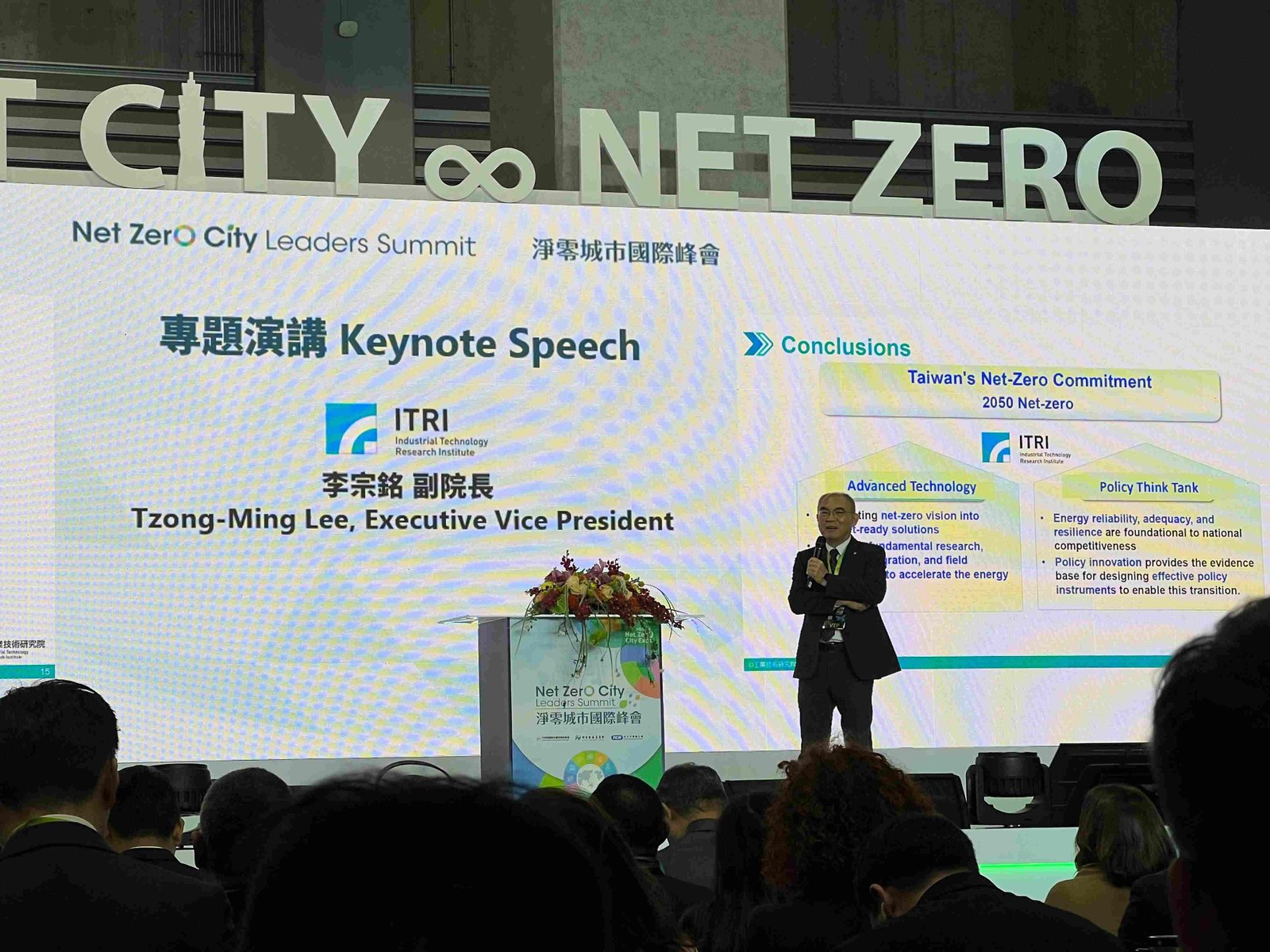
At the Net Zero City Leaders Summit, held alongside the Smart City Summit & Expo, Tzong-Ming Lee, Executive Vice President of the Industrial Technology Research Institute (ITRI), delivered a keynote presentation outlining Taiwan’s strategic approach to achieving its 2050 net zero commitment through the convergence of advanced technologies and policy innovation.
Speaking to an audience of global city leaders, policymakers, and industry stakeholders, Lee positioned Taiwan’s net zero transition as a coordinated effort that bridges research, industrial application, and governance frameworks.
He highlighted that Taiwan’s pathway to net zero is anchored in two core pillars: advanced technology development and policy driven implementation.
“Turning net zero vision into reality requires more than ambition,” Lee noted. “It demands technology readiness, scalable solutions, and strong alignment between research and policy.”
A central theme of the presentation was the role of advanced technology platforms in accelerating energy transition. Lee outlined how Taiwan is investing in fundamental research, demonstration projects, and field deployments to translate innovation into commercially viable and deployable solutions.
From next generation energy systems to smart infrastructure, ITRI is actively supporting the development of technologies that enable cities and industries to reduce emissions while maintaining operational efficiency.
Equally critical, Lee emphasised the importance of policy think tanks and governance frameworks in ensuring that innovation can be effectively implemented at scale.
He pointed out that energy reliability, adequacy, and resilience remain foundational to national competitiveness, particularly as countries transition towards low carbon systems. Policy innovation, he added, plays a crucial role in creating the right regulatory environment and incentives to accelerate adoption.
“Effective policy instruments are essential to enable this transition,” Lee said, stressing that collaboration between government and research institutions is key to aligning long term sustainability goals with economic realities.
The presentation also reinforced the role of cities as implementation hubs for net zero strategies. By integrating smart technologies with urban planning, cities can act as testing grounds for scalable solutions that can later be expanded nationally and internationally.
Lee’s address underscored Taiwan’s commitment to building a holistic ecosystem for net zero transformation, where technology, policy, and industry work in tandem to deliver measurable outcomes.
As discussions at the summit continue, Taiwan’s approach offers a structured and practical model for countries seeking to move from climate ambition to actionable, technology driven execution.