

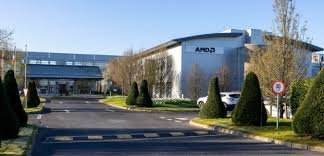
American chipmaker AMD has quietly built its second-largest design centre outside the US right here in Bengaluru, and the scale is impressive. With over 9,000 employees, the India operation has become far more than just a support hub.
"There is no AMD product released globally without contributions from the India-based engineering teams," says Jaya Jagadish, AMD India's Country Head and Senior Vice-President of Design Engineering. That's not marketing speak, it's the reality of how central India has become to AMD's operations.
From collaboration to ownership
What's changed in recent years is the shift from Indian teams simply contributing to actually owning entire product domains. AMD's software teams and DPU (Data Processing Unit) teams are based in India with complete end-to-end accountability. Indian engineers have largely taken over the ownership of AMD's server roadmap, working on the entire architecture of EPYC server processors from IP development to system level verification.
Indian engineers have been a crucial part in the development of AMD's Zen architecture and are still moving forward the data center and AI platforms that power supercomputers and healthcare AI applications. Therefore, their work is seen across the full product range of AMD: the high-performance CPUs for enterprise servers, the advanced GPUs of data centers and gaming, and the adaptive SoCs and FPGAs for specialized embedded systems.
Massive expansion underway
AMD isn't slowing down. In 2023, the company announced a $400 million investment to expand R&D capabilities in Bengaluru, including development of its largest global design centre at the Technostar campus with 3,000-seat capacity. The Hyderabad office is getting an additional 600 seats.
The growth has been remarkable – AMD India has expanded fourfold over the past five years. "India has been central to AMD's growth journey for the past 20 years," Jagadish notes, "and we remain deeply committed to India as a strategic hub for innovation, engineering, and global collaboration."
Skills for the AI era
So what skills is AMD hunting for? The industry is going through a significant change with the rapid evolution of demand accompanied by AI, high-performance computing, and edge computing. AI and machine learning application to chip design is one of the quickest development areas - the use of sophisticated algorithms to enhance semiconductor design and manufacturing.
There's also rising demand for embedded systems engineers and firmware developers to support IoT, automotive, and consumer electronics. And with growing focus on cybersecurity at the hardware level, AMD is seeking engineers specialising in secure hardware design – still an emerging skill in India.
Aligned with India's AI ambitions
AMD sees itself as a partner in India's AI Mission. "India is entering a truly transformative phase in AI," Jagadish explains. "The government's push to expand compute access, build research infrastructure, and drive innovation is a bold and timely decision."
Starting from high-performance data center processors to AI accelerators, AMD's scalable, energy-efficient technologies are the company's answer to the complex workloads of this new era, regardless of whether it is large-scale language model training or building multilingual applications, or inference at scale processing.
The firm goes as far as to say that the open GPU marketplace and subsidised compute access are initiatives that it will surely support, as they are exactly in line with AMD's open ecosystem approach and will allow the innovation across startups, universities and industries.
The bottom line
In a way, AMD India shows how much faith the company has in India's engineering talent and how much potential India holds as a semiconductor and AI hub. AMD has planned to allocate 9,000 engineers for the complete ownership of the product, is investing $400 million in a new facility, and is closely working with the national AI mission of the country; thus, the company believes that India will be the next great place to decide the future of computing technology.
For Indian engineers and the tech ecosystem of the country, this is not merely good news; it is the recognition that India can be a leader, not just a supporter, in the innovation of one of the world's most demanding and strategically important industries.