

Thailand's electronics sector has secured over $30.5 billion (1 trillion baht) in investment since 2023. Roughly a third of this capital, exceeding $10.1 billion (331 billion baht) across 224 projects, is concentrated in printed circuit boards (PCBs) and electronic components, driven by global manufacturers scaling their footprint in AI hardware and advanced semiconductor packaging across Southeast Asia.
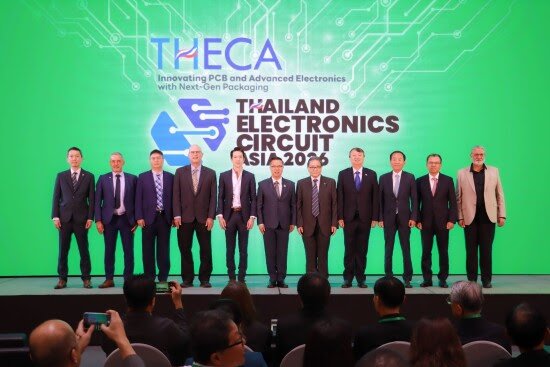
The investment momentum takes center stage at the Thailand Electronics Circuit Asia (THECA 2026) summit at Bangkok's BITEC exhibition center, which convenes more than 300 global tech enterprises and 7,000 international delegates across 40 nations. The summit's program includes more than 60 conference sessions spanning AI infrastructure, the semiconductor ecosystem, photonics, advanced packaging, PCBs, and electronics manufacturing services. The event reinforces the accelerating realignment of critical electronics manufacturing toward Southeast Asia amid ongoing global supply chain diversification.
The technological drive comes as Thai policymakers accelerate structural reforms aimed at overcoming the middle-income trap, lifting the country's global competitiveness ranking into the world's top 20, and driving annual gross domestic product growth.
With the electronics sector serving as a primary economic engine, the Thailand Board of Investment (BOI) is shifting its focus from basic capital attraction to maximizing national competitiveness. The agency's four-pillar framework prioritizes high-value and high-potential sectors, enhances Thailand's readiness for leading multinationals, deepens local economic benefits by upskilling the workforce and fortifying domestic supply chains, and builds international cooperation to connect Thai firms to global production networks.
"The investments flowing into Thailand's electronics sector today are fundamentally different from those of three decades ago," said Narit Therdsteerasukdi, Secretary General of the Thailand Board of Investment (BOI). "They are driven by frontier technologies, proprietary knowledge, and highly skilled labor. Our objective is not merely keeping pace with global technology, but anchoring Thailand as an indispensable co-creator of the future global supply chain."
Thailand's selection to host the 17th Electronic Circuits World Convention (ECWC17) in August 2027, a triennial flagship event that rotates among the world's premier electronics manufacturing economies, further underscores the country's rising clout in global electronics manufacturing.
Industry leaders note that surging demand for edge computing, smart mobility, and artificial intelligence is reshaping regional manufacturing footprints.
"In an era dominated by rapid breakthroughs in AI, advanced packaging, and semiconductors, competitive advantage is no longer determined by brute manufacturing capacity alone," said Canice Chung, Chairman of the Hong Kong Printed Circuit Association (HKPCA), a co-organizer of the event. "It hinges on international knowledge transfer, cross-border research cooperation, and developing specialized technical talent."