

As enterprises increasingly seek to connect digital intelligence with the physical world, Vision AI is emerging as a critical technology for enabling real-time visibility, operational intelligence and automation. From manufacturing and retail to agriculture, logistics, insurance and healthcare, the ability to interpret visual information can help businesses identify anomalies, assess quality and make faster, data-driven decisions.
Constems AI is developing this capability through CAInatics, its Vision AI platform designed to function as a “vision layer for the real world”. The platform combines visual perception, contextual understanding and AI-driven insights to help enterprises move beyond monitoring towards real-time operational intelligence. Its applications include agricultural commodity assessment, retail analytics, manufacturing quality inspection and other industry-specific use cases.
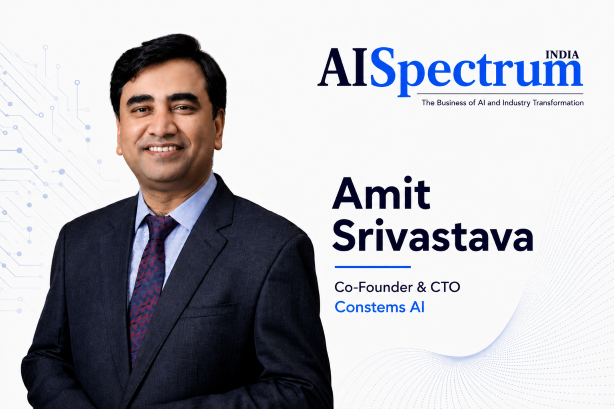
In this interview with AI Spectrum, Amit Srivastava, Co-Founder & CTO, Constems AI, discusses the evolution of Vision AI, the role of computer vision in standardising agricultural quality assessment, and the challenges of deploying AI across diverse physical environments. He also shares insights into data quality, model accuracy and continuous learning, and explains how perception-based AI could shape the next phase of enterprise transformation.
Constems AI describes CAInatics as a “vision layer for the real world.” What gaps in conventional enterprise technology and data systems led to the development of this platform, and how does Vision AI help businesses move from simply monitoring operations to understanding and acting on what is happening in real time?
Enterprise systems are excellent at recording what has already happened. The harder problem is understanding what is happening now.
A defect appears on a production line, a shelf goes empty or an asset moves out of place long before that event reaches a dashboard. This creates a visibility gap between physical reality and enterprise decision-making.
CAInatics was built to close that gap. Most computer-vision systems recognise images; CAInatics is designed to understand operational context. It is the difference between identifying an object and understanding what that object means for the business decision that follows.
It interprets visual signals, detects anomalies and converts them into actionable intelligence while events are unfolding. The objective is not more cameras or dashboards. It is to give enterprises a new capability: to see earlier, understand what matters and act before the problem becomes the outcome.
Agricultural quality assessment is one of the key applications of Constems AI’s technology. How is Vision AI being used to assess commodity quality, grading and characteristics, and what impact can this have on transparency, consistency and price discovery for farmers and other stakeholders across India’s agricultural value chains?
Agriculture presents a uniquely difficult visual problem. Unlike manufactured products, no two leaves, grains or produce batches are identical. Colour, texture, size, moisture and surface characteristics naturally vary across regions, seasons and growing conditions.
Yet these visual differences can directly influence grade and price.
Vision AI introduces a cognitive layer that evaluates such characteristics with consistency, speed and repeatability. Instead of quality remaining dependent only on individual interpretation, every assessment can become measurable, traceable and evidence-backed.
That changes more than grading. It changes how trust is created.
Constems AI’s engagement with the Tobacco Board of India to develop an AI-based mobile application for grading FCV tobacco bales reflects this opportunity. By making assessment more consistent and transparent, Vision Intelligence can strengthen confidence among farmers, buyers, exporters and regulators and move agricultural marketplaces towards quality that can be seen, explained and trusted.
Many traditional industries still rely heavily on manual inspection and subjective assessments. How can computer vision and AI help standardise processes such as commodity grading while improving efficiency, reducing human error and ensuring greater consistency at scale?
For decades, inspection has depended on one extraordinary instrument: the trained human eye. Its strength is judgement; its limitation is repeatability at scale.
Across thousands of products, shifts and locations, even experienced inspectors can assess the same visual signal differently. Vision AI changes what is possible by applying a consistent evaluation framework every time while preserving human expertise for decisions where context matters most.
Every visual observation can become measurable, confidence-scored and traceable rather than disappearing once an inspection is complete.
In manufacturing, this can move quality control from sample-based checks towards 100% product inspection, while time-stamped visual records create a trail for root-cause analysis and governance.
The larger transformation is from inspection after the fact to continuous operational intelligence. Problems that once had to be discovered, reported and corrected can increasingly be identified while they are emerging, allowing enterprises to intervene before quality is lost.
Constems AI has deployed its Vision AI solutions across sectors including retail, manufacturing, agriculture, logistics, insurance and healthcare. What are the key challenges involved in adapting a foundational Vision AI model to highly diverse real-world environments and industry-specific use cases?
The physical world does not speak one visual language.
A retailer needs to understand products, placement and availability. A manufacturer may need to detect a defect measured in millimetres. Agriculture introduces natural variation in colour, texture and condition. Insurance, healthcare and infrastructure bring entirely different contexts and decision thresholds.
The challenge is therefore not simply recognising an image. It is understanding what that image means in a specific operational environment.
Constems AI addresses this through a layered architecture. Its proprietary 3N Large Vision Modal Model provides a shared perception layer for objects, relationships, anomalies and context, while CAInatics operationalises that intelligence through domain-specific layers. Proprietary datasets, coordinated AI agents and API/SDK-led architecture support deployment across edge, cloud and on-premise environments.
The differentiator is fundamental: common intelligence underneath, specialised understanding on top, allowing one Vision Intelligence architecture to adapt to very different physical-world problems.
With CAInatics trained on millions of curated real-world data points and deployed across multiple international markets, how does Constems AI approach data quality, model accuracy and continuous learning when operating in complex and changing physical environments?
The real world never stays still, so a Vision AI model cannot be trained once and considered finished.
Products change, packaging evolves, lighting varies, environments differ and entirely new visual conditions appear after deployment. Constems AI therefore builds and evaluates models using proprietary data from real operating environments rather than relying only on controlled imagery.
But accuracy alone is not enough. Outputs can include confidence and similarity scores, model versions and reference imagery, creating an audit trail that allows decisions to be reviewed rather than accepted as black-box outputs.
Continuous monitoring tracks model and production-data performance, while version-controlled deployments allow models to evolve without losing traceability. In retail, for instance, open-set incremental SKU recognition allows new products to be enrolled through reference images without retraining the entire model.
The objective is intelligence that keeps learning as the physical world changes, without sacrificing explainability, governance or reliability.
As India-built AI solutions gain adoption across traditional sectors, what is Constems AI’s long-term vision for scaling Vision AI across agriculture, retail, manufacturing and other real-world industries, and how do you see perception-based AI shaping the next phase of enterprise transformation?
Our long-term vision is to make perception a foundational capability of the autonomous enterprise, creating a future where organisations can see earlier, understand faster and act with greater precision.
As India-built AI solutions gain adoption across agriculture, retail, manufacturing and other real-world industries, we see Vision AI moving beyond individual automation use cases to become an intelligence layer connecting the physical world with enterprise decision-making. The ability to continuously perceive what is happening, understand it in context and translate those insights into action will be critical to building more responsive and increasingly autonomous enterprises.
Whether it is identifying an operational anomaly on a manufacturing floor, understanding customer behaviour in a retail environment or interpreting changing conditions in agriculture, perception-based AI can help organisations move from simply reacting to events by enabling them to see earlier, understand faster and act with greater precision.
For Constems AI, the opportunity is to scale this capability across industries and make perception an integral part of how enterprises operate. We believe the next phase of enterprise transformation will be defined by organisations that do not just process information, but can see what is happening around them, understand its significance and act on it in real time.