
As artificial intelligence reshapes engineering and technology industries, academic institutions are under increasing pressure to equip students with skills that extend beyond traditional engineering disciplines. From AI and machine learning to Generative AI, MLOps, AI agents and responsible AI, engineering education is increasingly evolving towards interdisciplinary, hands-on and application-driven learning.
Vivekanand Education Society’s Institute of Technology (VESIT) is taking an integrated approach to this transformation by embedding emerging AI technologies across its engineering curriculum while strengthening industry exposure, research and experiential learning. The institute has also expanded its focus on semiconductor research through the Government of India’s Chip to Startup (C2S) Programme, with its faculty-developed Programmable Gain Amplifier chip recognised among the first 25 “Made in India” semiconductor chips.
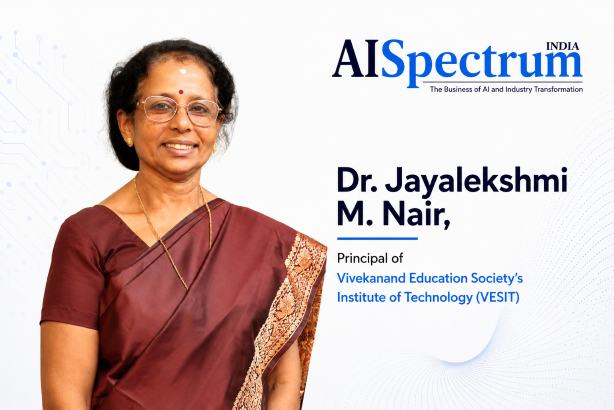
In this interview with AI Spectrum, Jayalekshmi M. Nair, Principal, Vivekanand Education Society’s Institute of Technology (VESIT), discusses how VESIT is integrating AI into engineering education, the impact of its C2S project on research and student training, and the role of internships, live projects and industry partnerships in developing future-ready engineers. The conversation also explores how engineering institutes must evolve as AI increasingly transforms industry requirements and the skills expected of graduates.
How is VESIT currently incorporating emerging AI trends into the engineering curriculum to better align with future industry requirements?
VESIT is actively integrating AI across its curriculum rather than treating it as a standalone subject. Our autonomous and NEP-based curricula include AI/ML, Deep Learning, Generative AI, NLP, Computer Vision, Explainable AI, MLOps, RAG, AI Agents, GPU and parallel programming, and Responsible AI. We are also extending AI into core engineering domains such as Electronics Engineering, Electronics & Telecommunication Engineering, Automation and Robotics, where students apply ML techniques to industrial automation, robotics, autonomous systems, and process control. The emphasis is on hands-on labs, interdisciplinary projects, industry exposure, and real-world applications, ensuring that students develop not only AI skills but also the ability to apply AI to solve engineering problems and remain future-ready.
Could you elaborate on the C2S grant project and how it is influencing your approach to research and student training?
The C2S grant project is closely aligned with the core research theme of our Ph.D. students, who are also members of our faculty. Therefore, the project has provided a strong foundation for integrating research, teaching, and practical semiconductor development. A key contributor to India’s semiconductor mission, VESIT secured Rs82.59 lakh under MeitY’s Chip to Startup (C2S) Programme in Industry Academia Category. This industry-oriented approach helped us focus not only on academic research but also on real-world applications, design requirements, and the eventual transition of research outcomes into technology. Through the dedicated efforts and close collaboration of all stakeholders, we successfully developed a Programmable Gain Amplifier (PGA) chip designed by our faculty members. The chip was recognized among the first 25 “Made in India” semiconductor chips and was presented by the Union Minister for Electronics & Information Technology, Shri Ashwini Vaishnaw, to the Hon’ble Prime Minister Shri Narendra Modi during the inaugural ceremony of Semicon India 2025. This achievement created a significant impact on our students, faculty, and the wider academic community. The recognition has demonstrated to our students that research undertaken within an academic institution can lead to tangible, nationally significant technological outcomes. It has greatly motivated them to pursue research in semiconductor design and related areas. The project has also influenced our approach to student training by encouraging more hands-on learning, industry interaction, problem-solving, and application-oriented research. We now place greater emphasis on taking students beyond theoretical knowledge and exposing them to the complete research and development cycle—from identifying a problem and conducting research to chip design, development, validation, and potential commercialization.
Overall, the C2S project has created a strong research ecosystem at VESIT and has inspired both faculty and students to pursue ambitious, technology-driven research with a clear focus on innovation, industry relevance, and contribution to India’s semiconductor mission.
How do your internship and live project programs bridge the gap between classroom learning and real-world engineering challenges?
Our internship, live project, and Tinkerer Lab programs bridge the gap between classroom learning and real-world engineering challenges through hands-on, problem-based learning. Students apply theoretical concepts to design, prototyping, testing, debugging, and validation, while industry projects provide exposure to real engineering requirements. The Tinkerer Lab further encourages experimentation, innovation, and rapid prototyping, building practical skills, confidence, and an industry-ready mindset.
What is your long-term vision for the institution, particularly regarding industry partnerships and academic collaborations?
Our long-term vision for VESIT is to leverage its autonomous status and the opportunities provided by NEP 2020 to build a strong, industry-driven and research-oriented academic ecosystem. Autonomy allows us to continuously update the curriculum, introduce emerging technologies, and promote interdisciplinary and experiential learning. We aim to strengthen industry partnerships through joint R&D, sponsored projects, internships, live projects, technology development, and commercialization, while expanding collaborations with leading national and international academic institutions. Our focus is to create a seamless academia–industry–innovation ecosystem that provides students with industry-relevant skills and enables faculty to undertake impactful research. Ultimately, we envision VESIT as a technology-driven institution known for innovation, industry relevance, strong research, and globally connected academic collaborations.
As an educator with over three decades of experience, how do you see the role of engineering institutes evolving in response to the rapid AI-driven shifts in the industry?
With over four decades of VESIT’s academic journey and more than three decades of my experience as an educator, I believe engineering institutes must evolve from being primarily knowledge providers to becoming innovation and technology-driven learning ecosystems. With rapid AI adoption, the focus should shift towards AI-enabled engineering, interdisciplinary learning, critical thinking, hands-on projects, and continuous up skilling. At VESIT, we aim to strengthen industry collaboration, AI-integrated curricula, research, internships, live projects, and innovation platforms so that students learn not only how to use AI tools, but also how to develop, validate, and responsibly apply AI-based solutions to real engineering problems. Our goal is to prepare graduates who are adaptable, creative, and industry-ready in an AI-driven world.