

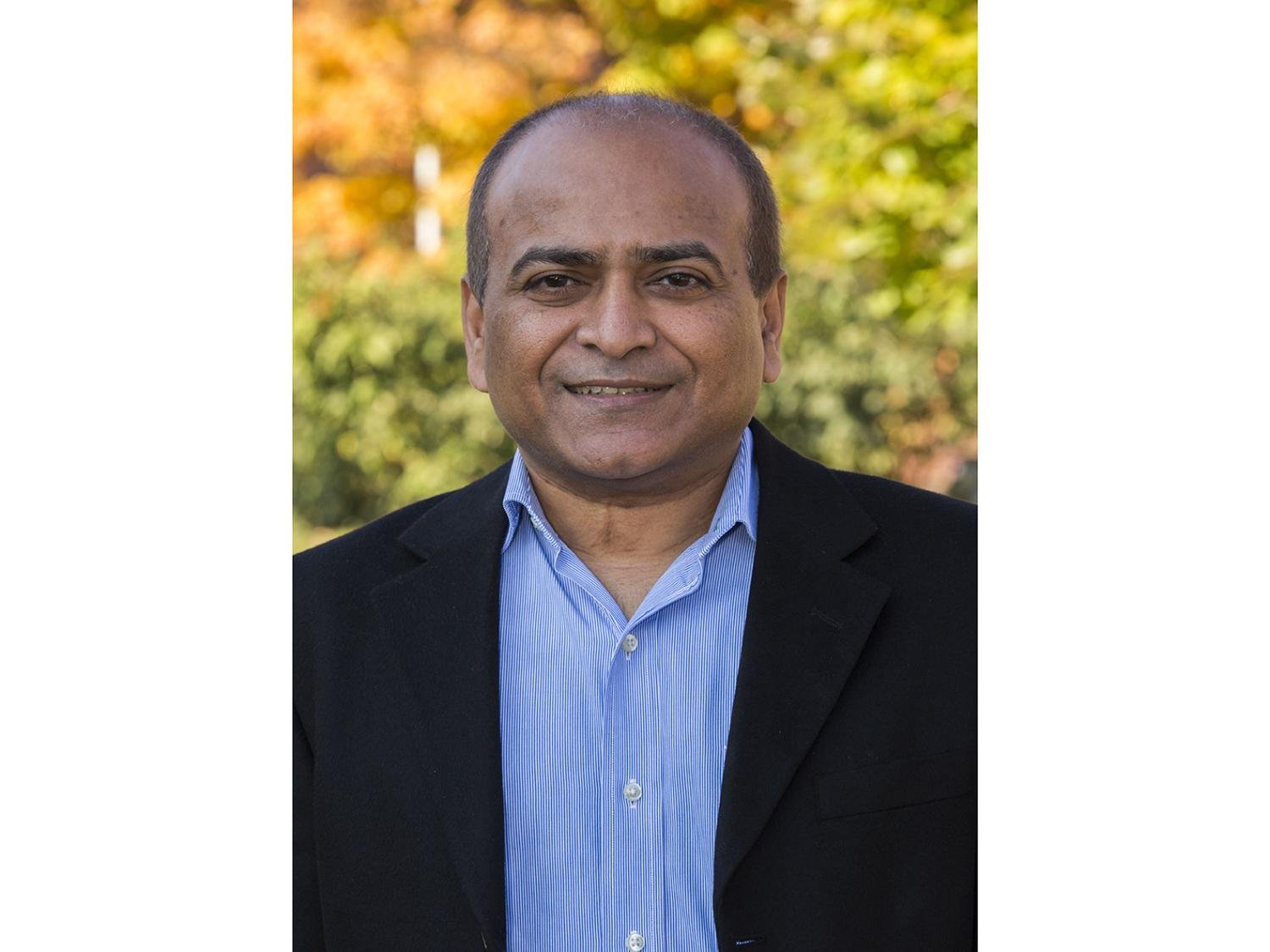
Penn State has selected Vasant Honavar as the inaugural vice provost for artificial intelligence (AI) to guide a comprehensive AI strategy and advance the University's leadership in human-centred and ethical AI innovation across teaching, learning, research and operations.
Honavar, who currently serves as the Dorothy Foehr Huck and J. Lloyd Huck Chair in Biomedical Data Sciences and Artificial Intelligence in the Huck Institutes of the Life Sciences and a professor in the Department of Informatics and Intelligent Systems in the College of Information Sciences and Technology, will begin his appointment on June 1.
“I am delighted Vasant will be stepping into this critical new leadership role as Penn State continues to integrate AI into our teaching, learning, research and operations,” said Executive Vice President and Provost Fotis Sotiropoulos. “With a distinguished career devoted to leadership, scholarship, research and teaching in AI and data sciences, Vasant brings both deep expertise and a commitment to people. His vision for what artificial intelligence can — and should — be at Penn State and across higher education is inspiring and will help position our University to lead with purpose at the intersection of technology, ethics and human impact.”
In this new position, Honavar, who will report to Senior Vice Provost and Chief of Staff Josh Davis, will collaboratively develop and implement Penn State’s AI Transformation initiative, working closely with Sotiropoulos and leaders across colleges, campuses and administrative units to ensure that Penn State’s AI strategy aligns with the University’s institutional values and long‑term strategic goals. Honavar will collaborate with the AI Coordinating Council, the AI Student Advisory Group, and other AI working groups and advisory bodies.
“I am honoured to serve as vice provost for artificial intelligence at Penn State,” Honavar said. “At a time when AI is reshaping discovery, learning, creative endeavours, and the nature of work, Penn State has a unique opportunity, indeed, a responsibility — to lead by reimagining the land-grant mission in a world being transformed by AI. I look forward to working with University leadership, faculty, staff and students to build a coordinated and impactful AI strategy that advances research and education and delivers tangible benefits to communities across the commonwealth and beyond.”