

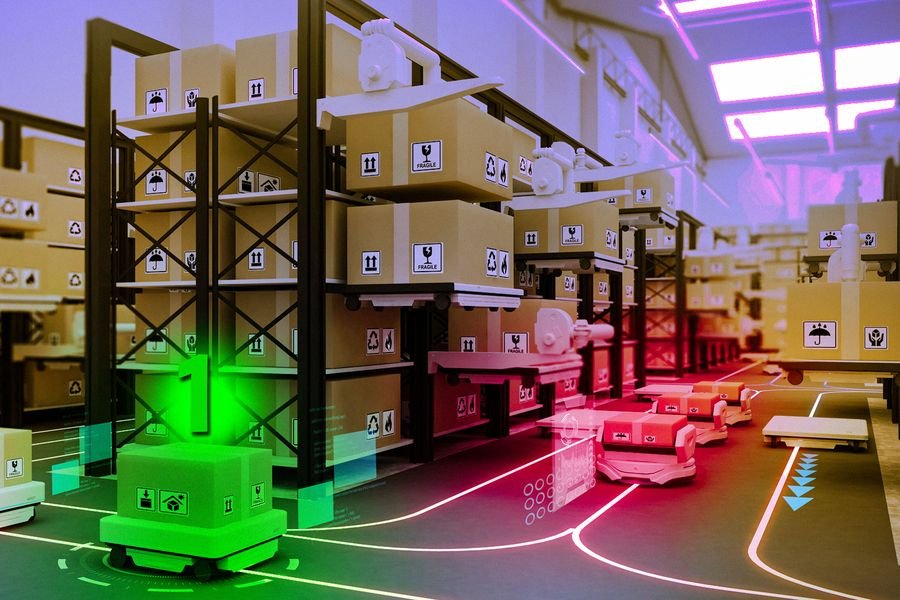
Researchers from the Massachusetts Institute of Technology, in collaboration with Symbotic, have developed an advanced artificial intelligence-based system that significantly improves the efficiency of autonomous warehouse operations.
Modern e-commerce warehouses rely on vast fleets of mobile robots to handle inventory movement and order fulfilment. However, as robot density increases, even minor congestion or collisions can trigger cascading delays, reducing overall throughput.
To address this challenge, the research team has introduced a novel hybrid system that dynamically coordinates robot movement, ensuring smoother operations in high-density environments. The system leverages Deep Reinforcement Learning to determine which robots should be prioritised at any given moment, based on real-time congestion patterns.
By learning traffic flow behaviours, the system can anticipate bottlenecks before they occur and proactively reroute robots, preventing slowdowns. A fast planning algorithm then translates these decisions into actionable instructions, allowing robots to respond quickly to constantly changing warehouse conditions.
In simulations based on real-world e-commerce warehouse layouts, the approach delivered approximately a 25 per cent increase in throughput compared to conventional methods. The system also demonstrated strong adaptability, performing effectively across different warehouse configurations and varying fleet sizes.
“There are many decision-making problems in logistics where companies rely on human-designed algorithms. Our work shows that deep reinforcement learning can achieve superhuman performance in such complex environments,” said Han Zheng, lead author of the study and a graduate student at MIT’s Laboratory for Information and Decision Systems.
The research team also includes Yining Ma, Brandon Araki, Jingkai Chen, and senior author Cathy Wu. Their findings have been published in the Journal of Artificial Intelligence Research.
The researchers highlight that even marginal efficiency gains can have significant commercial impact at scale. In large automated warehouses, a 2–3 per cent increase in throughput can translate into substantial operational savings and faster order fulfilment.
This development underscores the growing role of AI-driven optimisation in logistics and manufacturing, where intelligent coordination of autonomous systems is becoming critical to meeting rising global demand.