

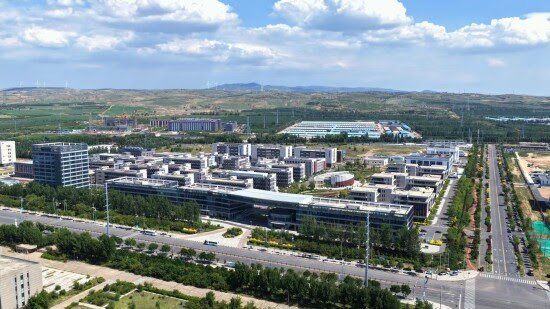
China is increasingly turning to renewable energy-rich regions to support the growing power demands of artificial intelligence (AI) computing, with Hohhot in Inner Mongolia emerging as a key hub for green computing infrastructure.
The development was highlighted at the fourth annual Green Computing Power (Artificial Intelligence) Conference, held on the Cilechuan Grassland in Hohhot under the theme “Building Synergy between Computing and Electricity, Exploring New Horizons in Token Economy, and Creating the Future of Artificial Intelligence Together.”
The conference showcased the Green Computing Power Development Research Report (2026) and pilot initiatives including “millisecond-level urban computing”. Companies including ByteDance and Cambricon also signed agreements worth tens of billions of yuan covering green intelligent computing centres and token factories.
Hohhot's appeal as an AI computing location is closely linked to its renewable energy resources. Wind turbines across the region generate electricity that can be transmitted through dedicated infrastructure directly to data centres, rather than relying entirely on the public grid.
Inside these facilities, large arrays of GPUs operate continuously, with wind and solar power providing a significant share of the electricity required for AI workloads.
The energy requirements of large-scale AI models are substantial. Training models using tens of thousands of GPUs can consume more than 100 million kilowatt-hours of electricity annually, making energy availability and cost increasingly important factors in determining where AI computing infrastructure is built.
At the Hohhot Intelligent Computing Center operated by China Mobile, electricity costs reached approximately 290 million yuan in 2025, accounting for more than 70 per cent of its total operating expenses.
The high energy consumption of AI computing is also influencing China's broader data-centre strategy. Through the country's “East Data West Computing” initiative, computing workloads are being directed from eastern regions with high computing demand towards western areas with greater energy and land resources.
The Horinger data-centre cluster in Hohhot is among China's top ten computing clusters and is benefiting from the region's combination of renewable energy availability, cooler temperatures and relatively low electricity costs.
Hohhot has an average annual temperature of around 7°C, with more than 200 days each year suitable for direct outdoor-air cooling. This can reduce cooling costs by more than 20 per cent.
Electricity prices of approximately 0.36 yuan per kilowatt-hour further improve the economics of large-scale GPU deployments. A large GPU cluster could potentially save around 50 million yuan annually in electricity costs compared with higher-cost locations.
Hohhot's total computing capacity has now reached approximately 150,000 P, with green electricity accounting for more than 80 per cent of its energy use.
The developments reflect a broader shift in AI infrastructure, where access to computing power is increasingly being considered alongside access to electricity. As AI models become larger and GPU clusters expand, renewable energy availability, cooling efficiency and electricity prices are becoming critical considerations for data-centre operators and technology companies.
The Hohhot model illustrates how the expansion of AI computing could increasingly be tied to the development of renewable-energy infrastructure, helping data-centre operators manage both the economic and environmental costs associated with rapidly growing AI workloads.