

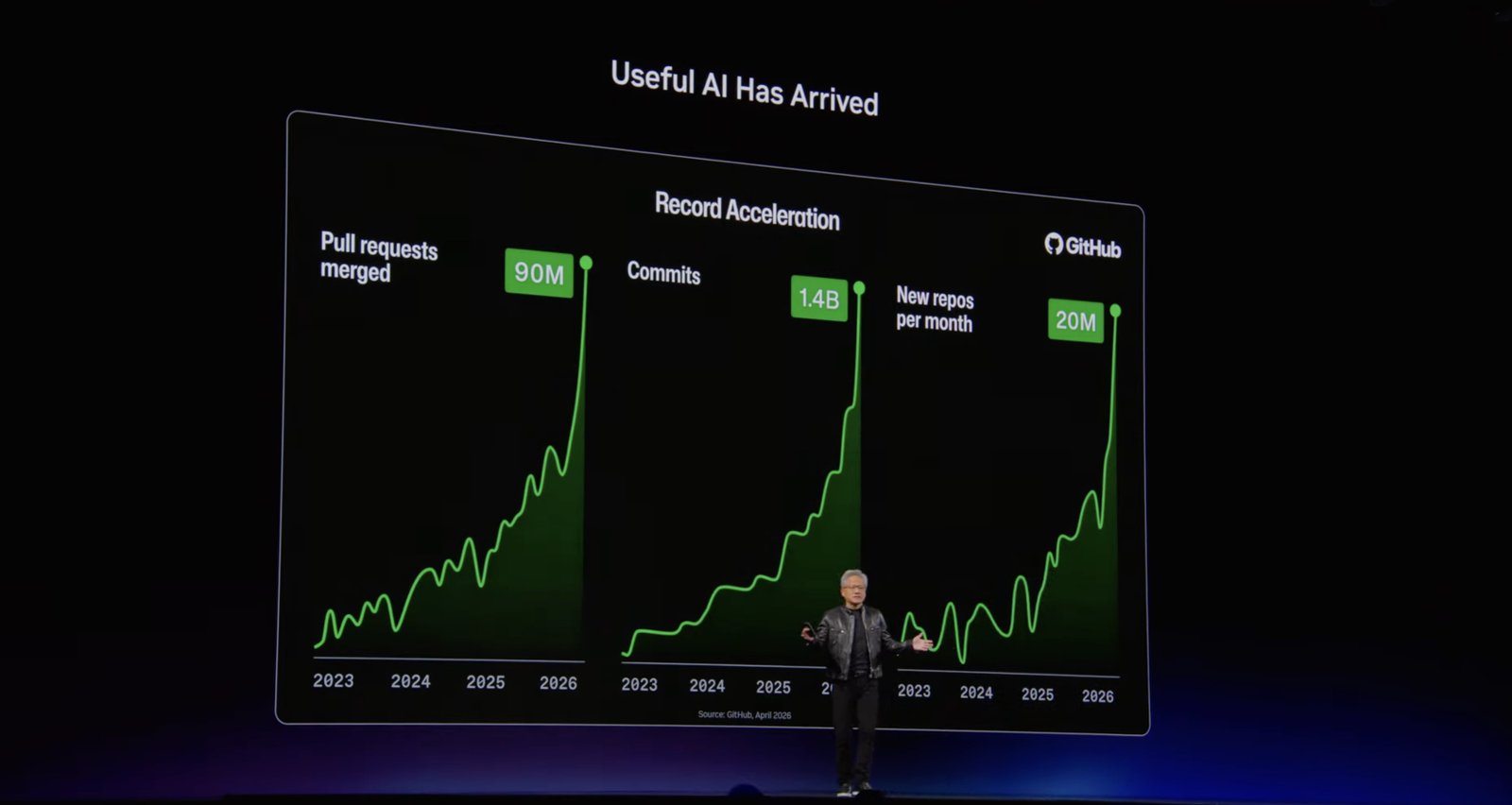
NVIDIA used its GTC Taipei 2026 keynote to unveil a sweeping set of announcements spanning AI infrastructure, consumer computing, robotics, and manufacturing partnerships, underscoring the company's ambition to shape the next era of artificial intelligence across industries.
Delivering the keynote in Taipei ahead of Computex 2026, NVIDIA Founder and CEO Jensen Huang outlined how the company is expanding beyond its traditional strengths in AI accelerators and data centres to build a broader ecosystem connecting AI development, enterprise infrastructure, autonomous systems, and next generation computing platforms.
"Taiwan has become one of the most important innovation ecosystems in the world. The extraordinary collaboration between NVIDIA and our partners across the region continues to accelerate breakthroughs in AI, advanced computing, and manufacturing. Together, we are shaping the future of technology on a global scale." -NVIDIA Founder and CEO Jensen Huang
NVIDIA Enters The Consumer PC Processor Market
Among the most significant announcements was NVIDIA's formal entry into the Windows PC processor segment with the introduction of its new Arm based N1 and N1X system on chip platforms.
Designed to bring AI accelerated computing directly into premium laptops, the processors combine high performance Arm CPU architectures with integrated Blackwell based graphics and full CUDA software stack support. The flagship N1X platform is expected to offer up to 20 CPU cores, advanced RTX class graphics capabilities, support for up to 128 GB unified memory, and manufacturing on TSMC's advanced 3 nanometre process technology.
The move positions NVIDIA to compete directly against Apple's M series processors and Qualcomm's Snapdragon X platforms, while giving AI developers access to native CUDA capabilities within portable Windows devices.
Initial systems are expected from leading manufacturers including Dell, Lenovo, Asus, and MSI.
Vera Rubin Platform Advances AI Factory Infrastructure
NVIDIA also highlighted the upcoming Vera Rubin platform, the successor to its Grace Blackwell architecture, designed to power the next generation of AI factories and large scale inference environments.
The Vera Rubin NVL72 platform combines 36 Vera CPUs and 72 Rubin GPUs interconnected through sixth generation NVLink technology. According to NVIDIA, the platform is designed to deliver significantly higher inference efficiency while reducing operational costs for hyperscale AI deployments.
The architecture has been developed to support increasingly complex reasoning models, agentic AI systems, and long context workloads that are driving global demand for advanced AI infrastructure.
NVIDIA noted that approximately 150 Taiwan based ecosystem partners contribute to the manufacturing and assembly of Vera Rubin systems, highlighting the scale of collaboration required for next generation AI infrastructure.
Physical AI And Robotics Take Centre Stage
Robotics and physical AI formed another key focus area of the keynote.
NVIDIA introduced Jetson Thor, its latest robotics computing platform built on Blackwell architecture, delivering substantial improvements in compute performance and energy efficiency for autonomous machines and industrial automation applications.
The company also showcased Alpamayo, an open platform supporting autonomous vehicle development through advanced vision language action models, simulation frameworks, and extensive physical AI datasets.
Huang emphasised that physical AI represents the next major growth frontier following the current wave of generative and agentic AI technologies, particularly across manufacturing, logistics, and industrial automation sectors.
Taiwan Emerges As A Strategic Growth Hub
Beyond product announcements, NVIDIA reinforced its growing commitment to Taiwan's technology ecosystem.
Huang revealed that NVIDIA's annual spending within Taiwan has expanded dramatically over recent years and is projected to continue rising as demand for AI infrastructure accelerates globally.
The company also unveiled plans for NVIDIA Constellation, its first overseas headquarters campus, located within Taipei's Beitou Shilin Technology Park. The facility is expected to accommodate approximately 4,000 employees and further strengthen collaboration with Taiwan's semiconductor manufacturing ecosystem.
The announcement reflects NVIDIA's increasingly deep integration with Taiwan's supply chain partners, which now play a central role across nearly every major NVIDIA platform.
Industry Significance
The GTC Taipei 2026 keynote highlighted NVIDIA's strategy to extend its influence across every layer of the AI value chain.
From AI powered consumer PCs and next generation AI factories to robotics platforms and global manufacturing partnerships, the company is positioning itself at the centre of the rapidly evolving AI economy.
With the introduction of the N1 processor family, continued investment in Vera Rubin infrastructure, and expanding commitments across Taiwan, NVIDIA is broadening its reach well beyond data centres and establishing a foundation for the next phase of AI driven computing.