

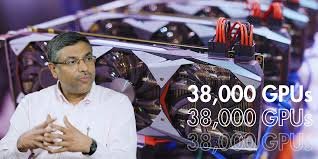
India has secured an unprecedented 38,000 graphics processing units (GPUs) under its national AI Mission — more than three times its original goal of 10,000 — in a decisive move to bolster the country’s artificial intelligence ecosystem. The expanded capacity will give researchers, startups, and enterprises the computational resources required to develop the next generation of AI models.
Removing the Compute Barrier
Mr S. Krishnan, Secretary of the Ministry of Electronics and Information Technology (MeitY), said the achievement reflects India’s determination to tackle one of the biggest hurdles to AI innovation: affordable and equitable access to compute power.
“This step reflects India’s intent to remove one of the biggest barriers to AI innovation — affordable access to compute,” Mr Krishnan said.
Voucher Model Replaces Direct Subsidies
In a shift from traditional public funding, the AI Mission has introduced a voucher-based model to ensure fairness and market stability. Rather than directly subsidising infrastructure, the government will guarantee a fixed price for GPU services provided by AI companies. This approach allows startups and research institutions to access high-performance computing without large upfront investments.
“We initially considered direct subsidies for GPU farms, but realised it would distort the market,” Mr Krishnan explained. “The voucher model ensures a level playing field while making computing widely available.”
Homegrown Large Language Models on the Horizon
India is also investing in the development of indigenous large language models (LLMs) designed to reflect the country’s cultural and linguistic diversity. Early initiatives include Sarvam, Gnani, Gyan, and Socket, with several more in the pipeline.
Government seed funding has been complemented by investment from private-sector partners and venture capital firms.
“These models will capture India’s multilingual reality in a way foreign systems cannot,” said Mr Krishnan.
AI Kosh: Data for All
A cornerstone of the AI Mission is AI Kosh, a growing national data repository that has already surpassed 1,000 machine-readable datasets. The platform provides innovators with access to high-quality training data across sectors such as healthcare, governance, and agriculture.
“Data is as fundamental to AI as compute,” Mr Krishnan said. “By making datasets widely available, we lower entry barriers for small teams and researchers.”
A Collaborative Indian Model
Describing the initiative as a “uniquely Indian experiment”, Mr Krishnan highlighted the collaborative framework driving the AI Mission — bringing together government leadership, private investment, and academic expertise.
The model has already drawn international praise from organisations such as the World Bank and the Bill & Melinda Gates Foundation for its inclusive and sustainable design.
Positioning India in the Global AI Race
With compute capacity secured, domestic language models in development, and open datasets accessible nationwide, India is rapidly emerging as a global contender in AI innovation.
“Our goal is to ensure India becomes a creator of AI technologies, not just a taker,” Mr Krishnan said.
By combining access, fairness, and innovation, the AI Mission is laying the foundations for India’s long-term global competitiveness in artificial intelligence.