
NVIDIA has announced a series of updates designed to simplify and accelerate AI-powered video generation for creators and developers working on RTX GPUs and the NVIDIA DGX Spark desktop supercomputer.
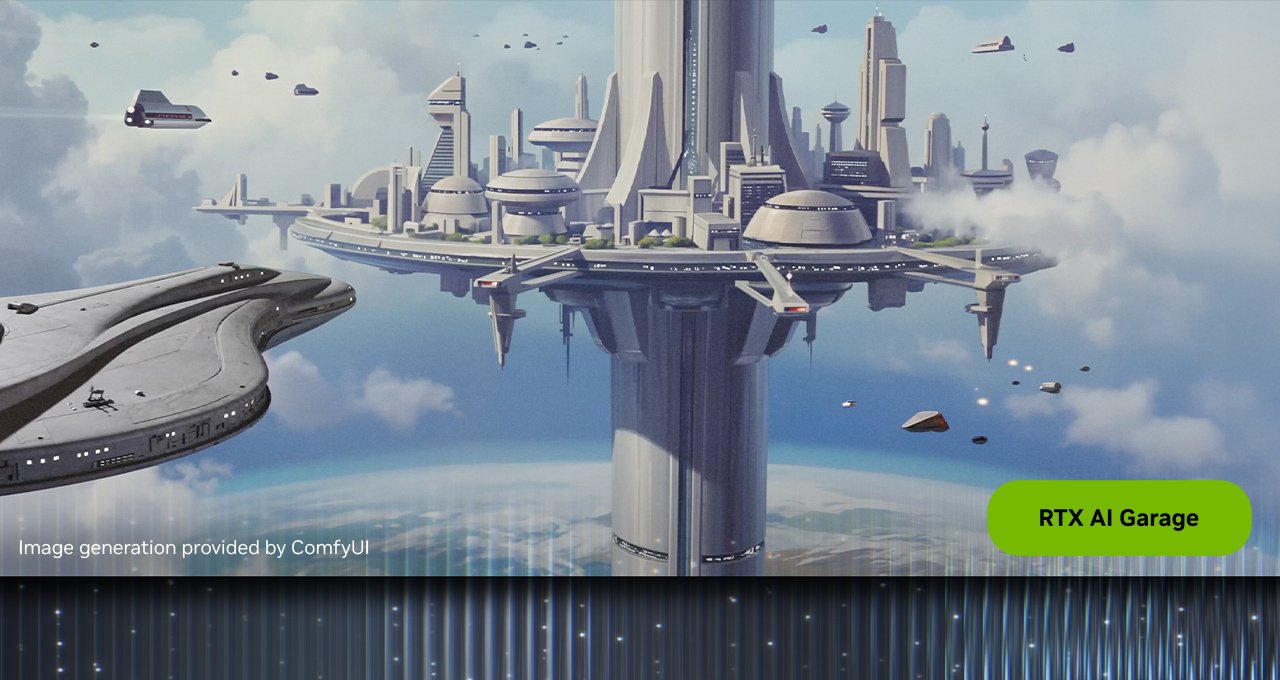
The updates focus on improving concept development and storyboarding workflows by enhancing the capabilities of ComfyUI, a popular generative AI tool used for building and running visual AI workflows.
One of the key announcements is the launch of ComfyUI’s new App View, a simplified interface that allows users unfamiliar with node-based workflows to generate content more easily. Instead of navigating complex node graphs, users can simply enter prompts, adjust parameters and generate results. The traditional Node View remains available, allowing experienced users to switch between both modes as needed.
NVIDIA said the improvements also include performance enhancements for RTX hardware. With RTX optimisations, performance in ComfyUI has increased by 40 per cent since September, while new support for NVFP4 and FP8 data formats significantly boosts efficiency. When used with the latest NVIDIA GeForce RTX 50 Series GPUs, the NVFP4 format delivers up to 2.5 times faster performance and 60 per cent lower VRAM usage, while FP8 enables 1.7 times faster performance and 40 per cent lower VRAM consumption.
The company also introduced new model variants compatible with these formats, including FLUX.2 Klein 4B and FLUX.2 Klein 9B, with NVFP4 support for LTX-2.3 expected soon. These models can be downloaded through Hugging Face and integrated into ComfyUI workflows.
Another major update focuses on 4K video generation. Producing high-resolution video content often requires balancing processing speed, memory usage and creative control. To address this challenge, NVIDIA has integrated RTX Video Super Resolution as a new node within ComfyUI, enabling users to upscale generated video to 4K resolution much more quickly.
According to the company, the technology can upscale video up to 30 times faster than many local upscaling tools, while using significantly less GPU memory. The feature runs directly on RTX GPU Tensor Cores and is powered by the NVIDIA Video Effects SDK.
To support developers, NVIDIA has also released a free Python package available through PyPI, along with sample code on GitHub. The package allows developers to access the same AI video upscaling technology programmatically and integrate it into custom visual effects or video generation workflows.
With these updates, NVIDIA aims to make advanced AI video creation tools more accessible to both professional creators and newcomers, while improving performance and reducing hardware constraints for local AI development.