
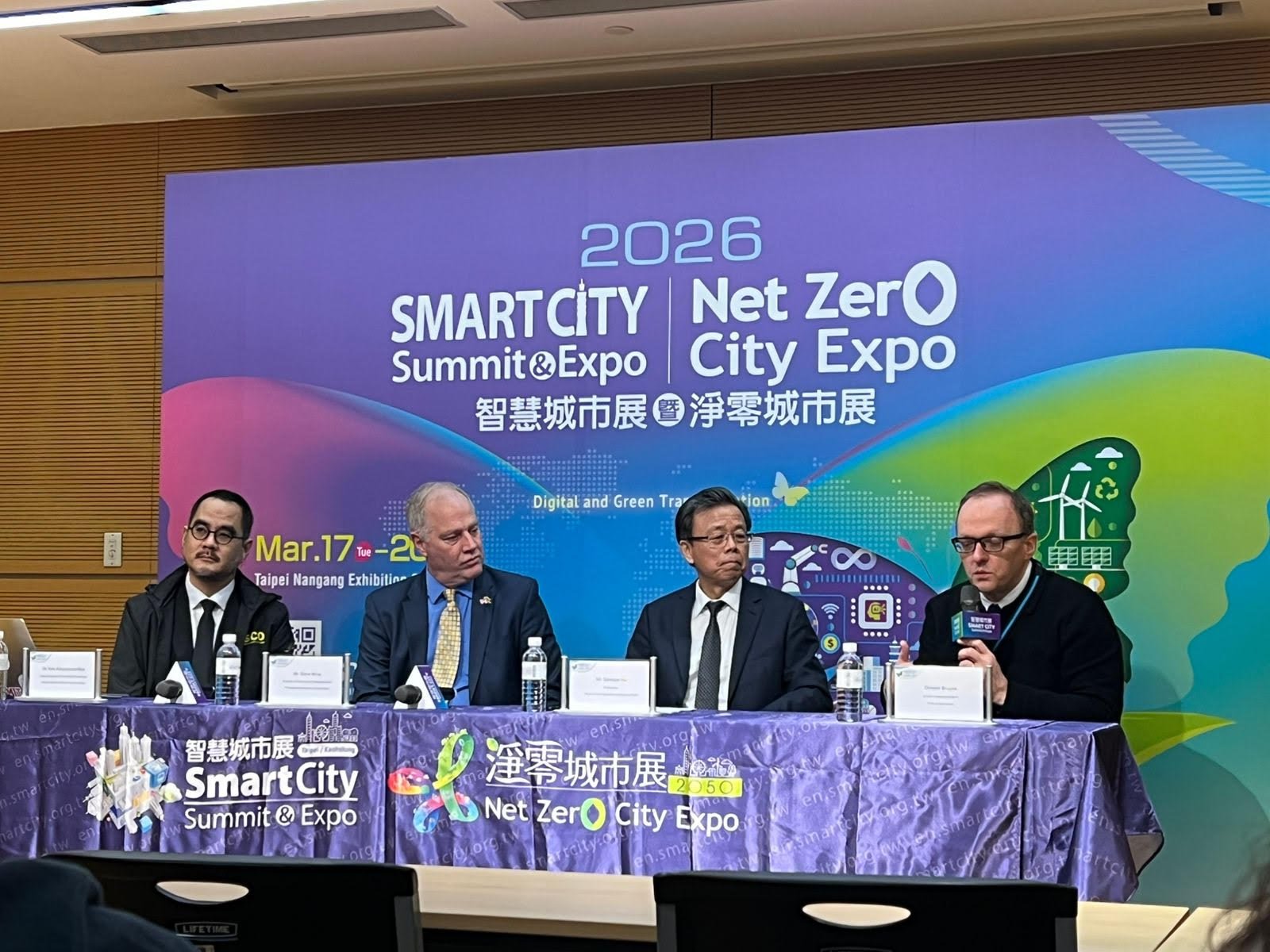
The Smart City Summit & Expo (SCSE) and the Net Zero City Expo opened with a decisive emphasis on next generation artificial intelligence, signalling Taiwan’s intent to move beyond conceptual smart cities toward fully operational, intelligence driven urban ecosystems. At the heart of this year’s showcase is the introduction of sovereign AI models and city scale digital twin systems, designed to fundamentally reshape how cities are governed, managed, and optimised in real time.
Speaking at the event opening press brief, Samson Hu, Co CEO of ASUS and Chairman of the Taiwan Smart City Solutions Alliance, positioned this development as a defining milestone in Taiwan’s smart city evolution. He highlighted the launch of an AI Large Language Model integrated with a live digital twin system, developed in collaboration with NVIDIA and the Kaohsiung City Government, as a tangible step towards predictive, intelligence led governance.
“At the core of future cities lies the ability to understand, simulate, and respond in real time,” Hu stated. “By combining sovereign AI with digital twin infrastructure, cities can transition from reactive administration to predictive governance that is faster, more precise, and citizen centric.”
The initiative brings together the engineering depth of the ASUS Group, one of Taiwan’s leading technology enterprises, with NVIDIA’s advanced AI computing architecture, creating a City Sovereign AI model specifically designed for municipal environments. This unified intelligence layer integrates complex, high volume urban data streams spanning transportation networks, healthcare systems, utilities, environmental monitoring, and public safety, enabling a holistic view of city operations.
Central to this framework is the digital twin system deployed in Kaohsiung, which acts as a dynamic, real time virtual replica of the city. This system allows authorities to simulate multiple scenarios, monitor infrastructure performance, and optimise decision making with unprecedented accuracy. Whether anticipating traffic congestion, allocating healthcare resources, managing disaster response, or improving energy efficiency, city administrators are empowered to act with foresight rather than hindsight.
“This is not merely about visual representation,” Hu emphasised. “It is about enabling cities to think, predict, and act intelligently. From mobility optimisation to healthcare planning, we are equipping governments with the tools to make faster and more informed decisions at scale.”
The integrated AI LLM and digital twin architecture is designed to strengthen predictive municipal services, marking a shift from static infrastructure management to adaptive, data driven governance. Key application areas include smart mobility and transport orchestration, AI enabled public safety systems, environmental and climate monitoring, and digitally enhanced citizen services.
Hu further underlined that Taiwan’s approach is anchored in the principle of City Sovereign AI, ensuring that cities retain control over their data governance, infrastructure sovereignty, and AI deployment frameworks.
“Cities must retain ownership of their data and intelligence systems,” he noted. “Our sovereign AI model ensures security, scalability, and regulatory alignment while delivering high performance outcomes tailored to local needs.”
Importantly, Hu acknowledged that while the technology is advancing rapidly, implementation remains a critical challenge for cities worldwide. Successful deployment requires not only infrastructure investment, but also institutional alignment, cross departmental integration, and robust governance frameworks.
“Execution is where many smart city initiatives falter,” Hu said. “The real opportunity lies in translating technology into deployable, interoperable systems that work seamlessly across city departments.”
This transition is also creating significant momentum in workforce transformation and global talent development. As cities adopt AI driven systems, demand is rising for expertise across data science, urban systems engineering, AI modelling, and public sector digital operations.
“Smart cities are becoming a convergence point for global design, engineering, and policy talent,” Hu added. “Taiwan is actively building an open ecosystem that invites international collaboration while nurturing local capabilities.”
The collaboration also reinforces Taiwan’s ambition to emerge as a global provider of integrated AI city solutions, particularly for developing and rapidly urbanising economies seeking practical and scalable frameworks.
“Many cities, especially in emerging markets, are not looking for fragmented innovation,” Hu explained. “They need proven, end to end solutions across transportation, healthcare, public safety, and mobility that can be implemented efficiently and scaled over time.”
He pointed out that countries such as Thailand are increasingly viewing Taiwan as a working blueprint for smart city development, studying how integrated ecosystems can accelerate digital transformation without excessive infrastructure burden.
The Kaohsiung deployment stands as a live, operational example of this model, demonstrating how sovereign AI and digital twin systems can be implemented in real world urban environments and scaled globally.
As the summit progresses, Taiwan’s convergence of AI innovation, digital infrastructure, and net zero strategy presents a clear and compelling direction for the future of cities. It is a model where intelligence is embedded at the core, sustainability is engineered into every layer, and real time responsiveness becomes the standard for governance.