

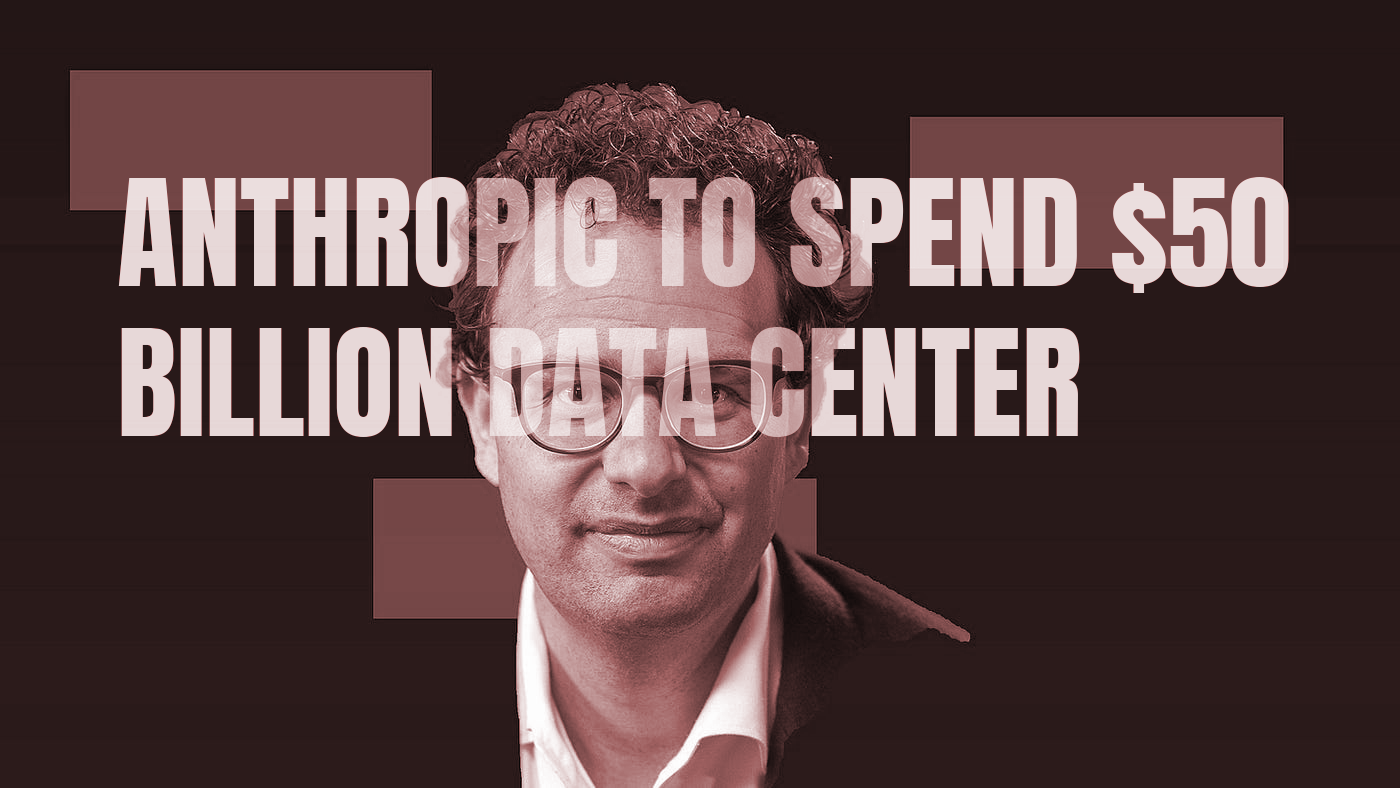
Anthropic has just placed a huge wager on its future. The firm that is behind Claude made a disclosure on Wednesday about its plan to spend $50 million besides that, in total, it is going to invest $50 billion to the building of custom US data centers in cooperation with the UK neocloud provider Fluidstack.
The states of Texas and New York are going to be the locations for the centers, and they are predicted to be operational over the course of 2026. Anthropic referred to these places as "designed and built specifically for Anthropic with maximizing efficiency for our workloads being the main focus."
Why build instead of rent?
The explanation of the whole thing is where pushing the AI limits went along with the establishment of the necessary power-hungry infrastructure support. And besides, who would want to spend $50 billion on a self-made foundation when they could easily rely on the existing ones? Dario Amodei, the CEO, and one of the founders, pointed out that this was the case of AI taking science and technology a step further, or to be more precise, giving the latter the necessary tools. "We're getting closer to AI that can speed up scientific research and solve difficult issues in ways that weren't possible before," he stated. "The full potential of that future requires powerful and super-continuously advancing infrastructure."
You should note this down if interested in LLM's, Claude's compute demands are so intense that even massive cloud partnerships aren't enough. The company needs infrastructure optimized specifically for how its models work.
The numbers narrate the story
The extensive commitment of $50 billion sounds huge. It is, indeed. However, it is perfectly in tune with the internal estimates of Anthropic. The company is said to be eyeing $70 billion in sales and $17 billion in cash flow from operations by 2028.
Should those estimations prove to be correct, then the investment of $50 billion in the infrastructure that supports that growth would be a wise move financially. Should they not, it might be a very expensive error in judgment turned to be. It is crucial to note that context is a factor which play a major role here.
Although the investment of $50 billion is a considerable commitment both in terms of money and processing power, still rivals are coming in with even larger amounts. Meta has pledged to create data centres worth $600 billion over the next three years. The Stargate collaboration between SoftBank, OpenAI, and Oracle has already earmarked $500 billion for infrastructure spending.
These mind-boggling amounts have raised doubts about the reality of the AI bubble. Are companies making a mistake by overbuilding on the foundation of such optimistic demand projections? Is the allocation of funds wrong? No one has the answer to these questions yet, but the risk is definitely very high.
Fluidstack's AHA moment
This project is a stark victory for Fluidstack, the young neocloud company that has already situated itself right in the midst of AI development and ever-growing demand as a supplier.
Fluidsstack, born in 2017, had its name often mentioned, after being officially declared in February, when partnering with a 1 gigawatt AI project of the French government, taking responsibility for the giant investment of $11 billion. Also, Forbes cites that the firm is already in coalition with the likes of Meta, Black Forest Labs, and Mistral of France.
Furthermore, Fluidstack got the early chance to use Google's TPUs (Tensor Processing Units), which were purposefully built for AI, thus winning over the trust of the company to a large extent. Such early access to Google's AI chips indicates that the company regards Fluidstack as an important player in the field worth backing up.
What this means for AI development
Anthropic's decision is indicative of a more general trend. The major players in AI have come to the conclusion that they cannot completely rely on cloud providers or the existing data centre infrastructure and thus are building custom facilities that are specifically designed to meet their needs.
For the big players who have to lunch their workloads at enormous scale with distinct requirements, vertical integration is the future. Generic cloud infrastructure, even from giants like Google and Amazon, is not always the most efficient option for frontier AI development.
The risk is quite clear. Constructing data centers is a costly, lengthy, and meticulous process. Moreover, it entails the proper prediction of future demands. Should the AI demand not turn up as expected or should the company's growth estimates be overly optimistic, then this company will have billions worth of infrastructure standing idle.
However, if the predictions are accurate and the Claude continues to be widely adopted, then the company's purpose-built infra could be a source of great advantage to the company both in terms of performance and cost efficiency.
Forward-looking the development
In the course of 2026, the facilities that are coming online will soon show whether or not this huge investment has been wise. Anthropic is deeming that by having run-of-the-mill infrastructure, their development would not only be in line with the rest of the technology but even surpass it.
Such a decision comes with the price tag of $50 billion. To give a clear picture, that amount surpasses the GDP of some nations. Should Anthropic guess right about the future of AI, this would then be a good investment. If not, it would go down as one of the most expensive errors in the tech industry, if not the most.
In any case, the race for AI infrastructure is getting faster. What's more, the figures involved are becoming unbelievably huge.