

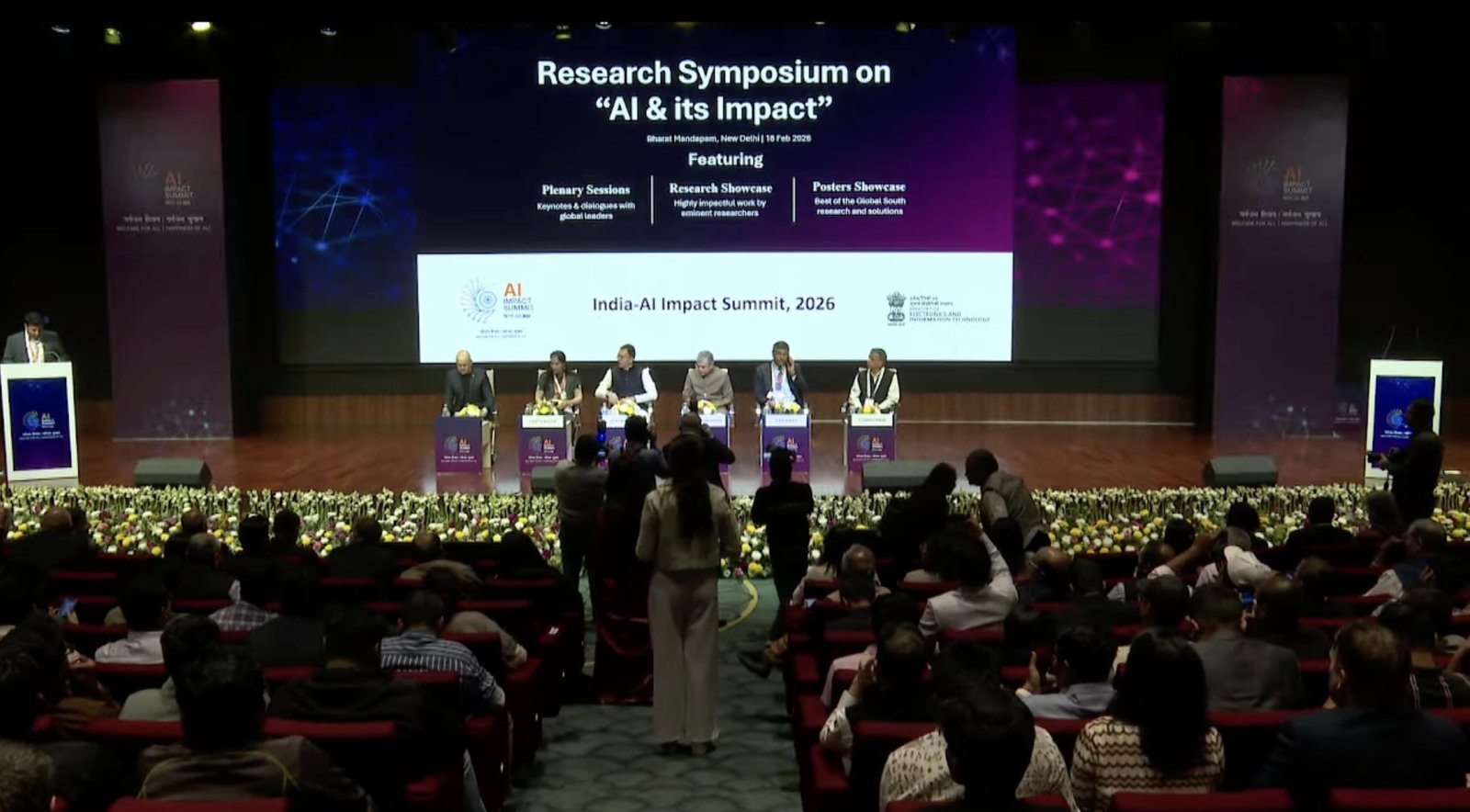
The Research Symposium on Enabling AI at Nation Scale, hosted by the Ministry of Electronics and Information Technology (MeitY), brought together some of the world’s most influential artificial intelligence researchers, policymakers, and industry leaders to explore how AI can accelerate scientific discovery, strengthen engineering capability, and support national scale digital infrastructure.
Held at Bharat Mandapam, the Symposium represented a strategic convergence of global research leadership and public policy, reflecting the growing view that AI is evolving from a technology trend into foundational national infrastructure. Across keynotes, policy discussions, and research sessions, the event emphasised collaboration, responsible innovation, and the need for long term scientific investment.
Opening Ceremony Establishes A Vision For Nation Scale AI
The opening ceremony set a forward looking tone focused on partnerships between government, academia, and industry. Leaders highlighted how enabling AI at scale requires not only compute and data resources but also governance frameworks, ethical standards, and sustained research ecosystems.
Ashwini Vaishnaw, Minister For Electronics And Information Technology
Ashwini Vaishnaw highlighted India’s commitment to building AI capabilities that combine scale, responsibility, and innovation driven growth. He stressed that AI must be developed as a national priority with strong research backing, trusted governance mechanisms, and infrastructure that empowers both academia and industry.
He further noted that India’s approach focuses on enabling innovation while ensuring technology remains aligned with societal needs and long term economic development.
“AI will define the next era of innovation, and India’s approach is to build it responsibly at scale with strong research, trusted governance, and inclusive participation.”
— Ashwini Vaishnaw
Speakers at the opening session included:
-
Kavita Bhatia, Chief Operating Officer, IndiaAI Mission, Ministry of Electronics and Information Technology
-
S. Krishnan, Secretary, Ministry of Electronics and Information Technology
-
Jitin Prasada, Minister of State for Electronics and Information Technology
-
Ashwini Vaishnaw, Minister for Electronics and Information Technology
-
H.E. Mr. Alar Karis, President of Estonia
-
P. J. Narayanan, Professor and Former Director, International Institute of Information Technology Hyderabad
“AI has moved beyond isolated innovation. The real challenge now is enabling research, infrastructure, and governance to operate together at national scale.”
— Opening Ceremony Perspective
Leaders spoke about the importance of building trusted digital ecosystems where AI innovation can progress responsibly while delivering measurable outcomes for society and industry.
Global AI Pioneers Discuss The Next Frontiers
A major highlight of the Symposium was the keynote series featuring globally recognised AI researchers Demis Hassabis, Yoshua Bengio, and Yann LeCun. The sessions explored future trajectories of AI research, including scientific discovery systems, large scale reasoning models, and the evolving relationship between foundational research and real world deployment.
“The future of AI research will be defined by how effectively we connect scientific curiosity with real world problem solving.”
— Keynote Insight
Discussion themes included:
-
expanding AI’s role in scientific discovery
-
improving model reasoning and reliability
-
balancing innovation with transparency and accountability
-
ensuring AI systems deliver broad societal value
The keynotes reinforced a growing consensus that long term progress depends on both research ambition and robust governance.
AI As A Catalyst For Grand Challenges
A recurring theme throughout the Symposium was how AI can act as a catalyst for solving complex global research challenges. Panellists highlighted opportunities across healthcare, climate science, industrial engineering, and computational research.
“Nation scale AI is not only about capability. It is about enabling research communities to solve problems that were previously considered too complex or resource intensive.”
— Research Panel Perspective
Sessions emphasised the importance of shared infrastructure, collaborative research networks, and open innovation models that allow institutions to accelerate experimentation and discovery.
Policy, Governance And Responsible Innovation
Beyond technical discussions, participants gave significant attention to the governance structures needed to support responsible AI development. Speakers stressed that transparency, fairness, and accountability must evolve alongside rapid technological progress.
“Responsible innovation is not a constraint. It is the foundation that allows AI adoption to scale with trust.”
— Governance Session Insight
The dialogue reflected increasing global alignment around the need for common frameworks that support both innovation and public confidence.
India’s Emerging Role In Global AI Leadership
The Symposium reinforced India’s growing role as a convening platform for international AI collaboration. By hosting global experts alongside national policymakers and researchers, the event highlighted how emerging digital economies are shaping the future direction of AI research and governance.
“India’s AI journey is about building capacity, creating global partnerships, and contributing to the shared scientific future of AI.”
— Strategic Perspective From The Event
Participants highlighted the importance of nurturing talent pipelines, investing in compute infrastructure, and encouraging cross sector collaboration to sustain long term innovation.
Key Takeaways From The Symposium
-
AI is increasingly viewed as foundational national infrastructure
-
Collaboration between research, policy, and industry will define future progress
-
Responsible governance is central to long term adoption
-
Nation scale AI requires shared infrastructure and global cooperation
-
Scientific discovery remains a core driver for next generation AI development
Looking Ahead
As the Symposium concluded, the overall message was clear: the next phase of AI growth will be shaped by coordinated effort across governments, researchers, and technology leaders. Nation scale AI is no longer a theoretical concept but an evolving operational reality requiring long term vision and collaborative execution.
The event closed with a shared commitment to strengthening global research partnerships and accelerating responsible innovation capable of delivering meaningful societal impact.