
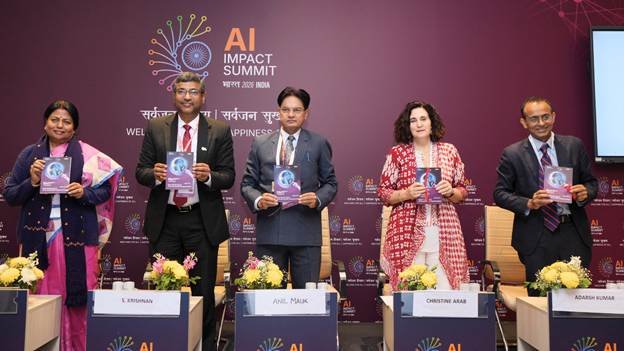
The Casebook on AI and Gender Empowerment was officially launched at the India AI Impact Summit 2026, marking a significant milestone in India's commitment to inclusive and ethical artificial intelligence advancement.
Developed by the Government of India through the IndiaAI Mission under the Ministry of Electronics and Information Technology (MeitY) in partnership with UN Women and supported by the Ministry of Women and Child Development (MoWCD), the casebook brings together 23 real-world AI solutions from across the Global South that demonstrate measurable impact on gender equality and women's empowerment.
The publication was jointly launched by S. Krishnan, Secretary, Ministry of Electronics and Information Technology (MeitY); Anil Malik, Secretary, Ministry of Women and Child Development (MoWCD); and Christine Arab, Regional Director, UN Women Asia and the Pacific.
The casebook received international recognition when United Nations Secretary-General António Guterres visited the UN Women stall at the JanAI Expo on 20 February 2026. During his visit, the Secretary-General engaged with young women from rural communities pursuing STEM careers under the WeSTEM project, implemented by UN Women in collaboration with the Governments of Madhya Pradesh, Gujarat, and Maharashtra, the European Union, Micron, Nokia, and the Head Held High Foundation.
The young women shared how they are using AI to build new skills, expand access to learning, and explore emerging employment opportunities, reflecting practical pathways toward becoming future technology leaders. A copy of the casebook was presented by Kanta Singh, Country Representative a.i., UN Women to the Secretary-General during his visit, in the presence of the Under-Secretary-General and the Secretary-General’s Envoy on Technology, Amandeep Singh Gill.
The casebook features 23 AI solutions selected from 233 submissions across more than 50 countries through a rigorous multi-stage evaluation process. An independent evaluation committee comprising senior officials from MeitY, MoWCD, and UN Women assessed submissions based on real-world deployment, measurable gender impact, and evidence-based outcomes.