

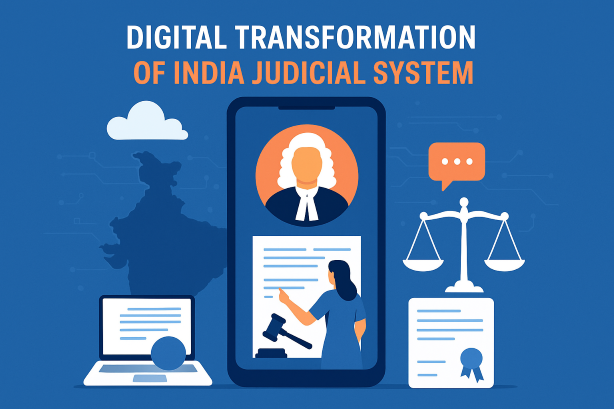
The Government of India has reported significant progress under the ambitious e-Courts Project Phase III, a Rs7,210-crore initiative aimed at transforming India’s judiciary into a fully digital, paperless and technology-enabled ecosystem. The four-year project has so far utilised Rs768.25 crore in FY 2023-24 and Rs1,029.11 crore in FY 2024-25, with an additional Rs907.97 crore released in the current financial year.
Phase III focuses on digitising legacy and ongoing court records, expanding video-conferencing capabilities to all courts and jails, enabling online courts beyond traffic cases, and deploying emerging technologies such as Artificial Intelligence (AI) and Optical Character Recognition (OCR) for case analysis and forecasting. A unified cloud-based data repository and universal expansion of e-Sewa Kendras are also key components.
According to the Ministry of Law and Justice, Digital Courts 2.1 the upgraded platform providing judges digital access to all case documents, evidence, and filings is currently under pilot testing.
Key Achievements Reported
99.5 per cent of court complexes connected via Wide Area Network (10–100 Mbps).
CIS 4.0 implemented across all courts with standardised user manuals.
More than 4 lakh SMS and 6 lakh emails issued daily; 35 lakh daily hits on the e-Courts portal.
29 Virtual Courts established, processing 8.96 crore challans, with 7.84 crore disposed and fines worth ₹895.59 crore paid.
3.38 crore downloads of the e-Courts Services mobile app; the JustIS app assists judges with workload management.
Digitisation of 224.66 crore High Court pages and 354.87 crore District Court pages.
Video-conferencing enabled in 3,240 courts and 1,272 jails, facilitating 3.81 crore online hearings.
Live-streaming operational in 11 High Courts.
92.08 lakh e-filed cases across 5,187 court establishments.
e-Payments platform processed transactions worth ₹1,277.95 crore for court fees and fines.
1,987 e-Sewa Kendras operational for litigant support.
6.21 crore e-processes handled through the NSTEP platform.
Judgment Search Portal now hosts 1.69 crore judgments.
730 District Court websites hosted on the secure S3WaaS platform.
The government also highlighted the introduction of Nyaya Shruti, a 2024 mobile app under the Inter-operable Criminal Justice System (ICJS), enabling virtual testimony by accused persons, witnesses, and officials. The e-Sakshya platform now supports digital recording of evidence, and e-Summons has streamlined digital service of notices and summons.
Challenges and Roadmap Ahead
Despite rapid progress, the Ministry acknowledged challenges such as uneven infrastructure across states, complexities in digitising massive legacy records, data security requirements, and the need for digital capacity building among judicial stakeholders.
To address these issues, the government is undertaking extensive training programmes, periodic security audits, special financial support for North-Eastern states, and enhanced interoperability across police, prisons, courts, and forensic systems.
Minister of State for Law and Justice Arjun Ram Meghwal informed the Rajya Sabha that these measures will progressively enable a fully digital judicial process, reduce delays, strengthen coordination across criminal justice agencies, and improve citizen access to justice.