

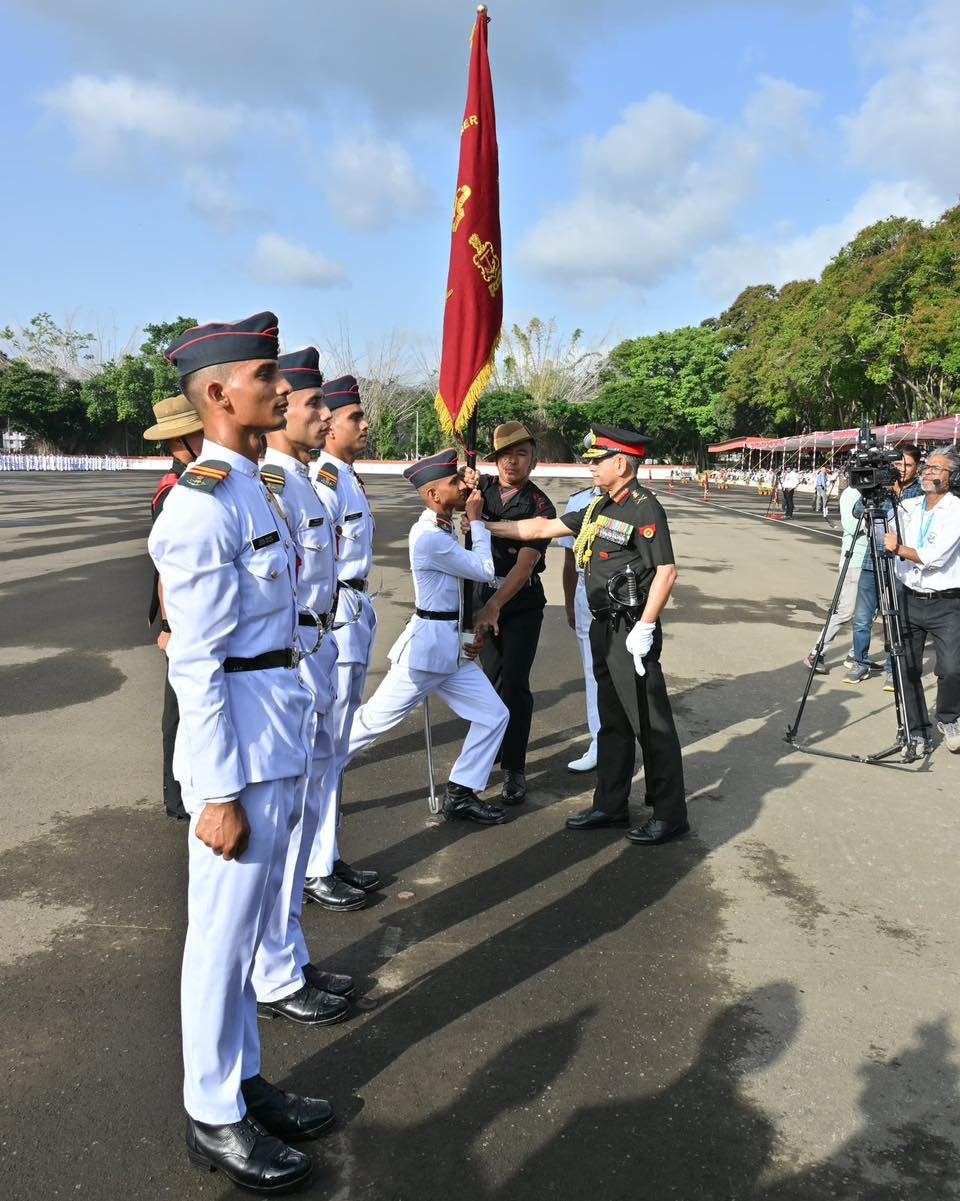
The Indian Army is rapidly integrating Artificial Intelligence (AI), drones, and automation technologies into its operational and training ecosystem as part of its broader modernisation strategy for future warfare, Chief of Army Staff (COAS) General Upendra Dwivedi said during a press conference and address at the National Defence Academy (NDA).
Addressing the evolving nature of warfare, General Dwivedi highlighted that Artificial Intelligence is no longer a futuristic concept but a present-day operational necessity. He stated that AI-enabled platforms such as “Tadai” and “Ekalavya” are being developed and deployed to support faster decision-making, battlefield management, and resource optimisation in increasingly complex combat environments.
According to the Army Chief, the growing velocity of warfare demands rapid “Observe, Orient, Decide and Act” (OODA) cycles, where AI-driven systems and language models such as SLMs (Small Language Models) and LLMs (Large Language Models) can significantly reduce response times across the military “kill chain” from target identification to precision engagement.
“AI enables much faster decision-making regarding target engagement, weapon allocation, and Identification of Friend or Foe (IFF),” he explained, adding that automation is becoming essential as modern battlefields become increasingly saturated with drones and counter-drone systems.
General Dwivedi also underscored the Indian Army’s growing focus on drone warfare readiness. Reiterating his vision of building an “Eager Army,” he said every soldier should possess the capability to operate drones effectively.
“When I say ‘Eager,’ I am referring to the Eager Drone concept. Every soldier should be able to fly and understand drones,” he stated.
The Army has already begun integrating drone and counter-drone training into military academies and training establishments through simulators and live drone systems. General Dwivedi revealed that several large drones and simulators had been deployed to training teams to accelerate operational familiarity among cadets and personnel.
He emphasised that drone literacy is now becoming a critical battlefield requirement, given the increasing role of unmanned systems in surveillance, reconnaissance, targeting, and tactical operations.
Speaking at the passing out parade of the 150th course at the National Defence Academy, where 353 cadets, including 18 women cadets graduated, General Dwivedi said future conflicts would no longer remain confined to conventional battlefields alone.
“Wars of the future will be fought across land, air, sea, space, cyber, electromagnetic and cognitive domains,” he said, stressing the need for integrated and technology-driven military preparedness.
The Army Chief also highlighted the importance of “Operation Sindhu,” describing it as a demonstration of India’s ability to respond with speed, precision, and purpose. According to him, the operation showcased the significance of integrated planning, real-time intelligence, precision targeting, secure communications, and cross-domain synergy in modern warfare.
General Dwivedi noted that the Indian Army is actively preparing itself as a “future-ready force” under what he described as the “Decade of Transformation.” He said indigenous niche technologies, including advanced weapons platforms, the ‘Shakti’ command system, software-defined radios, and next-generation communication architectures, are being incorporated into the Army’s operational framework.
“Our next major step is the networking of inter-service systems, where data will become a strategic resource and decision-making will become faster, smarter, and more precise,” he stated.
He further emphasised that innovation remains central to the armed forces’ transformation agenda. Under a “Whole-of-Nation” approach, the Army is collaborating with organisations such as DRDO, startups, industry partners, academia, and national institutions to convert indigenous ideas into deployable battlefield capabilities.
Referring to Prime Minister Narendra Modi’s “Jai Anusandhan” vision, General Dwivedi said joint innovation across the armed forces would continue to guide India’s military modernisation efforts.
Alongside technological modernisation, the Army Chief also addressed progress on the long-discussed theatreisation reforms within the Indian armed forces. He confirmed that deliberations within the Chiefs of Staff Committee (COSC) have been completed and that the report has already been submitted to the Ministry of Defence for stakeholder review.
General Dwivedi said the proposed structure would allow Service Chiefs to focus on raising, training, and sustaining forces, while Theatre Commanders would oversee operational deployment and execution. He expressed confidence that the reforms would continue progressing under the leadership of the new Chief of Defence Staff (CDS), with implementation expected over the next two to three years.
The Army Chief also reiterated that the role of the Indian Armed Forces extends beyond warfare to nation-building, including border security, disaster relief, support for remote regions, youth engagement initiatives, strengthening border villages, and promoting national unity.
The address and press conference together highlighted the Indian Army’s increasing emphasis on AI-enabled warfare, autonomous systems, integrated military networks, and indigenous innovation as India prepares its armed forces for next-generation combat environments.