

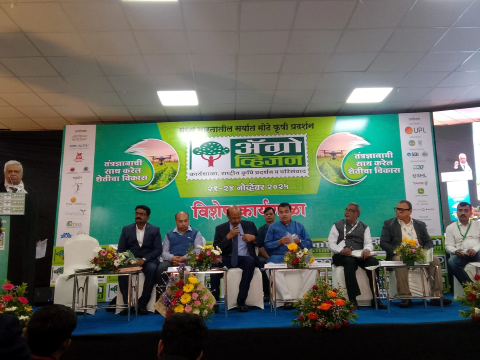
In a move that could redefine the technological architecture of Indian agriculture, Baramati-based institutions, Agrovision Foundation and the National Bureau of Soil Survey and Land Use Planning (NBSSLUP) have signed a landmark Memorandum of Understanding to accelerate the deployment of artificial intelligence across Vidarbha’s farming systems. The agreement positions NBSSLUP — a premier soil research institute under the Indian Council of Agricultural Research (ICAR) — as the central scientific partner responsible for developing advanced agronomic algorithms that will power AI-driven decision tools for crops, soils, irrigation, and climate management.
The partnership represents a decisive shift from pilot-scale experimentation to full-scale institutionalisation of AI in agriculture. NBSSLUP scientists will lead the development of spatially precise soil–crop models, real-time nutrient guidance engines, and predictive decision-support modules calibrated specifically for Vidarbha’s cotton, toor, and citrus ecosystems. The collaboration aims to create a unified, cloud-linked agronomy stack capable of assisting farmers with hyper-local insights on fertiliser dosage, irrigation scheduling, pest forecasting, and weather-linked advisories.
Padma Shri Prataprao Pawar, Chairman of Sakal Media Group and a long-time champion of agricultural transformation in Western Maharashtra, framed the MoU within a broader global context. Citing the White House’s AI policy frameworks, he argued that India’s agricultural future hinges on local ecosystems that can translate frontier technology into farmer-ready practice. “Baramati has the potential to be India’s most consequential AI-agriculture innovation district,” he noted, adding that initiatives by Microsoft and ongoing collaborations with scientists from Oxford have revived Baramati’s agricultural capabilities over the last decade. He urged Nitin Gadkari, Union Minister for Road Transport and Highways, Government of India to help bridge the widening gap between high-end AI research and rural Vidarbha’s on-ground realities.
Pawar underscored that the economic logic for AI adoption is now irrefutable. Precision recommendations can sharply reduce the cost of cultivation by eliminating wasteful inputs and minimising pesticide misuse. He warned that Punjab’s rising cancer cases — widely linked to excessive pesticide exposure — should serve as a national alert. AI, he said, is uniquely capable of enabling judicious application of fertilisers and crop protection chemicals while amplifying the utilisation of organic manure and regenerative soil practices.
Nitin Gadkari delivered a pointed message on the need for credibility, efficiency, and accountability in India’s agricultural modernisation. “Financial audits are important, but performance audits are far more important,” he declared, arguing that AI, machine learning, and automation must become the backbone of farm-level performance monitoring. Gadkari emphasised that AI deployment should begin with irrigation, calling it the most strategic input in Indian agriculture. AI, he said, can map crop-wise water demand, soil moisture dynamics, fertiliser requirements, and meteorological variability — generating measurable yield improvements for farmers across Vidarbha.
Gadkari confirmed that Standard Operating Procedures for AI-led cultivation in cotton, toor, and oranges are under preparation, with Microsoft providing technological support for scalable model development. He urged the technical staff of Dr. Panjabrao Deshmukh Krishi Vidyapeeth (PKV) to embed themselves deeply in the initiative, ensuring that research institutions act as force multipliers rather than spectators. Reiterating the need for soil health cards for every farmer, he argued that AI-enabled agriculture is central to improving profitability, reducing risks, and accelerating the next agricultural revolution. “No revolution in agriculture can occur in silos,” he said, advocating for direct selling platforms and market-access innovations that can ensure farmers receive fair remuneration.
Offering a practitioner’s perspective on field mechanisation and drone agronomy, Dr. Sunil Gorantiwar, Director of Research at Mahatma Phule Krishi Vidyapeeth (MPKV), described how AI-powered equipment could reshape labour productivity and crop management. He outlined how tractors operating in tandem with drones represent the next stage of mechanised synergy, enabling synchronised data capture, crop assessment, and input application. Gorantiwar elaborated on the wide spectrum of drone technologies — from fixed-wing drones suited for rapid, large-area spraying to multi-rotor drones ideal for precision work on fragmented fields.
Gorantiwar highlighted that drone-assisted irrigation, once considered speculative, is now technically feasible. A single drone can irrigate 10 to 14 acres a day, offering a lifeline for regions facing acute labour shortages or irregular water distribution. He also identified challenges including payload optimisation, regulatory clearances, battery endurance, and the need for certified operators trained in both aviation and agronomy. By integrating AI-based flight paths with crop stress signatures and soil moisture maps, drones can move beyond mere spraying and evolve into autonomous field managers capable of micro-irrigation, targeted fertigation, and precision pesticide application.
Taken together, the MoU and the institutional alignment behind it signal a structural turning point for Vidarbha’s agricultural landscape. The convergence of Baramati’s innovation ecosystem, NBSSLUP’s scientific rigor, Agrovision’s farmer networks, and Microsoft’s digital infrastructure could establish a replicable template for India’s first AI-ready agricultural region. As policymakers, scientists, technologists, and farmers converge on a shared agenda, Vidarbha is poised to become the proving ground for how AI can deliver profitability, sustainability, and resilience across India’s diverse agricultural geographies.
— Suchetana Choudhury (suchetana.choudhuri@agrospectrumindia.com)