

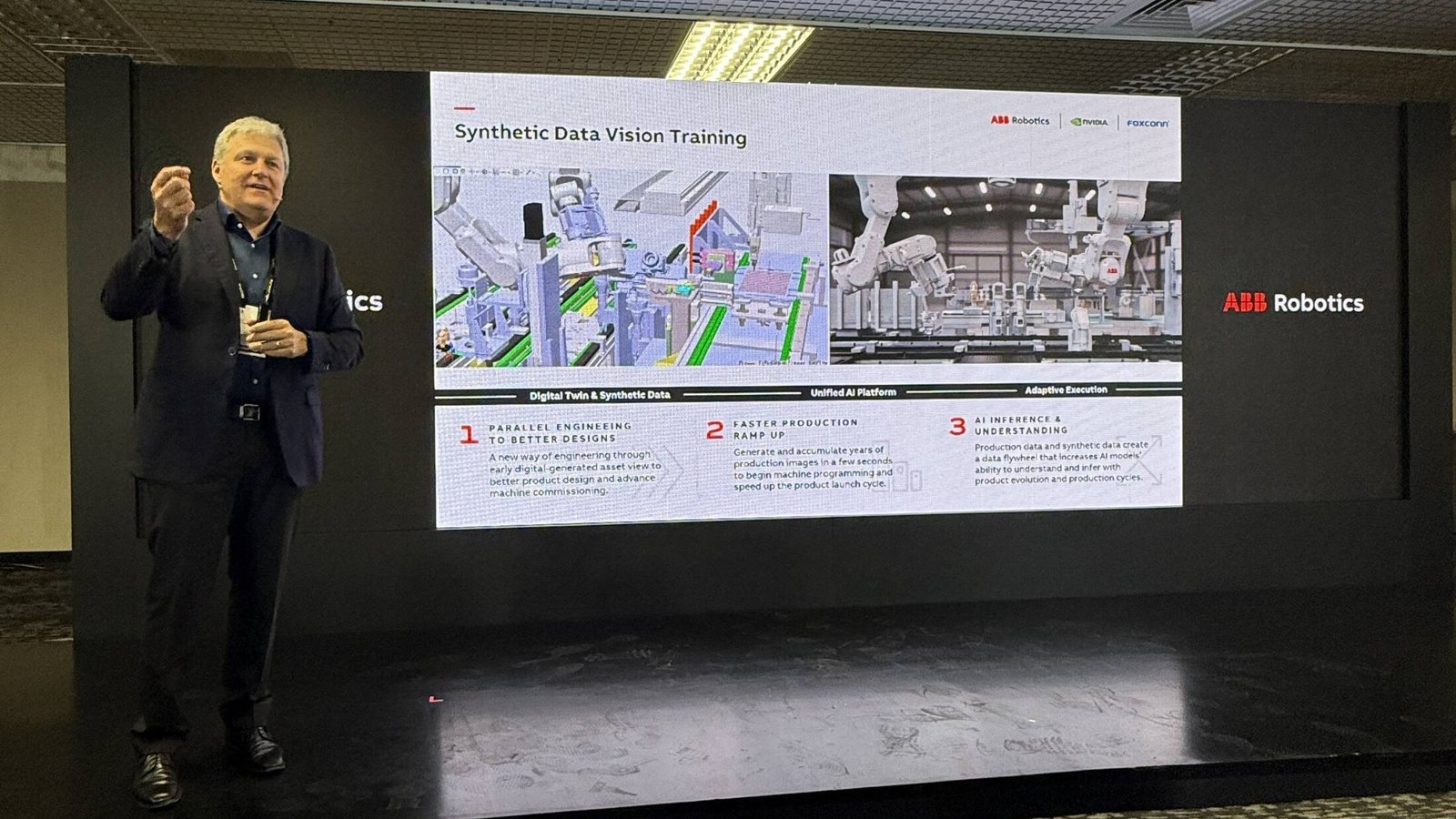
ABB Robotics has outlined its vision for the next generation of industrial automation, highlighting how the convergence of robotics, artificial intelligence, simulation technologies and digital twins is enabling a new era of Autonomous Versatile Robots (AVRs) capable of learning, adapting and operating with greater autonomy across complex industrial environments.
Speaking at COMPUTEX during the forum Robotics, Autonomous Machines & Physical AI, Craig McDonnell, Business Line Industries Lead at ABB Robotics, detailed how industrial grade physical AI is transforming manufacturing by bridging the digital and physical worlds through advanced simulation and virtual training environments.
ABB's Robotics approach combines decades of robotics expertise with emerging AI technologies to create robotic systems that can perceive, reason and continuously improve their performance. The company believes this shift will allow manufacturers to automate a broader range of applications while reducing the complexity traditionally associated with robotic deployment.
A key pillar of this strategy is ABB's collaboration with NVIDIA, which brings together ABB's robotics capabilities and NVIDIA's accelerated computing and simulation technologies. Through hyper realistic synthetic data generation, manufacturers can train AI models across countless production scenarios before deploying them in real world environments.
At the centre of this innovation is RobotStudio HyperReality, ABB's next generation platform that uses industrial physical AI and digital twin technology to create fully simulated production environments. The platform enables manufacturers to design, train, test and validate robotic systems virtually before implementation on the factory floor.
The technology is particularly relevant for electronics manufacturing, where increasing product complexity, high mix production and frequent product introductions create challenges for traditional automation systems. By moving from rule based programming to AI powered adaptive systems trained within digital twins, ABB aims to improve manufacturing flexibility while reducing engineering effort and deployment risks.
ABB Robotics highlighted its collaboration with Foxconn as an example of how synthetic and production data can be combined to continuously improve automation performance and accelerate deployment in electronics manufacturing operations.
RobotStudio HyperReality is expected to become commercially available during the second half of 2026. ABB Robotics estimates the platform can help manufacturers achieve up to 40 per cent cost reduction, up to 50 per cent faster time to market, improved operational efficiency and greater progress towards near 100 per cent Overall Equipment Effectiveness (OEE).
Craig McDonnell said, “The future of industrial automation lies in systems that can learn, adapt and operate autonomously at scale. By combining robotics, industrial AI, simulation and digital twins, we are creating the foundation for more resilient, flexible and efficient manufacturing operations.”
ABB Robotics is one of the world's leading robotics companies, offering an AI powered portfolio spanning industrial robots, collaborative robots and Autonomous Mobile Robots. The company employs approximately 7,000 people globally and continues to advance intelligent automation solutions across industries including electronics, logistics, healthcare and manufacturing.