

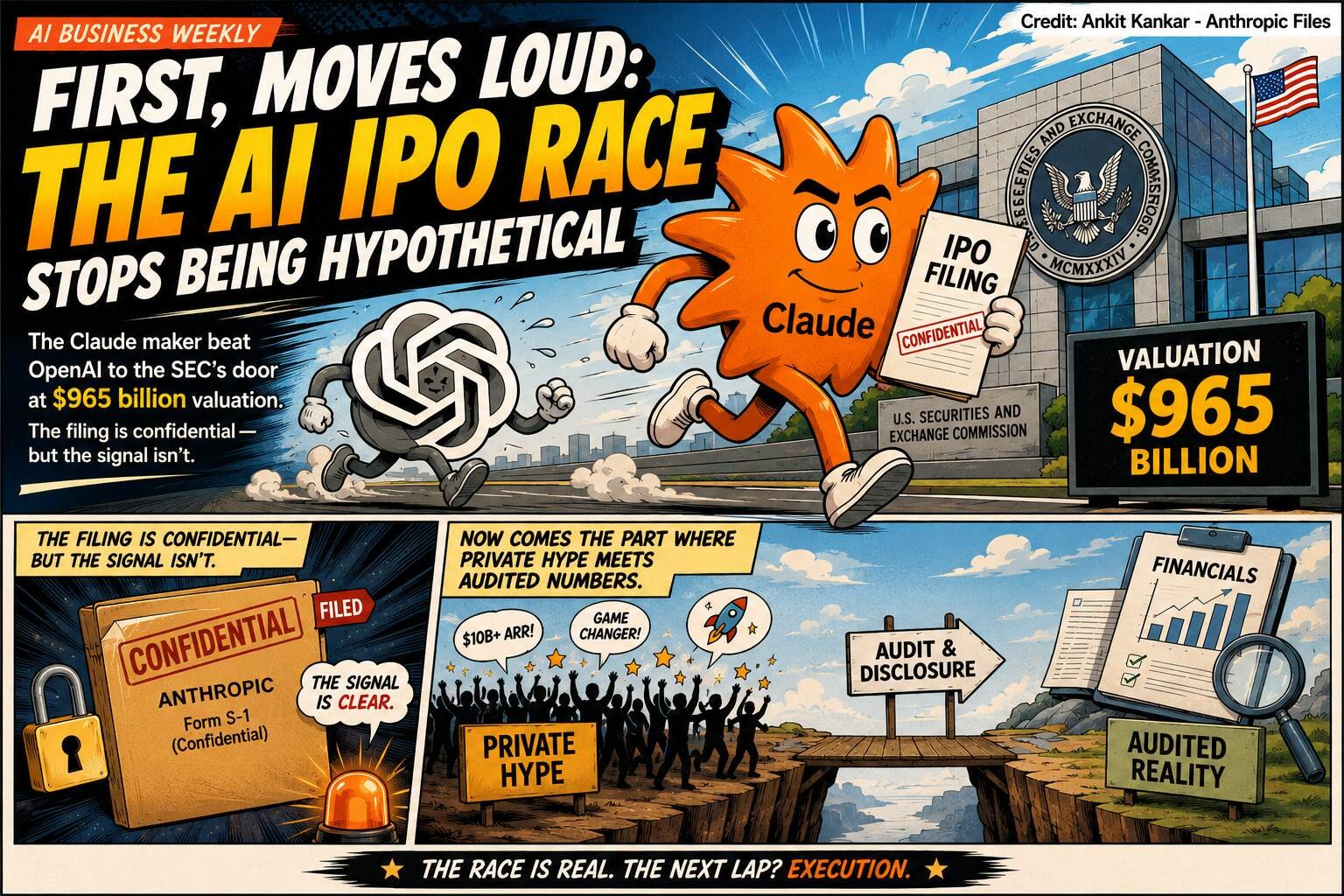
Anthropic did a strange thing on Monday: it filed a secret document and then told everyone about it.
The company confirmed in a public blog post that it had confidentially submitted a draft registration statement on Form S-1 to the U.S. Securities and Exchange Commission, the first formal step toward an initial public offering. The timing, Anthropic said, will "depend on market conditions and other factors," and no share count or price has been set.
A confidential filing is, on its own, a low-commitment move. It lets a company start the SEC review process privately, refine its disclosures, and walk away with no one the wiser. Plenty of confidential S-1s never become anything. What makes this one different is that Anthropic chose to announce it — and in doing so, fired the starting gun on the most consequential IPO race the AI industry has produced.
The race, suddenly real
For more than a year, "AI is going public" has been a sentence said at conferences, not a date on a calendar. That changed in the span of about six weeks.
SpaceX is furthest along: it filed its public prospectus on May 20 after a confidential April submission and is targeting a Nasdaq debut as soon as mid-June, aiming for a valuation near $1.75–1.8 trillion. OpenAI is reported to have filed confidentially around late May, with a debut eyed for September and a prior valuation of roughly $852 billion. Anthropic has now slotted itself squarely between them — behind SpaceX, ahead of OpenAI on the paperwork.
The subtext is hard to miss. By filing first and publicizing it, Anthropic is telling the market it intends to reach public markets before OpenAI does. Whether it actually gets there first is undecided; OpenAI can still accelerate, and a confidential filing locks no one into a timeline. But the posture is the message.
The number everyone is staring at: $965 billion
Anthropic's filing landed less than a week after it closed a $65 billion Series H that pushed its valuation to $965 billion — co-led by Altimeter, Dragoneer, Greenoaks, Sequoia, Capital Group, Coatue, and D1 Capital Partners. That puts a roughly trillion-dollar price tag on a company founded in 2021 and run by siblings Dario and Daniela Amodei.
The valuation climb has been near-vertical. Anthropic raised its $30 billion Series G in February at a $380 billion post-money valuation. Eight months and one Series H later, the figure has more than doubled — all of it in private markets, without a single share trading publicly.
The revenue curve underneath it is the part that makes investors lean in. By Anthropic's own disclosures, run-rate revenue went from about $9 billion at the end of 2025 to $14 billion in February, $19 billion in March, roughly $30 billion in April, and crossed $47 billion by late May. (Run-rate is an annualized projection, not booked annual revenue — typically the latest month times twelve — so it flatters a company growing this fast and deserves the asterisk.) Much of the surge is enterprise: Anthropic says it now has more than 1,000 customers spending over $1 million a year, and Claude Code, its agentic coding tool, has become one of the fastest-growing software products on record.
A word of caution on the figures circulating in the wake of the filing: claims of a specific quarterly profit — a number near $559 million for Q2 has been passed around on social platforms — are commentary, not confirmed reporting, and Anthropic has disclosed no such figure. Treat them as speculation until the actual document says otherwise.
Why the S-1 matters more than the valuation
Here is the genuinely new thing buried in this story. Every AI valuation since 2023 has been a private-market assertion — unaudited, marked up round over round, with each financing referencing the last as price discovery. If Anthropic follows through, its S-1 will contain audited GAAP financials, the first time such a document has existed for a frontier AI lab.
That document does one of two things. It either anchors the entire valuation stack the industry has built over three years — or it begins to show how much of that stack was circular validation. Either way, the guessing ends. Public markets have never had to price a company in this category, and they are about to be handed real numbers to do it with.
LinkedIn-investor optimism leans toward the first outcome. Reid Hoffman, weighing in this week, argued that AI revenue is durable — enterprise and code revenue both compounding, with new business models still to emerge, the way search eventually found AdWords. The bear case is simpler: a company can grow run-rate revenue at this pace and still be a long way from the kind of profitability that justifies a near-trillion-dollar price, and a confidential filing is exactly where you'd start if you weren't certain the numbers would survive sunlight.
The wrinkle the hype is skipping
Lost in the IPO-race excitement is a complication that belongs in any honest account: Anthropic is in active litigation with the U.S. government. The company was hit with a federal designation flagging it as a potential supply-chain risk — a move that led some defense contractors to drop it and reportedly prompted more than 100 enterprise customers to raise concerns. Anthropic has sued the Trump administration to reverse the blacklisting, and that case is ongoing. Commercial momentum has, by the company's account, accelerated regardless; consumer adoption climbed and Claude topped the U.S. free-app charts earlier this year. But "material pending litigation with a primary regulator" is the sort of line that reads very differently in a marketing blog post than it does in a risk-factors section.
What to watch
Three things, in order. First, whether OpenAI accelerates to file publicly and reclaim the "first" narrative. Second, how SpaceX's mid-June debut trades — a strong open greases the runway for everyone behind it; a wobble does the opposite, and no one wants to be remembered as the listing that popped the bubble. Third, and most important, the moment Anthropic's confidential draft becomes a public S-1, because that is when assertion turns into disclosure.
For now, everything carries an asterisk. Anthropic could go public this summer, this fall, or not at all. The filing can be withdrawn, quietly, and the public might never know. What's no longer hypothetical is the contest itself. The three biggest private companies in the world are sprinting for the same exit at the same time, into a market that has never had to value any of them.
AI Spectrum will update this story as the SEC review progresses and public filings become available.