
As artificial intelligence continues to reshape the future of work, enterprise learning is undergoing a fundamental transformation from static content delivery to intelligent, adaptive, and outcome-driven skill development. Organisations today are seeking learning ecosystems that go beyond traditional learning management systems to deliver real-time personalisation, autonomous interventions, and measurable workforce readiness at scale. At the centre of this shift is agentic AI, an emerging paradigm that is redefining how enterprises build, deploy, and optimise workforce capabilities.
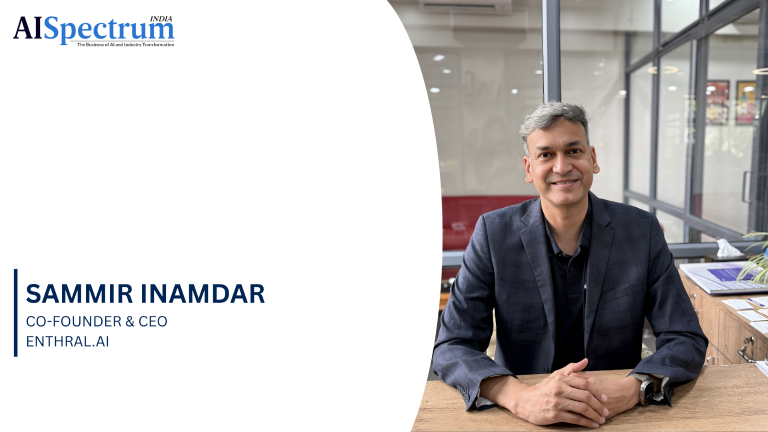
In this interview with AI Spectrum, Sammir Inamdar, Co-founder and CEO of Enthral.ai, discusses the company’s evolution from launching India’s first SaaS-based learning management system to building an agentic AI-powered skilling platform. He shares insights on how autonomous AI agents are transforming enterprise learning through intelligent decision-making, real-time interventions, and seamless integration across enterprise systems, while highlighting the future of AI-driven workforce development in an increasingly skills-first digital economy.
Enthral.ai has evolved from launching India’s first SaaS LMS to building an agentic AI-powered skilling platform. What triggered this shift, and how does agentic AI fundamentally change the role of learning platforms within enterprise ecosystems?
The shift was driven by a clear realisation that traditional learning platforms, even SaaS-based LMS systems, were not built for scale, deep personalisation, or real behaviour change. Enterprises today don’t just need content delivery; they need systems that can continuously align learning with business outcomes. This “knowing-doing gap” highlighted that the problem was not a lack of knowledge but a lack of execution.
Agentic AI fundamentally changes the role of learning platforms by transforming them into intelligent, action-oriented ecosystems. By combining LMS (Learning Management System), LXP (Learning Experience Platform), and LCMS (Learning Content Management Systems) with autonomous AI agents, Enthral.ai’s platform enables continuous, contextual learning and real-time interventions. Our AI agents support diverse learner and admin use cases and can even integrate with existing HR and L&D systems, allowing organisations to scale without disrupting their infrastructure while driving measurable impact.
Many platforms offer AI-driven personalisation, but Enthral.ai emphasises “agentic” capabilities. How do your AI agents enable autonomous decision-making and real-time interventions in learning and workforce productivity?
Many platforms offer AI-driven personalisation, but the real difference with agentic AI lies in execution. Enthral.ai’s autonomous agents handle execution, adaptation, and continuous improvement, eliminating manual workflows and admin-heavy processes. As roles evolve rapidly, research shows that skills in AI-exposed jobs are changing 66 per cent faster than before, up from 25 per cent last year, with the fastest shift seen in automatable roles. Organisations need systems that can respond in real time, not just recommend content.
Our agents proactively manage learning workflows, from content curation to skill gap analysis, and recommend, assess, and support based on each learner’s role, goals, and growth potential.
They continuously analyse learner behaviour and performances to trigger timely intervention such as personalised learning paths, context-based nudges, and role-play-based practice. With the capabilities of simulations, role-play environments, and performance mapping, learning gets aligned with actual work. Agentic AI transitions learning into an intelligent, automated system of continuous improvement, shorter time-to-productivity, and measurable workforce readiness.
Your platform integrates LMS, LXP, and LCMS while deploying AI agents across existing enterprise systems. Could you walk us through the underlying architecture that ensures scalability, security, and seamless interoperability?
We have built our platform around a unified Agentic AI architecture, one that doesn't treat LMS, LXP, and LCMS as three separate tools stitched together, but rather as a cohesive intelligence layer designed for real enterprise skilling outcomes.
Our autonomous AI agents operate across all three systems, managing workflows, curating content, analysing learner behaviour, and triggering real-time interventions from one orchestration core. Scalability is native to this design. The agents distribute tasks dynamically, ensuring personalisation and performance don't degrade as learner volumes grow across geographies. Security and compliance are embedded at every layer, with role-based access, data governance, and audit-ready workflows suited for enterprise and regulated environments.
What makes interoperability seamless is that our agents are designed to integrate with existing HR & L&D systems rather than replace them. With our platform, organisations can scale their skilling capabilities without disrupting their existing infrastructure, while the AI layer continuously aligns learning with business outcomes.
With over 3 million learners across 65 countries, how is data leveraged to generate actionable insights on skill gaps, learning effectiveness, and business outcomes? What differentiates your analytics approach?
With over 4million learners across 65 countries and an NPS of 98 per cent, the focus is not just on scale but on making data meaningful and actionable. Traditionally, organisations could only track course completion, but that rarely reflects true readiness. Our approach captures how learning translates into performance by analysing factors like time to proficiency, quality of decision-making, and reduction in errors.
This allows us to generate actionable insights on skill gaps, role readiness, and overall learning effectiveness. What differentiates our analytics is real-time visibility into performance through data-driven dashboards, enabling targeted interventions at both individual and team levels. By directly linking learning to business outcomes, we ensure that skilling is not just tracked but continuously optimised for impact.
Enthral.ai has a strong footprint in government and PSU sectors. How can AI-powered learning platforms accelerate digital transformation and capability building in large, traditionally complex public sector organisations?
AI-powered learning platforms can significantly accelerate digital transformation in large public sector organisations by combining scale, standardisation, and data-driven capability building. In environments traditionally defined by legacy systems and distributed workforces, the ability to deliver consistent, role-based training becomes even more critical.
At Enthral.ai, platforms like RoleReady.io enable standardised learning experiences across geographically dispersed teams through AI-powered simulations, ensuring every employee is exposed to the same quality of training regardless of location. With features like real-time feedback, AI avatars, and two-way interactions, learning becomes immersive and directly linked to real work scenarios. This is critical, as governments adopting AI have seen improvements in productivity, responsiveness, and decision-making through data-driven insights.
What makes this impactful is the combination of “always-on” practice and data-driven insights. Leaders gain real-time visibility into role readiness, enabling targeted interventions and measurable improvement in capability. This shifts public sector learning from completion-based training to performance-driven transformation at scale.
As AI reshapes the future of work, what are the next big shifts you foresee in enterprise learning? How is Enthral.ai positioning itself to stay ahead in this rapidly evolving space?
AI is reshaping enterprise learning by shifting focus from static training to continuous, adaptive, and work-integrated skill development. Learners now use AI in their roles at least a few times a year, a reflection of how quickly AI is becoming embedded in everyday workflows. Within organisations implementing AI, 65 per cent of employees say it has improved their productivity and efficiency, regardless of how often they personally use it, highlighting its broad impact on work outcomes and skill requirements.
The next big shift will be toward real-time, personalised learning ecosystems where learning is embedded directly into workflows rather than delivered separately. Enterprises will increasingly need dynamic systems that adapt to evolving roles, skills, and business priorities in real time.
At Enthral.ai, we are positioning ourselves as an AI-powered skilling platform that enables continuous upskilling through intelligent agents, personalised learning journeys, real-time insights, and outcome-driven learning, helping organisations close skill gaps faster in an AI-first world.