

Artificial intelligence is rapidly reshaping agriculture, enabling farmers to make smarter, data-driven decisions in the face of climate change, resource constraints, and rising food demand. Recognising the growing need for advanced agricultural technologies, India and Australia have launched a Joint Centre of Excellence that brings together ANNAM.AI at IIT Ropar and the Western Sydney University to develop next-generation AI solutions for the farming sector.
The collaboration aims to build a globally relevant agri-intelligence ecosystem by combining India’s large-scale agricultural datasets and digital infrastructure with Australia’s expertise in environmental modelling, robotics, and climate-adaptive farming. The initiative is expected to accelerate innovations in areas such as AI-powered soil intelligence, digital twins for farms, climate-risk prediction, and agricultural robotics.
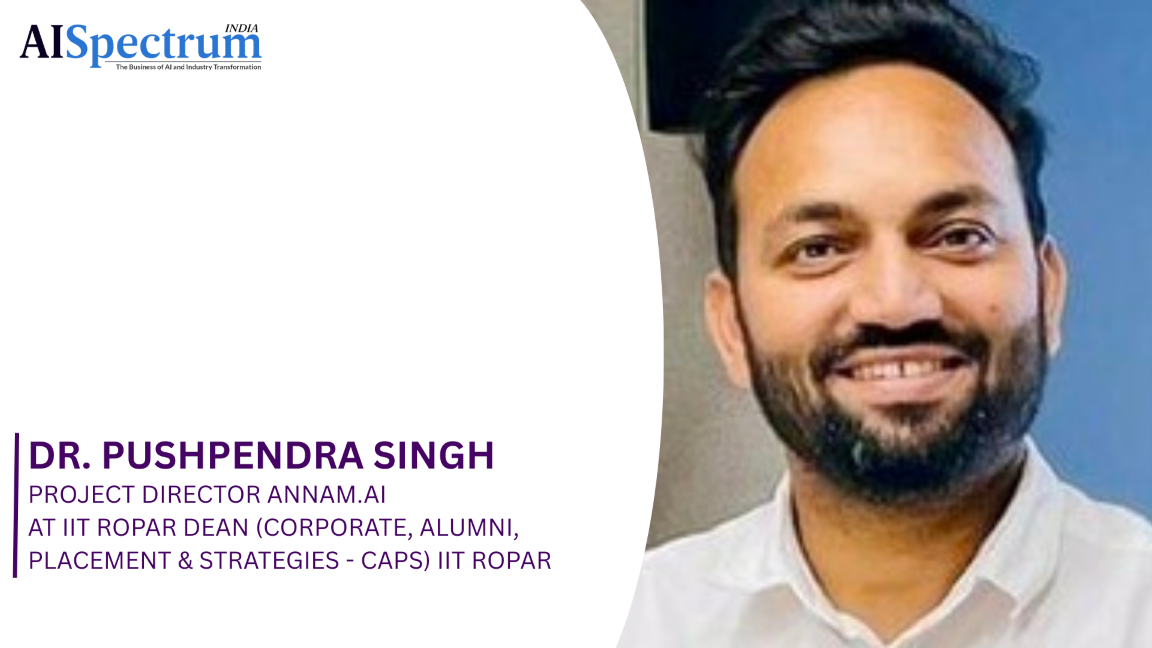
In this interview with AI Spectrum, Pushpendra Singh, Project Director of ANNAM.AI at Indian Institute of Technology Ropar and Dean of Corporate, Alumni, Placement & Strategies (CAPS), discusses how the new centre plans to harness artificial intelligence to improve farm productivity, enhance climate resilience, and create scalable technologies for millions of farmers. He also shares insights into how joint research programs, startup incubation, and industry partnerships could help position India and Australia as leaders in AI-driven sustainable agriculture.
The Joint Centre of Excellence brings together ANNAM.AI at IIT Ropar and the University of Western Sydney. What specific AI capabilities or research strengths from each institution will be integrated to create a truly differentiated agri‑intelligence ecosystem?
The strength of this Centre lies in the complementarity of both institutions. ANNAM.AI brings India‑scale agricultural datasets, multilingual AI systems, and deep expertise in data-driven precision agriculture insights, and digital public infrastructure. India generates more than 15 petabytes of agricultural data annually, and ANNAM.AI has been working to convert this into real‑time, hyper‑local intelligence for Indian farmers.
The University of Western Sydney contributes world‑leading capabilities in environmental modelling, robotics, phenomics, and climate‑adaptive agriculture, areas where Australia has decades of experience due to its own challenges with drought, heat stress, and soil degradation.
By combining India’s scale with Australia’s precision, the Centre will create an agri‑intelligence ecosystem capable of supporting millions of farmers while advancing frontier research in green intelligence, digital twins, and climate resilience.
AI‑powered soil intelligence and digital twins are highlighted as core focus areas. How do you envision these technologies transforming on‑ground decision‑making for farmers in the next three to five years?
Soil degradation affects nearly 55 per cent of India’s agricultural land, and farmers often rely on intuition rather than data. AI‑powered soil intelligence will change this dramatically. Digital twins, virtual replicas of farms that integrate soil, weather, crop, and management data being developed at ANNAM.AI at IIT Ropar, will allow farmers to simulate decisions before taking them on the ground through a ChatBot.
In the next year, farmers will be able to:
- Receive real‑time soil health scores using AI models trained on satellite and sensor data.
- Reduce fertiliser use by 10–15 per cent through dynamic nutrient recommendations.
- Save 20–30 per cent of irrigation water with predictive irrigation scheduling.
- Identify crop‑specific soil suitability, enabling diversification beyond paddy and wheat.
Digital twins will become the farmer’s “decision cockpit,” helping them plan every stage of the crop cycle with scientific precision.
Climate resilience is becoming central to global food security. How will the Centre leverage AI and predictive analytics to help farmers adapt to soil degradation, erratic weather patterns, and water scarcity?
Climate variability is already reducing yields by 15–20 per cent in several Indian states, and groundwater levels in Punjab and Haryana are falling by over 0.5 meters per year. The Centre will use AI‑powered climate models, digital twins, and hyper‑local advisory systems to help farmers anticipate and adapt to these risks.
We will integrate IMD data, satellite imagery, Micro-Climate Intelligence Infrastructure (MCII) developed at ANNAM.AI and IoT sensors to:
- Predict drought onset weeks in advance.
- Forecast pest and disease outbreaks with high accuracy.
- Provide climate‑adaptive cropping recommendations.
- Support regenerative practices that restore soil carbon and fertility.
The goal is to shift farmers from reactive to predictive agriculture, reducing climate‑related losses and improving long‑term sustainability.
Automation and robotics for farm operations are still emerging in many parts of India. What scalable deployment model do you foresee to ensure these technologies remain affordable and accessible to small and marginal farmers?
With 86 per cent of Indian farmers classified as small or marginal, individual ownership of robotics is not feasible. The Centre envisions a Robotics‑as‑a‑Service (RaaS) model, delivered through:
- Farmer-Producer Organisations (FPOs)
- Custom Hiring Centres
- Panchayat‑level service hubs
This model has already proven successful for tractors and harvesters in states like Punjab. By pooling demand, the cost per acre for robotic services can drop by 40–60 per cent, making advanced automation accessible even to smallholders.
We will also work with startups to develop low‑cost, ruggedised robots suited to Indian field conditions, ensuring scalability across diverse agro‑climatic zones.
With the Centre located in Noida, close to industry and policy ecosystems, how do you plan to accelerate commercialisation and translate research outcomes into field‑ready solutions and agri‑tech startups?
Noida is strategically positioned at the intersection of India’s technology industry, agribusiness ecosystem, and national policy institutions. The Centre will leverage this location to accelerate commercialisation through:
- Industry‑co‑developed prototypes in robotics, soil intelligence, and digital twins.
- Startup incubation supported by venture partners and government innovation funds.
- Regulatory sandboxes for testing AI‑enabled farm solutions.
- Integration with national digital platforms such as Bharat Vistaar and ONDC‑Agri.
With India’s agri‑tech market projected to reach $24 billion by 2030, we expect the Centre to catalyse a new generation of AI‑first agri‑startups that can scale across India and the Global South.
Beyond research outputs, how will joint PhD programs, faculty exchanges, and innovation challenges contribute to building a long‑term India-Australia AI talent pipeline in agriculture?
India will require over 1 million AI‑skilled professionals in the next decade, and agriculture is one of the sectors with the highest potential for impact. Joint PhD programs and faculty exchanges will create a continuous flow of talent between India and Australia, combining India’s field‑scale challenges with Australia’s advanced research infrastructure. Digital Agriculture students from IIT Ropar will also spend 6 months to a year at UWS in Australia.
Innovation challenges and hackathons will expose students to real‑world agricultural problems, fostering a generation of researchers and entrepreneurs who can build globally relevant solutions. This talent pipeline will not only strengthen bilateral collaboration but also position India and Australia as leaders in AI‑driven sustainable agriculture for the Indo‑Pacific region.