
As manufacturers accelerate their adoption of artificial intelligence, the focus is shifting from predictive maintenance and machine monitoring towards agentic AI systems capable of reasoning, diagnosing operational challenges and supporting decision-making across industrial environments. However, scaling these technologies requires more than advanced algorithms. Reliable industrial AI depends on contextual understanding, integration with legacy infrastructure, data quality, human oversight and the ability to demonstrate measurable business outcomes.
Augury is advancing this shift through its Industrial AI Workforce, a suite of AI agents designed to support manufacturing teams across equipment reliability, process engineering and plant operations. Its approach combines machine and process data with operational histories, engineering knowledge and human expertise to help manufacturers identify root causes, improve production performance and make informed operational decisions. The company's platform has monitored more than 1.1 billion machine hours across 800+ plants for over 170 manufacturers.
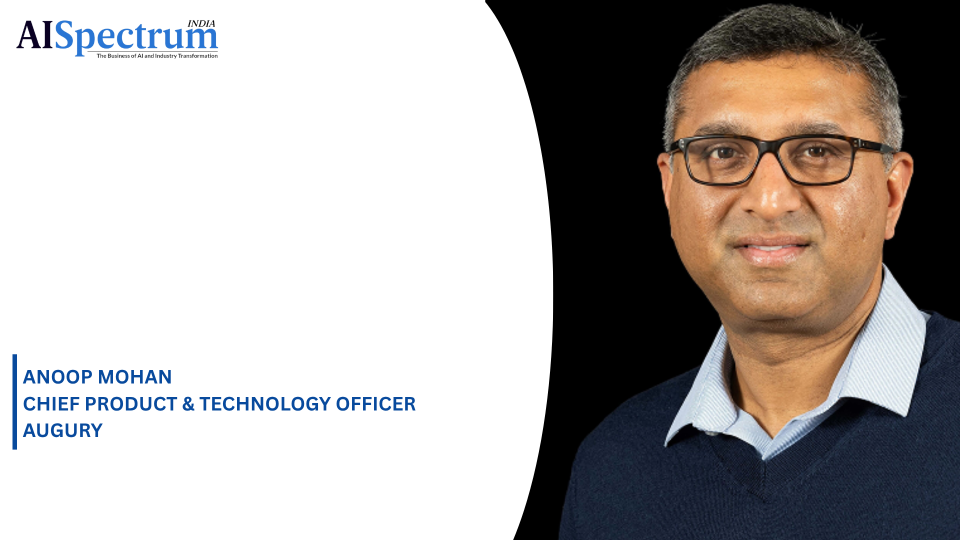
In this interview with AI Spectrum, Anoop Mohan, Chief Product & Technology Officer, Augury, discusses how agentic AI is transforming industrial operations, the role of contextual intelligence in improving AI reliability, and the safeguards required to ensure human oversight and accountability. He also explores the challenges of integrating AI with existing manufacturing systems, measuring enterprise-level returns on AI investments, and the technological developments that will shape the next phase of industrial AI adoption.
From predictive maintenance to Agentic AI: How does Augury’s Industrial AI Workforce differ from conventional machine-monitoring and predictive maintenance systems in terms of reasoning, decision-making, and executing actions? What level of autonomy can these AI agents currently achieve in industrial environments?
For years, industrial technology has been very good at identifying problems. Sensors detect anomalies, predictive maintenance systems flag potential failures, and dashboards tell teams what is going wrong. But there is still a big gap between knowing something is wrong and fixing it. Engineers can spend hours, sometimes days, finding the root cause and deciding what to do next.
That is the gap we are focused on closing.
Augury is building a trusted Industrial AI Workforce: agents for manufacturing that move beyond monitoring to reasoning, decision-making and action. Predictive maintenance is where we started, and it remains a strength. But the bigger opportunity is the process itself. Most plant value is won or lost in yield, quality and throughput, and that means reasoning across process, quality and production data, not just vibration signals. Each key role in the plant, starting with reliability engineers, process engineers and operations supervisors, gets its own AI agent built around the job they do.
Our Operations Agent works with process engineers and operations teams. It brings together historians, MES and quality data, spots process drift before it hits yield, traces problems to their root cause and recommends setpoint changes. Our Reliability Agent does the same for asset health: it investigates a machine alert, compares it with past failures and recommends next steps. The Reliability Agent asks, “Is my machine healthy?” The Operations Agent asks, “Why is my yield dropping, and what do I do about it?”
We also meet customers where they are. Customers who want outcomes on day one use our ready-made, outcome-driven agents. Customers who want to build their own use our Industrial Context & Trust Agent, or ICTA. It is the same context and trust layer our own agents run on, and teams can use it to build agents for energy, supply planning or anything else.
On autonomy, our principle is simple: agents recommend, and people act. Today, our agents investigate, diagnose and recommend, and plant teams approve what happens next. Where a customer agrees on bounds in advance, the Operations Agent recommends setpoint changes within those limits. Autonomy is earned step by step, as agents build a track record.
The future is not about removing people from industrial operations. It is about giving every engineer and operator the expertise of their best colleague, on demand.
Data quality and AI reliability: Industrial AI systems rely on machine sensor data, operational histories, and contextual engineering knowledge. How does Augury combine these data sources to generate reliable recommendations, particularly when data is incomplete, noisy, or inconsistent across manufacturing facilities?
The biggest challenge in industrial AI is not a lack of data. Manufacturers have collected machine and process data for decades. The problem is that it sits in disconnected systems, and much of the knowledge needed to interpret it exists only in the minds of experienced operators and engineers.
Telemetry tells you what a machine is doing. Your people know why, and what counts as normal. That human knowledge is often the most valuable data in the plant, and the least captured.
That is why we built a human-readable context graph. It connects sensor data, process data, operating procedures, engineering drawings and operator know-how into one map of the plant: its assets, its signals and how they relate. We capture tribal knowledge from shift handover notes, emails and, soon, quick voice notes on the floor. Each insight records who said it, their exact words and who confirmed it.
Here is a simple example. Sensor data alone might suggest that a pump tripped because of a failing seal. But an experienced operator knows that a brief pressure dip on a cold start is normal and clears in about 90 seconds. With that note in the graph, the answer changes from “replace the seal” to “likely a nuisance trip; check the trip delay.”
Everyone builds a knowledge graph, but a web of nodes and edges means little to the people who run the plant. So we gave ours a human interface: the Process Wiki. It reads like a book about the plant, written in plain English, with chapters on its equipment, its signals, how material flows and how the process behaves under different conditions. Plant managers and experts can read it, review it and correct it. When they edit a page, they are editing the graph itself, and every agent learns from the change.
The same structure handles messy data. Every claim carries its source, a confidence level and a review status. If a reading is stale, the agent’s answer is marked advisory rather than acted on. When sources disagree, the system flags it instead of guessing. If the drawing places a sensor in one spot and the historian in another, the conflict goes to a named expert, and agents don’t treat it as fact until it is resolved.
The same approach works across facilities. Because every site is described in the same structure, knowledge confirmed at one plant can be compared with, and reused at, another, instead of starting from scratch each time.
We built this on an open standard. Augury created OKF-I, the industrial profile of Google’s Open Knowledge Format. It structures assets, process relationships, operator heuristics and the rules for when data can be trusted, so that plant knowledge is not locked inside any one vendor’s system.
The objective is to make AI understand how a particular plant operates, rather than expect a generic model to work it out from raw data alone.
Human oversight and safety: As AI agents become more capable of recommending or initiating actions on the factory floor, how does Augury ensure human oversight, traceability, and accountability? What safeguards prevent an AI system from making decisions that could compromise equipment safety or disrupt production?
Trust is earned on the plant floor. You cannot introduce an AI agent and expect an operator to hand over decisions that affect production or safety. Autonomy has to be earned through demonstrated reliability, transparency and control.
That is why we built a trust layer that sits beneath every agent, whether it is ours, the customer’s or a partner’s. It applies a few simple rules to every answer:
Every answer shows its source. People can see what data the agent used, which operating relationships it considered and whose expertise informed it.
Only confirmed knowledge counts as fact. Agents can propose new findings, but these stay pending until a plant expert confirms them.
Uncertain information means advice, not action. If a reading is stale or sources disagree, the answer is downgraded to advisory and the conflict goes to a named reviewer.
Agents recommend; people act. Customers set the thresholds, approval requirements and safety limits that agents work within. Operating limits stay in the control system, where they belong.
An AI answer nobody can check is a liability on a plant floor. Our Process Wiki makes the reasoning checkable. Engineers can trace each recommendation back to the knowledge behind it and correct anything that is wrong.
We see autonomy evolving in stages. At first, people review every recommendation. As agents build a track record, manufacturers can authorize them to handle specific tasks within defined bounds. Oversight then shifts from approving each action to monitoring performance and exceptions.
Humans remain accountable, while agents progressively take on more of the work. The goal is a trusted Industrial AI Workforce that gives people the confidence to delegate, knowing they stay in control.
Measuring enterprise value: Manufacturers often struggle to translate AI pilots into measurable, large-scale business outcomes. What metrics does Augury use to assess the impact of its Industrial AI solutions on unplanned downtime, equipment performance, energy efficiency, and maintenance costs? Could you share examples of outcomes achieved by customers?
We always start with the business problem, not the technology. The first question we ask a manufacturer is: what is the biggest operational challenge you are trying to solve?
For one plant, that is unplanned downtime. For another, it is poor yield, quality losses, a maintenance backlog or limited capacity. The metrics have to match the problem.
We typically measure equipment uptime, mean time to repair (MTTR), maintenance productivity, production yield, throughput, quality and waste. Where relevant, we also measure energy efficiency and maintenance costs.
The shift is from measuring how many alerts a system generates to measuring how much operational value it creates. A Reliability Agent should cut the time spent investigating failures. An Operations Agent should help process engineers find the root cause of yield losses and fix them.
Our Operations Agent is now in production with enterprise customers and expanding across both our existing base and new accounts. The reason is simple: yield, waste and product quality matter to almost every manufacturer we speak with. They are the KPIs that move margins, and they are exactly where the Operations Agent focuses. We’ll be able to share specific customer results in the coming weeks.
Scale matters too. Augury has monitored more than 1.1 billion machine hours across 800+ plants for more than 170 manufacturers. This quarter, our Reliability Agent is rolling out across those plants, bringing agentic AI to an installed base, not just a pilot.
The path to scale is applied AI. Our forward-deployed engineers work alongside customers to understand their environment, implement the technology and adapt it to their needs. The focus is on proving value and return on investment, not on completing a deployment.
Ultimately, success is measured by what changes on the factory floor: fewer disruptions, better asset performance, higher yield and more productive teams.
Integration with industrial technology ecosystems: How does Augury integrate its AI capabilities with existing manufacturing systems, such as industrial IoT platforms, enterprise asset management systems, manufacturing execution systems, and operational technology infrastructure? What are the biggest technical barriers to deploying agentic AI across legacy industrial environments?
Manufacturers don’t need another system that creates another data silo. They need technology that works with what they already have.
Most plants run a mix of sensors, historians, manufacturing execution systems, ERP platforms and maintenance management systems. Each holds part of the operational picture. The opportunity is to connect that information and make it useful within the workflows people already follow.
We connect to those systems where they are. That includes OPC UA and OPC DA servers, historians such as AVEVA PI, relational and cloud databases, and business systems such as SAP, Fiix and MaintainX. Customers can also push data to us in batches or as real-time streams, through SFTP, Google Cloud Pub/Sub or Azure Event Hubs. Our platform is not tied to our own hardware: it works with third-party sensors and gateways as well as Augury’s.
Just as important, we link to systems of record and never copy them. Operating limits stay in the control system, and data stays where it lives. The platform runs as SaaS or in the customer’s own Azure or Google Cloud tenant.
On top of those connections sits ICTA, our Industrial Context & Trust Agent.. It is built on OKF-I, our industrial profile of Google’s Open Knowledge Format. Over the open Agent2Agent (A2A) protocol, any agent can use the same trusted context: our agents, the customer’s own agents and partner agents, with no custom integration for each one. Customers can take our ready-made agents or build their own on ICTA.
Partnerships make this real. With Rockwell Automation, our agents feed Fiix work orders and FactoryTalk Optix operations, which turns a diagnosis into scheduled work. With AVEVA, we combine PI historian data with our machine data for sharper diagnostics. And the Industrial AI Workforce runs on Google Cloud, with Gemini as a core reasoning engine.
The technical barriers are real: fragmented data, inconsistent information across systems, legacy infrastructure and strict security requirements. But the answer is not to rebuild the factory’s technology stack. It is to add a context layer that connects the systems, understands how they relate and lets agents work within existing operational and governance frameworks.
No single company can own every layer of the industrial AI stack. The companies that combine advanced AI, industrial expertise and established ecosystems will drive adoption at scale.
The next phase of industrial AI: As large language models and agentic architectures evolve, what technical breakthroughs are still needed to make industrial AI more context-aware, explainable, and dependable? How does Augury see the balance between domain-specific AI models, general-purpose models, and human industrial expertise evolving over the next few years?
The next era of AI will be defined by application. The last few years were about building more capable models. The next few will be about applying them to real-world problems where context, complexity and consequences matter, and manufacturing is one of the most demanding of those environments.
A general-purpose model may understand what a pump does. It does not know how that specific pump behaves in a particular process, what normal looks like on a cold start, or what happens when you change a process parameter. So the breakthroughs still needed are less about model size and more about three things.
The first is context. AI needs a model of how a particular plant works: its assets, how they connect, what influences what, and the know-how of the people who run it. It also has to be in a form those people can read. Our context graph has a plain-English interface, the Process Wiki, which reads like a book about the plant. Experts review and correct it, and every edit updates what the agents know.
The second is explainability. Every answer should show its source: which data, which relationships and whose expertise. An answer nobody can check is a liability on a plant floor.
The third is dependability. Systems need rules for when information can be trusted. A stale reading should make an answer advisory, not actionable. When sources disagree, the conflict should go to an expert instead of being guessed. Open standards such as OKF-I matter here, because they keep that knowledge portable rather than locked inside one vendor’s system.
On the balance, I see three layers working together, each doing what it does best. General-purpose frontier models provide reasoning and language, and they get better every year. Domain-specific models handle the quantitative work: detecting drift, predicting failures, forecasting yield. The frontier model itself can choose and tune the right one for each customer’s process, instead of a team hand-picking it. Human expertise is the ground truth that validates the knowledge everything else depends on.
Over the next few years, models will become more of a commodity, and trusted context will become the differentiator. People’s role will shift from digging through data to teaching and verifying the system, so that a new engineer can draw on what a 20-year veteran knows from day one.
The future of manufacturing is humans and AI working together, with a trusted Industrial AI Workforce helping people do more, solve problems faster and push the boundaries of human productivity.