

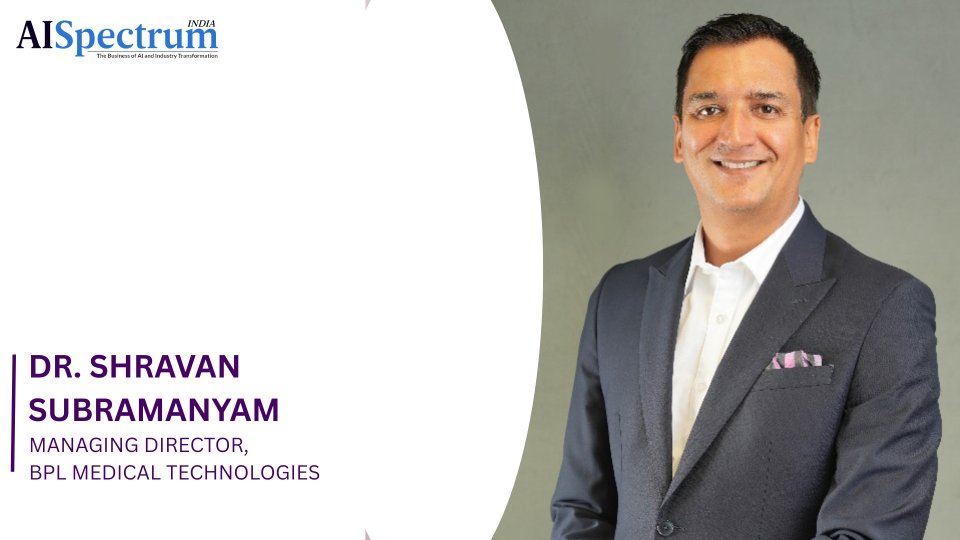
Artificial intelligence is playing an increasingly pivotal role in expanding access to diagnostic healthcare, especially in regions where specialist resources remain limited. With the launch of India’s first AI-integrated smart mobile cancer screening bus, BPL Medical Technologies aims to bring advanced imaging and AI-driven decision support directly to communities that need it most. In conversation with AI Spectrum Dr Shravan Subramanyam, Managing Director, BPL Medical Technologies, the company explores how AI embedded within digital radiography and mammography systems is improving screening workflows, supporting clinical triage in low-resource environments, and shaping the future of scalable, technology-driven preventive healthcare.
BPL Medtech describes this as India’s first AI-integrated smart mobile cancer screening bus. Could you elaborate on the specific AI capabilities embedded within the digital radiography and mammography systems?
BPL Medtech has embedded AI directly into the 5KW Digital Radiography (X ray) system and the digital mammography workstation. The AI analyses images immediately after exposure and generates an instant preliminary report with clinical findings. Trained on millions of clinical images, it triages scans as normal or abnormal and highlights suspicious areas for further review. Images and reports can be shared remotely with clinicians through PACS, cloud, or PDF formats, enabling screening without requiring a radiologist on site.
How does the AI layer enhance diagnostic accuracy and workflow efficiency compared to conventional mobile imaging units?
The AI layer, developed using millions of referral images, delivers accuracy of over 96 per cent and significantly improves workflow efficiency. In conventional mobile units, a radiologist must review each scan, which limits scale in mass screenings. Here, technicians can conduct screenings while AI prioritises abnormal cases for expert review. This allows radiologists to focus on high risk patients, reduces reporting time, and enables a larger number of people to be screened in remote settings.
In low-access or rural settings where specialist radiologists may not always be available, how does the AI system support clinical decision-making and triage?
In areas where radiologists are scarce, the AI system functions as a frontline decision support tool. It instantly categorises cases, generates reports, and flags suspicious findings. Technicians can send abnormal cases along with AI-generated reports to clinicians for remote opinion. The X-ray system stores images locally, while mammography data is stored on the cloud, ensuring continuity of care even with connectivity challenges.
Has the AI platform been trained on India-specific datasets to account for demographic and epidemiological variations, and how important is localisation in such deployments?
Yes, the AI platform has been trained on India-specific patient datasets to reflect local demographics, disease patterns, and clinical variations. Localisation is essential to ensure accuracy and reliability across diverse populations, making the system more effective for screening programmes within the country.
Looking ahead, do you envision AI-enabled mobile diagnostic units becoming a scalable national model for preventive healthcare? What technological advancements would further strengthen this approach?
AI-enabled mobile diagnostic units have the potential to become a scalable national model for preventive healthcare if integrated with public health programmes, digital health infrastructure, and sustainable financing. India already operates more than 1,400 government-supported mobile medical units under the National Health Mission, reaching remote populations across India. Evidence from deployments in Delhi, Tamil Nadu, and Odisha shows that mobile clinics reduce access barriers and improve screening coverage. Future advances, such as more on-device AI, affordable point-of-care diagnostics, seamless digital integration, longitudinal risk tracking, and offline multilingual applications, will further strengthen this approach over the next decade.
What data infrastructure supports the mobile unit, particularly in terms of image processing, cloud connectivity, cybersecurity, and patient data privacy?
All image processing is performed entirely on the device, without reliance on external computing resources. The system is designed to operate in a fully air-gapped mode with no cloud connectivity, ensuring consistent performance even in remote or low network environments. Patient data is encrypted at rest within the device, and there are no external data transmission pathways. By eliminating data egress points, the architecture significantly reduces cybersecurity risks and strengthens compliance with healthcare data privacy requirements, making the unit suitable for sensitive clinical deployments in the field.