

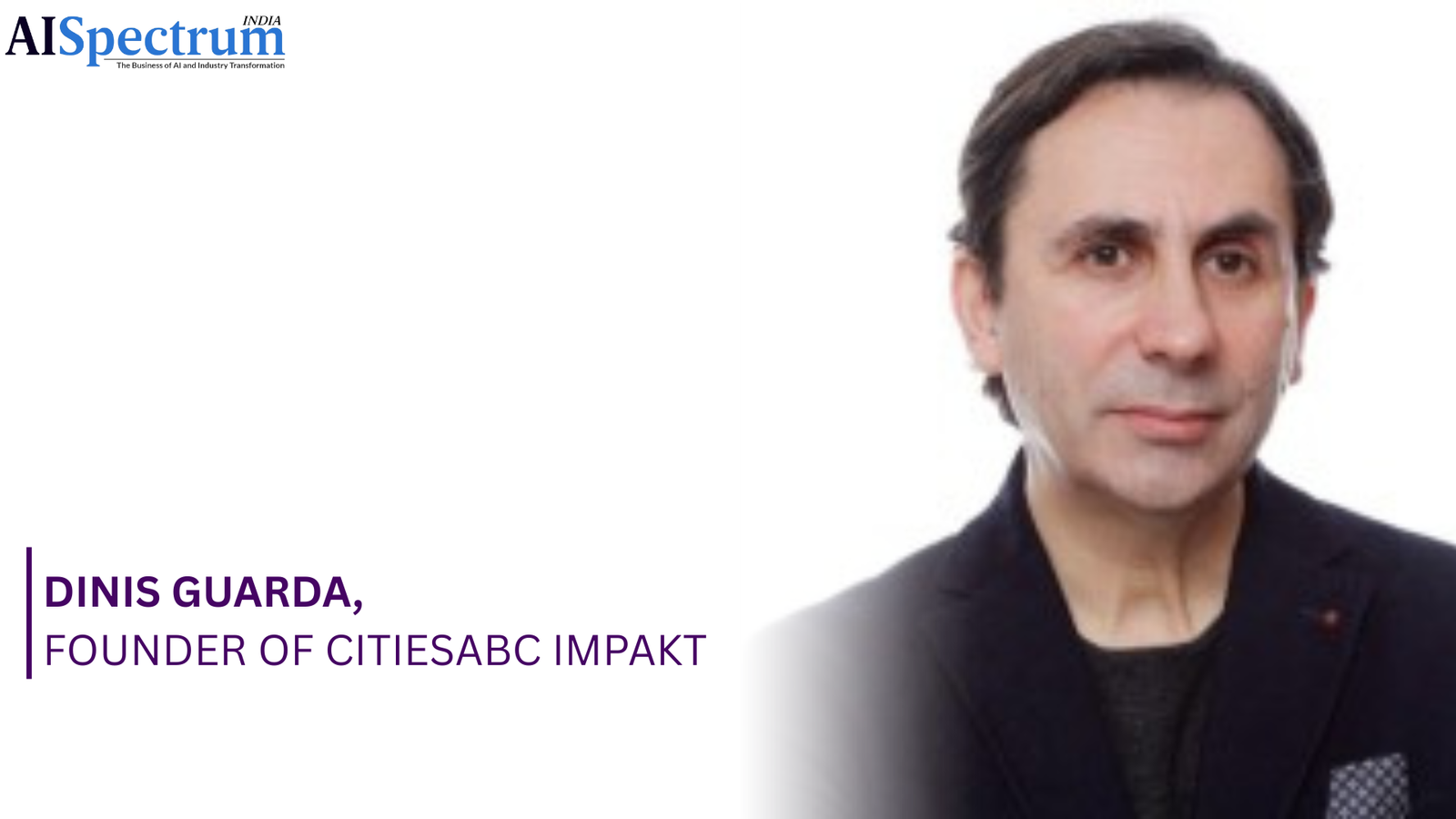
As artificial intelligence reshapes industries worldwide, agriculture, long treated as fragmented, informal, and analogue, is undergoing a quiet but profound transformation. At the centre of this shift is Dinis Guarda, a global thought leader in AI, blockchain, and digital public infrastructure, and the Founder of Citiesabc Impakt.
Citiesabc Impakt is not positioning itself as another agri-tech platform, but as a system-level Agriculture-as-a-Service (AaaS) operating framework designed to function as a national digital backbone for food security, climate resilience, financial inclusion, and sustainable growth. By unifying farmer identity, sovereign AI, climate intelligence, finance, carbon markets, education, and policy intelligence into a single interoperable layer, the platform reimagines agriculture as critical national infrastructure in the AI era.
In this conversation with AI Spectrum, Dinis Guarda explains why fragmented agri-tech solutions are failing farmers and governments, why verified digital farmer identity is foundational to inclusion and trust, how sovereign AI architectures protect data and national interests, and how sustainability and carbon economics are redefining the future of farming across India, Indonesia, Africa, and beyond.
This interview explores how agriculture is evolving from a sector into a digital nervous system for rural economies and why AI is becoming the operating system of global food systems.
Citiesabc Impakt positions itself as a system-level AaaS platform rather than a standalone agri-tech solution. What gaps prompted this approach and how does Citiesabc Impakt differ?
Most agri-tech platforms today solve fragments one for weather, another for loans, another for marketplaces, another for drones.
Farmers and governments are left managing a patchwork of disconnected tools that don’t share identity, data trust, payments, or intelligence.
This fragmentation creates five systemic failures:
Farmers remain unbanked and uninsurable
• Governments lack real-time agriculture intelligence
• Climate risk remains unmanaged
• Carbon and ESG value is lost
• Markets remain inefficient and exploitative
Citiesabc Impakt was designed as a national agriculture operating system — not a product.
It unifies identity, finance, intelligence, marketplaces, education, carbon, and climate infrastructure into one sovereign digital layer.
It is the difference between:
“An agriculture app”
and
“A digital nervous system for national food security and rural economies.”
Why is verified digital farmer identity (iDNA) critical?
Because identity is the missing key to financial inclusion, intelligence and trust.
In emerging economies, farmers are invisible to banks, insurers, markets and governments.
No identity → no credit → no insurance → no climate protection → no market power.
iDNA converts every farmer into a verified digital economic actor.
Once a farmer has iDNA, they instantly gain:
A digital wallet
Credit & subsidy eligibility
Insurance access
Carbon credit rights
Market price intelligence
AI advisory
Education & skills profiles
This transforms millions of informal farmers into formal digital citizens of the agricultural economy.
How do you balance AI intelligence with data sovereignty?
Citiesabc Impakt is built on sovereign AI architecture.
We do not centralise or extract national data.
Each country operates its own national AI agriculture stack built on AI.DNA + Blocksdna.
This ensures:
Data residency compliance
Local model training
Government control over policy intelligence
Regulatory alignment
Secure cross-border market corridors only when allowed
AI becomes a public infrastructure layer, not a private extraction engine.
This is critical because agriculture is now a matter of national security, climate resilience and food sovereignty.
How is the platform localized across India, Indonesia and Africa?
Localization is not cosmetic — it is structural.
Each country receives:
Local-language AI advisors
Crop-specific AI models
Climate & soil-based prescriptions
Cooperative-based onboarding
Local finance & subsidy rails
Local education & agronomy institutions integrated
We localize the AI itself, not just the interface.
So in Indonesia, the system is built around cooperative economies and carbon farming.
In Maharashtra, India — precision farming, weather risk, and education are core.
In Africa — financial inclusion, climate resilience, and market access are primary.
How does sustainability & carbon reshape agriculture economics?
We are entering the era of carbon-positive farming economies.
With AI-driven ESG verification:
Farmers earn from carbon credits
Governments track sustainability in real time
Banks price climate risk accurately
Subsidies become performance-based
New green financing flows open
This turns sustainability from a cost into a new income engine for farmers and nations.
Agriculture becomes not just food production — but climate infrastructure.
What are the biggest challenges in scaling B2B2C2G globally?
The biggest challenges are:
Trust
Data coordination
Financial interoperability
Regulatory diversity
Institutional fragmentation
AI becomes the orchestration layer.
It manages:
Identity verification
Climate intelligence
Market pricing
Subsidy distribution
Carbon verification
Cooperative coordination
Financial risk modelling
AI is no longer just analytics — it has become the operating system of rural economies.
Closing Statement
Citiesabc Impakt is a digital transformation first platform that aims to create solutions. We are not an agri-tech startup.
It is a global digital public infrastructure framework for agriculture, designed to deliver food security, climate resilience, financial inclusion and sustainable growth at national scale.
This is how agriculture enters the AI economy.