

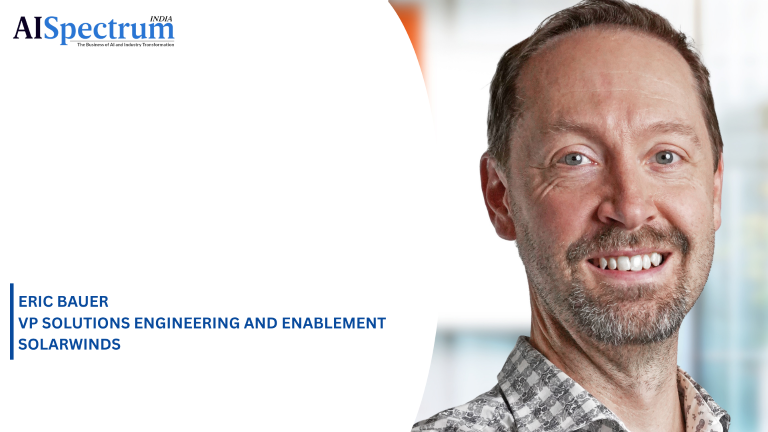
As enterprises increasingly navigate complex hybrid IT environments, the emergence of agentic AI is creating new opportunities to move beyond conventional IT monitoring and automate mission-critical operations. SolarWinds is advancing this shift with Avior, a goal-oriented agentic AI system designed to coordinate specialised AI agents, address operational challenges and drive measurable outcomes across IT environments. With capabilities spanning incident management, configuration drift remediation, compliance monitoring and IT capacity management, Avior combines autonomous execution with human oversight, security controls and auditability. In this interview with AI Spectrum, Eric Bauer, VP, Solutions Engineering and Enablement, SolarWinds, discusses how Avior differs from traditional AI-powered IT operations tools, the role of deterministic execution and risk-tiered autonomy in building enterprise trust, and the company's roadmap for delivering measurable business value through agentic AI.
Avior is positioned as a goal-oriented agentic AI system for mission-critical IT environments. How does its approach differ from conventional AI-powered IT operations tools, and what role do specialized agents play in achieving end-to-end operational outcomes?
Conventional AI-powered IT tools can summarize alerts or suggest next steps within a product, but teams still have to decide what to do and coordinate the work. Avior is designed to work towards an operational goal: it assesses the situation, coordinates work across the IT environment, and tracks progress through to an outcome.
Specialized agents handle defined tasks, such as bringing related events into one incident, checking devices against policy, identifying and correcting configuration drift, or monitoring utilization and spend. Drawing on operational data and enabled third-party integrations, they can help teams address issues across products and environments, not just respond to isolated alerts
Enterprise adoption of agentic AI often raises concerns about reliability, unpredictable actions, and accountability. How does Avior’s deterministic execution framework and risk-tiered autonomy help address these challenges while enabling AI agents to act across hybrid IT environments?
In mission-critical IT, teams need to know what goal an AI system is pursuing, what it can do and when a person must step in. Avior combines AI with a deterministic execution framework, so agents work towards predefined goals within guardrails, approval controls and auditable workflows.
Risk-tiered autonomy lets organizations set the level of independence for each task. Lower-risk work can proceed within configured controls, while potentially dangerous actions require human approval. Avior is also designed to explain its reasoning, track progress and keep audit trails. Actions inherit the initiating user’s permissions, and least-privilege access limits agents to the tools they need.
SolarWinds highlights use cases such as reducing alert noise, remediating configuration drift, monitoring compliance, and managing IT capacity. What measurable improvements can organizations expect in areas such as downtime, incident resolution, operational costs, and engineering productivity?
At launch, Avior is designed to reduce time spent sorting alerts, help engineers investigate issues more efficiently, and cut repetitive configuration and compliance checks. These are just a few examples within Avior’s goals. They are a starting point, not the limit of our ambition: we have significant plans to expand Avior’s capabilities well beyond the initial launch.
Results will vary with each organization’s infrastructure, processes, and goals, so we wouldn’t promise a universal reduction in downtime or resolution times without validating outcomes in customer environments. We recommend measuring impact against a pre-deployment baseline using indicators such as alert volume, mean time to resolution, repeat incidents, and manual effort.
Avior incorporates human approval for potentially risky actions, granular audit trails, data masking, and least-privilege tool access. How has SolarWinds designed these safeguards to balance agent autonomy with security, transparency, and human oversight?
Avior’s safeguards apply throughout an agent’s workflow. Organizations can set autonomy controls for different tasks, and potentially dangerous actions require explicit human approval. Tool access follows least-privilege principles, while actions inherit the permissions of the user who initiated them.
For self-hosted environments, a dedicated Avior connection securely links the environment to the SolarWinds Platform. This is distinct from Platform Connect as it exists today, and data moves through the dedicated Avior connection rather than directly to a model. Data is masked, and customer data isn’t used to train underlying models.
Avior is also designed to explain its actions, track goals, and keep granular audit trails. Automated rollback can help teams reverse an action when needed.
Many enterprises operate complex IT estates comprising legacy infrastructure, cloud platforms, and multiple monitoring and management tools. How does Avior integrate across different products and environments, and what challenges should organizations address before deploying agentic AI at scale?
Avior is designed as a standalone software solution that supports a broad set of environments from legacy infrastructure to advanced cloud workflows, meeting customers where they are today. It uses operational context across networks, systems, applications, databases and cloud, and can work with enabled SolarWinds and third-party integrations, including systems connected through Model Context Protocol.
Before scaling up, teams should choose the operational goals to address first, confirm the needed data and integrations are available, review permissions, set autonomy and approval levels, and define policy baselines and audit processes. Starting with bounded tasks – such as alert correlation or configuration checks – helps teams evaluate performance before expanding. Measures might include triage time, compliance, time to resolve drift, capacity-related incidents and staff time spent on routine work.
Looking ahead, how does SolarWinds plan to evolve Avior’s capabilities, and what milestones will demonstrate that agentic AI is delivering sustained business value rather than simply automating individual IT tasks?
Avior will evolve beyond its initial launch goals, with the roadmap expanding to include integrations across SolarWinds and third-party tools, adding more specialized agent profiles and giving teams more flexibility to tailor goals to their environments. The aim is to help teams pursue measurable operational outcomes across their estates, rather than simply automate individual tasks; timing and availability will depend on release plans.
Sustained value will be demonstrated by progress against a baseline and target over time, with evidence that goals are being achieved and verified. Avior’s goal scorecards and value ledger are intended to make that progress visible through measures such as alerts reduced, improvements in mean time to resolution, hours saved, and time saved gathering audit evidence.