

As enterprises move beyond AI experimentation to production-scale deployments, the focus is shifting from the number of pilots launched to the measurable business value AI delivers. Reliable integration with enterprise systems, continuous evaluation, security and governance are becoming critical to scaling AI across complex workflows.
Against this backdrop, KnackLabs has been named an OpenAI Select Partner, strengthening its focus on helping enterprises translate frontier AI capabilities into production-grade applications and automation solutions. The company, which has deployed AI systems at scale and shipped more than 15 billion conversations, is also expanding its focus on agentic AI and enterprise automation across areas such as customer support, finance, procurement, IT and research.
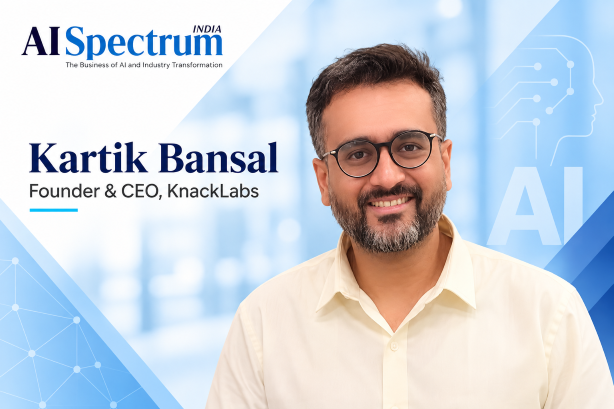
In this interview with AI Spectrum, Kartik Bansal, Founder & CEO of KnackLabs, discusses the significance of OpenAI Select Partner status, the challenges enterprises face in moving from AI pilots to reliable production deployments, and the safeguards required for agentic AI. He also shares insights into measuring AI-driven business outcomes, leveraging frontier AI capabilities for complex enterprise use cases, and the opportunities emerging across the Middle East and UAE as organisations accelerate their AI adoption.
KnackLabs has been named an OpenAI Select Partner. What does this partnership mean for the company’s enterprise AI strategy, and how will it change the way you help organizations adopt and scale AI?
Becoming an OpenAI Select Partner is an important milestone for KnackLabs. It strengthens what we have been building: the ability to turn frontier AI capabilities into reliable systems that solve real enterprise problems.
Our strategy has always centred on moving enterprises beyond experimentation. They need AI that understands their business context, works with existing systems, executes workflows and delivers measurable outcomes. Our role is to bridge frontier models and production-grade applications.
The partnership brings our teams closer to OpenAI's engineering and product ecosystem, so we can evaluate and apply new advances faster. Our experience deploying AI in complex enterprise environments then tells us where those capabilities create real value. The goal is to help enterprises put AI to work.
You have highlighted the experience of deploying AI systems in production and shipping more than 15 billion conversations. What are the key challenges enterprises face when moving from AI experimentation and pilots to reliable, production-grade deployments?
The biggest gap is between showing AI can do something and engineering it to do so reliably and at scale.
A pilot can succeed with narrow data, a few users and heavy human oversight. In production, the system has to handle imperfect data, edge cases, latency, integrations, security, shifting business rules and millions of interactions.
The challenges are organisational too. AI cuts across functions, and a technically successful pilot can still fail if nobody owns the workflow after launch.
Over 15 billion conversations have taught us to design for this from day one. AI behaves differently depending on context, so evaluation has to be continuous, measuring quality and catching failures early. The real work is engineering the system around the model.
Enterprise agentic AI is becoming a major focus for organizations. Which business processes or workflows do you see as having the greatest potential for agentic AI, and what safeguards are necessary before deploying autonomous or semi-autonomous systems at scale?
The greatest potential lies in repetitive, information-heavy workflows that span multiple steps or systems: customer support, procurement, sales and finance operations, IT service management and enterprise research. Much of that work involves gathering information, moving between systems and taking routine actions. Agentic AI can reason across those steps, use enterprise tools and handle parts of the workflow itself.
But autonomy has to be earned. Once an agent's actions carry financial, operational, legal or reputational consequences, enterprises need clear limits on what it can access and do independently, when it needs human approval and how each action is logged. Identity and access controls, monitoring, data security and human-in-the-loop checks are fundamental. The aim is useful autonomy, with the enterprise in control.
How is closer access to OpenAI’s engineering and frontier AI capabilities expected to influence KnackLabs’ ability to develop enterprise automation solutions, particularly for complex or model-dependent use cases?
The biggest advantage is speed of learning and iteration.
Frontier AI is moving fast. Being closer to OpenAI's engineering ecosystem lets our teams understand new capabilities earlier and test them against real enterprise problems.
That matters most in complex use cases, where the model has to reason over enterprise context, use tools, work across multiple steps or run inside a larger automated system.
Better models are only part of the answer. The hard work usually sits around the model: data architecture, workflow design, integration, security, evaluation and deployment. That is where our experience counts. The partnership tightens the feedback loop between what's possible at the model layer and what enterprises need from their applications.
AI adoption is increasingly being measured by business outcomes rather than the number of AI pilots launched. How does KnackLabs assess the return on investment and measurable impact of AI deployments for its enterprise customers?
We start with the business problem. Before designing anything, we work out what the current process costs the organisation in time, people, errors, delays or lost revenue. That gives us a baseline to measure impact against.
The metrics depend on the use case: handling time, resolution speed, throughput, conversion, operating cost, accuracy or employee capacity freed for higher-value work. If an AI system automates hours of manual review, we ask what happened to the economics of that process.
Measurement also continues after launch, because performance shifts as data, workflows and user behaviour change.
For us, AI maturity shows in how many business processes have materially improved through AI, and whether that improvement can be proven in numbers.
KnackLabs is expanding its presence across the Middle East and UAE. What opportunities do you see in these markets for enterprise AI, and which sectors or use cases are likely to drive the next phase of the company’s growth?
The Middle East, and the UAE in particular, combines ambition, strong digital infrastructure and an appetite for new technology across enterprise and government. The UAE also treats AI as a national and institutional priority, so organisations are asking how AI fits into their operating model.
We see the most potential in complex operational workflows across financial services, government and public infrastructure, logistics, real estate, energy and large enterprises.
For KnackLabs, this is a natural extension of our work in India. The approach is the same: work with enterprises to identify high-value workflows, build the right AI systems around them and take them into production. The next phase of enterprise AI belongs to those who can operationalise it at scale.