

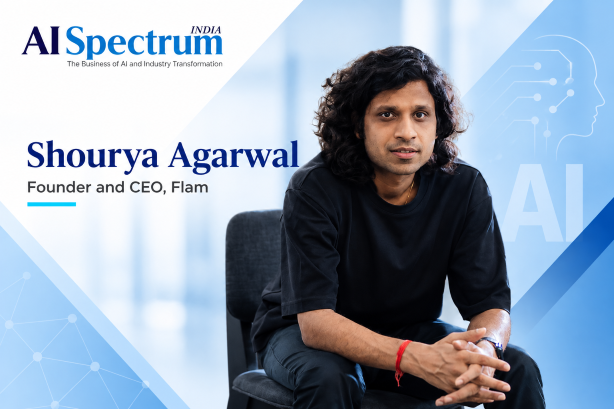
As enterprises look beyond conventional static and linear content, artificial intelligence is enabling a shift towards interactive experiences that respond to users in real time. Flam is developing an AI-powered platform that combines interactive video, 3D content and visual agents to enable brands and enterprises to create more responsive and personalised digital experiences.
The company’s technology stack includes proprietary AI models such as Fable, Fantom and Falcon, alongside its Finesse speech synthesis engine. These technologies support applications ranging from interactive product visualisation and brand storytelling to conversational AI agents, with a focus on reducing latency and enabling real-time engagement across digital and physical environments.
In this interview with AI Spectrum, Shourya Agarwal, CEO of Flam, discusses the technology behind Flam’s interactive content platform, the role of its proprietary models in powering 3D experiences and visual agents, and the engineering challenges involved in delivering low-latency multilingual AI interactions. He also shares insights into enterprise adoption, AI-driven content creation and how interactive experiences can provide organisations with richer consumer engagement data.
Flam describes its platform as enabling a shift from passive to interactive content. What are the key AI and technology breakthroughs that have made real-time, interactive content scalable for enterprise use?
Flicks: interactive video
Flicks change based on what the viewer taps, and they play with effectively zero latency, so the interactivity does not cost the viewer a loading screen. That comes from a patented AI compression method that merges multiple variations of a single piece of content into one small file, so variants switch in under 10ms.
Flicks run in the standard video and display placements a brand already buys, starting at less than 50ms time to first buffer.
The Forge video editing model takes image references and changes only the specified element.
Flam’s technology stack includes proprietary models such as Fable, Fantom, and Falcon. Could you explain the distinct roles of these models and how they work together to power interactive videos, 3D experiences, and real-time Visual Agents?
Products and key tech/models behind them
Airboards: interactive 3D content on the camera
Airboards stream high-fidelity 3D content onto the phone's camera interface, with no app download required. Viewers interact through touch, voice and haptic feedback.
Fable builds those graphics from a text or image prompt, removing the traditional 3D asset pipeline from the process. It is the only image-to-video model that generates native alpha video.
Flam Streaming serves them at sub-300ms latency. Airboards can be opened from a digital placement or from physical media, so the format is channel-agnostic.
Visual agents: AI interactive characters. Visual agents see, listen, respond to users and take actions. They are hyperreal characters built for conversation, with an industry-leading response time of under two seconds.
Fantom handles identity preservation and motion transfer, holding a likeness consistently while the character moves and speaks, and generating accurate lip sync and natural expression from a single image.
Falcon, a 26B mixture-of-experts LLM, drives answers and agentic actions at 30ms time to first token, the fastest available, and is specialized for Indic languages. It is the world's fastest and cheapest multilingual conversational LLM.
Finesse, a non-autoregressive multilingual speech synthesis engine with voice cloning. It produces 24 kHz speech in 60+ languages at approximately 300 ms streaming time-to-first-audio, at the same speed in every supported language.
With Falcon being a 26-billion-parameter Mixture-of-Experts LLM and delivering a 30-millisecond time-to-first-token inference, what technical challenges did Flam have to overcome to achieve low-latency AI interactions at scale?
Training the base model to adapt to all languages while keeping the core capabilities intact required a novel method of SFT; none of the known methods worked.
We had to iterate and engineer an SFT method capable of predicting a distribution of tokens rather than a single next token to make it work for multilingual use cases, conserving abilities like tool calling and agentic workflows.
Enterprises are using Flam across product visualization, brand storytelling, customer support, learning, and fan engagement. Which enterprise use cases are seeing the strongest adoption, and how is AI changing the way organizations approach content creation and customer engagement?
Flam is relevant to every industry because every organization already communicates through photos and videos. Anything a brand does with static images or linear video today can be done better with Flam: the same content, made interactive, so audiences can explore, tap, and choose what they want to see.
Product visualization, brand storytelling, customer support, learning, and fan engagement are the top categories today. Adoption is picking up especially fast in automotive, FMCG, financial services, consumer tech, and real estate.
AI is what makes this possible at scale. Interactive content used to require weeks of 3D, video, and development work. Now it can be created in hours, personalized for different audiences, and launched across markets at once.
Interactivity also gives enterprises something they have always struggled to get: direct consumer preference data. Every choice a viewer makes- which feature they explore, which variant they pick, what question they ask- is a signal of what they actually want. Traditional photo and video can only tell you whether someone watched. Interactive content tells you why they cared.
Flam states its platform can deliver content programmatically at runtime with a 300-millisecond time-to-first buffer. How does Flam approach AI inference, compression, and deployment to maintain responsiveness across different physical and digital environments?
We don't optimize for speed at the end. From the start, speed is a design requirement for everything we build, because interactive content only works if it feels instant. There is no single technique behind it. Each product has a different bottleneck, so we built a different solution for each one.
Flicks. Interactive video means loading and switching between video paths in real time as the viewer makes choices. To make that seamless, we built our own compression algorithm that compares frames and stores only the differences between them, which significantly reduces bandwidth. All assets for a Flick are also compiled into a single package, so when a viewer switches paths, the next segment is already there and the transition is instant.
Airboards. Traditional 3D experiences require downloading heavy models, textures, and animation files before anything appears on screen. We built 3D streaming, which packs these assets together and streams them in real time, the same way video streams. Users start interacting immediately instead of waiting for a download.
Visual Agents. For a conversation with an AI agent to feel natural, the response needs to arrive in under 1.2 seconds. In that window, the system has to run speech-to-text, inference, tool calls, text-to-speech, and video generation with lip sync and facial expressions, all while keeping answers accurate. Existing AI models are not optimized for that kind of speed, so we built fast, purpose-built models for each step of the pipeline.