

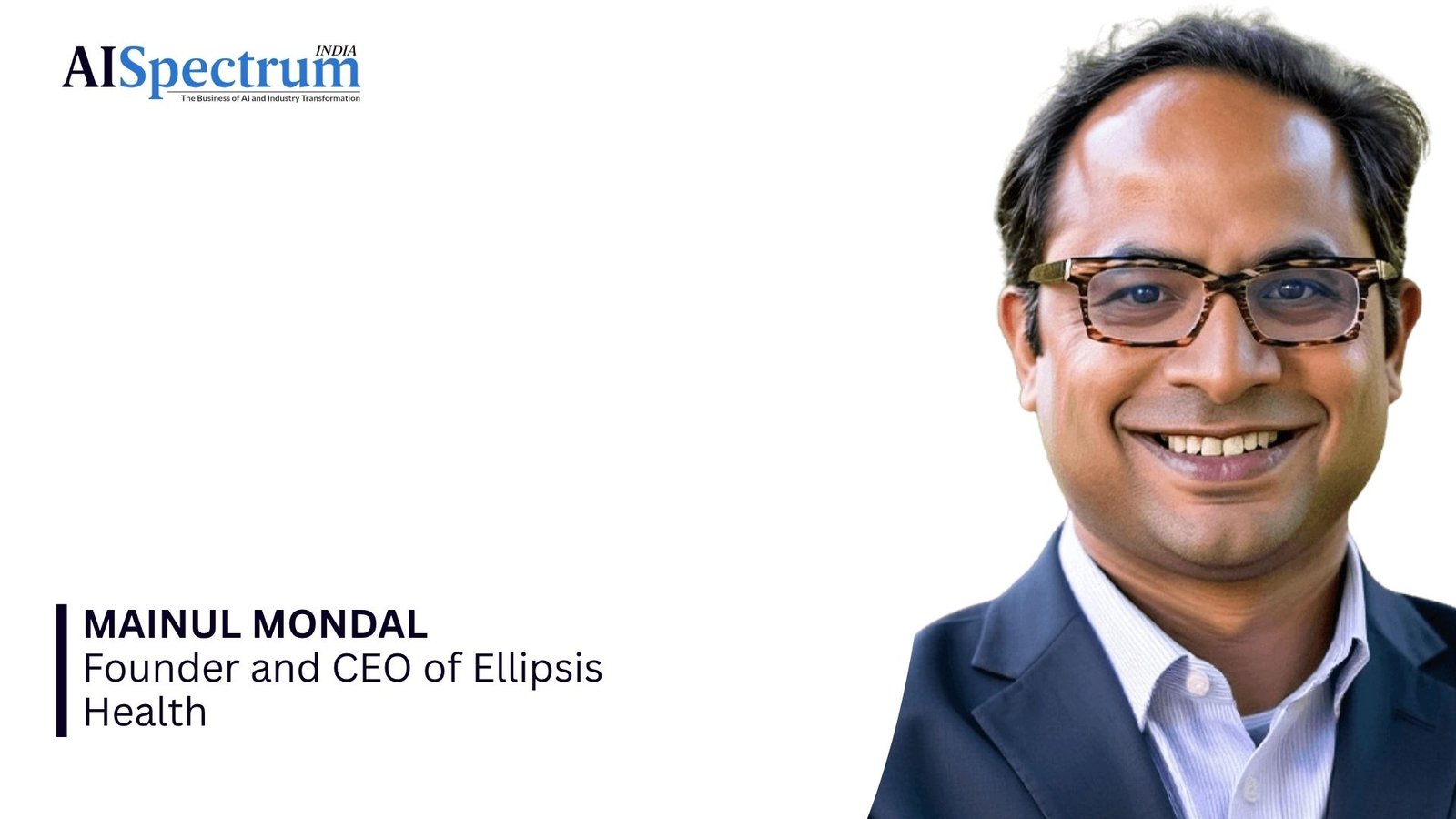
As healthcare organisations increasingly turn to artificial intelligence to improve efficiency and patient engagement, questions around empathy, trust, clinical validation, and real-world outcomes are becoming more critical than ever. In this exclusive interaction with AI Spectrum, Mainul Mondal, Founder and CEO of Ellipsis Health, shares his perspective on why much of today’s healthcare AI innovation is falling short of patient and provider expectations.
Drawing on nearly a decade of clinical research and millions of real healthcare conversations, Mondal explains how Ellipsis Health is building conversational AI solutions designed to operate within real clinical workflows while prioritising empathy, safety, and measurable patient outcomes. He discusses the growing importance of clinically grounded AI, the need for stronger validation standards, and how healthcare organisations can adopt AI technologies without compromising patient trust or human connection.
Mondal also offers insights into the future of conversational AI in care management, where emotionally intelligent and clinically credible systems could help health systems balance operational efficiency with more personalised, accessible care at scale.
You have highlighted a growing disconnect between what Silicon Valley is building and what healthcare stakeholders actually need. In your opinion, where is the current wave of healthcare AI innovation missing the mark?
The core problem is that most healthcare AI is optimised for reach rather than outcomes. Vendors celebrate how many patients they can contact, but getting someone on the phone is the easy part. What actually moves clinical and financial outcomes is engagement, trust, and follow-through. Most AI in healthcare today is fast and robotic, which is simply not acceptable when you are talking to a patient about managing a chronic illness or medication adherence. The industry has rushed to deploy technology without first doing the hard clinical science work, and the result is AI that may look impressive in a boardroom but fails patients in the moments that matter most.
Ellipsis Health operates within real clinical workflows alongside major insurers such as Aetna. Based on your experience, what differentiates AI solutions that succeed in healthcare environments from those that fail to gain adoption?
The solutions that succeed are built on clinical credibility and genuine empathy. Ellipsis spent eight years building clinical science before building a product, learning from over three million real clinical conversations to understand how patients actually communicate when they are scared, confused, or in pain. That foundation is what allowed Sage, our AI care manager, to achieve outcomes like 66 per cent higher task completion versus human agents and a 100 per cent win rate in head-to-head evaluations against competitors. Solutions fail when they treat healthcare like a contact centre optimisation problem. Healthcare stakeholders, both plans and health systems, can tell the difference, and so can patients.
Many healthcare organisations are under pressure to rapidly implement AI technologies. How can providers and payers evaluate whether an AI solution is genuinely improving patient care rather than simply adding another layer of operational complexity?
The standard has to be outcomes. Any evaluation should look at whether patients are actually enrolling in programs, adhering to care plans, and showing up for appointments, not just whether outreach volume increased. Concrete benchmarks matter here: up to 7x ROI, up to 6x acceleration in program enrollment, and 60 per cent reductions in administrative burden are the kinds of numbers that indicate real impact. Organisations should also demand peer-reviewed clinical evidence. Ellipsis has more than 10 published peer-reviewed studies, including an FDA study, because healthcare cannot afford to experiment on patients with unvalidated tools.
Patients are increasingly concerned about privacy, safety, and the loss of human connection in AI-enabled healthcare interactions. How is Ellipsis Health addressing these concerns while scaling conversational AI solutions?
On privacy and safety, every deployment of Sage is HIPAA and SOC 2 compliant, with clinical guardrails and human oversight built in from the start. These are not optional add-ons. On human connection, our Empathy Engine is at the core of Sage. The technology detects emotional signals in real time and responds accordingly, meaning conversations adapt to where a patient actually is emotionally. The goal is to deliver the empathy and consistency of the best human agent at any scale, 24/7. By reducing administrative burden by up to 60 per cent, Sage frees up care teams to spend more meaningful time with the patients who need them most, so human connection is not being replaced; it is being protected and made more possible.
You have emphasised the importance of confirming whether patients and providers actually want AI tools before deployment. What practical steps should healthcare organisations take to ensure AI adoption remains patient-centric and clinically relevant?
Healthcare organisations should approach AI adoption as a clinical, operational, and human workflow decision, not simply a technology decision. Patient-centric AI starts with listening, not launching. The goal is not to insert AI into healthcare workflows for the sake of innovation; it is to improve care in ways that patients trust and clinicians find genuinely useful. That means starting with the problem, not the tool. AI should be deployed only when it addresses a real pain point–access delays, administrative burden, missed follow-up, care navigation, documentation burden, or difficulty reaching high-risk patients. It also means measuring success more broadly than efficiency alone. Completion rates, cost savings, and call volume matter, but they are not sufficient. Healthcare organisations should also track patient experience, opt-outs, complaints, safety events, clinical appropriateness, provider burden, equity, and whether the AI is improving or worsening access for vulnerable populations.
Looking ahead, how do you see conversational AI evolving within care management and patient engagement over the next few years, particularly as health systems continue balancing efficiency with personalised care?
Recent launches signal that voice AI in healthcare is going mainstream, and that validates the direction Ellipsis has been building toward for nearly a decade. Over the next few years, the category will mature, and the market will begin separating clinical AI from AI that is simply conversational. Empathy and clinical grounding will become the primary differentiators, because health systems and plans will have enough real-world data by then to know which solutions actually move outcomes. The opportunity ahead is making high-quality, empathetic care management a universal right rather than something limited by the number of trained humans available to deliver it. That is the future Sage is being built for.