

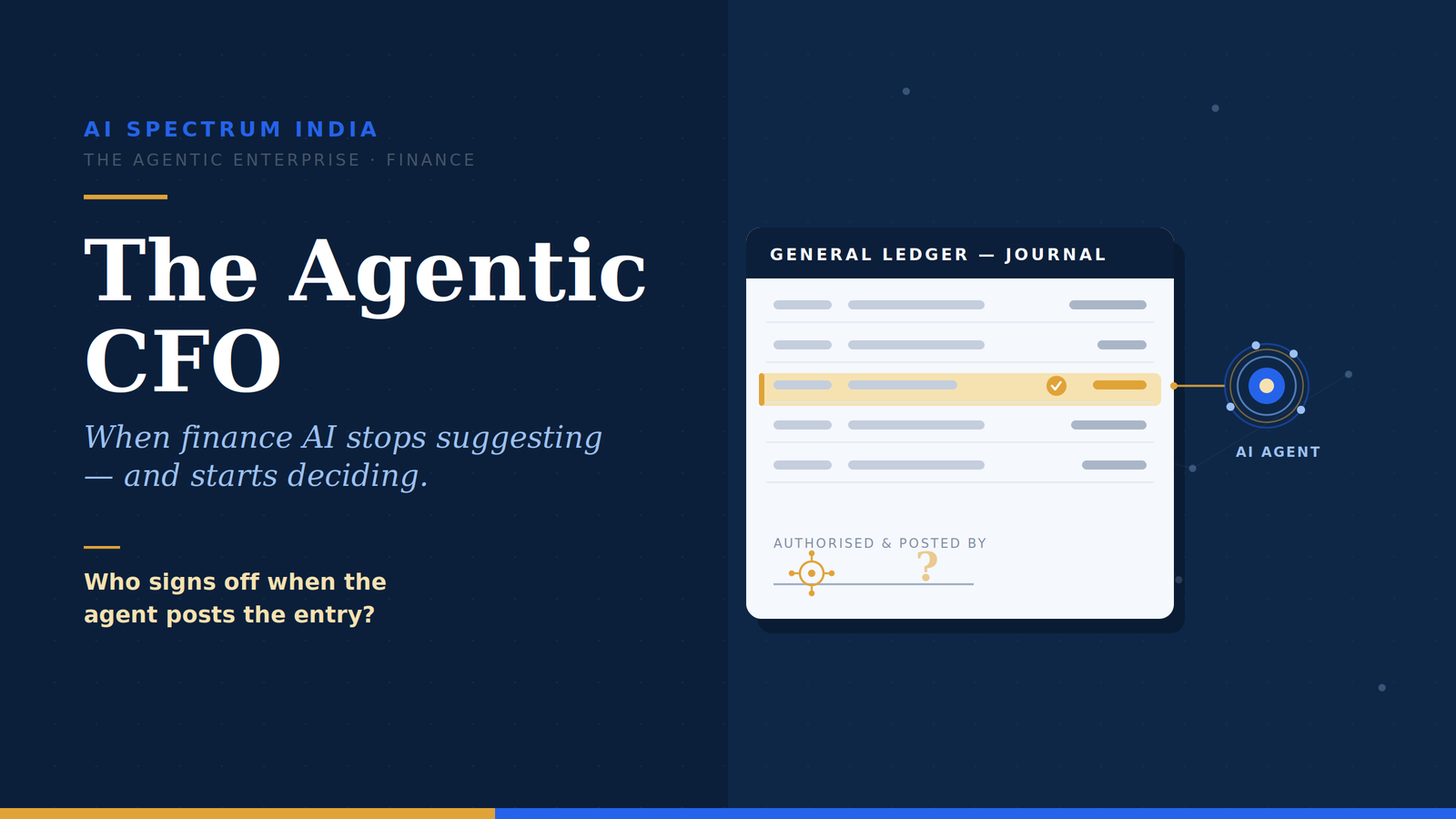
Somewhere in a Bengaluru shared-service centre, software is closing the books. Not assisting — closing. It pulls the bank statement, matches the receipts, clears the exceptions it recognises, posts the routine accruals, and routes only the genuine oddities to a human who arrives in the morning to a near-finished ledger. A year ago that workflow needed a team. Today it needs a reviewer.
This is the quiet threshold finance crossed in 2026: the shift from AI that suggests to AI that acts. For most of the last decade, “AI in finance” meant automation — robotic process automation shuttling data between systems, machine learning flagging an anomaly for a person to judge. The human stayed in the loop because the software only ever proposed. Agentic AI removes that assumption. An agent sets a goal, plans the steps, executes across the ERP and the banking layer, and pauses to ask a person only at the checkpoints it has been told to respect.
The category has stopped being theoretical. Gartner expects nine in ten finance functions to be running at least one AI-enabled tool by the end of 2026, and forecasts that 15% of routine work decisions will be made autonomously by agents by 2028 — up from effectively zero in 2024. Goldman Sachs already runs autonomous agents in production for reconciliation and trade accounting. What was a slide is now a deployment.
India is where the experiment runs at scale
And nowhere is the experiment more consequential than India. The country now hosts more than half the world’s global capability centres and employs roughly 2.4 million finance professionals — the single largest concentration of finance work on the planet, by the count of the accounting bodies AICPA and CIMA. Nearly 70% of those centres are already investing in AI. The wider Nasscom–Zinnov tally puts the GCC ecosystem above 2,100 centres and close to US$100 billion in annual revenue.
The phrase the industry now repeats — the move from labour-cost arbitrage to capability arbitrage — is precisely the shift from cheaper hands to autonomous systems. India is not importing the agentic-finance debate; it is conducting the trial, at volume, on behalf of the world’s multinationals. Indian CFOs, far from cautious, lead on the numbers: a dMACQ survey presented at an ET CFO summit found 68% of Indian finance leaders had already implemented some form of AI — ahead of a global benchmark near 58% — with every respondent planning adoption inside two years.
What the agents actually do — and where they break
Strip away the vendor language and five jobs are quietly being handed over. The first is reconciliation — matching thousands of payments to invoices, once a clerk’s week, now a continuous background process. The second is collections: an agent reads the ageing report, predicts which customers are drifting toward default, and drafts — or sends — the follow-up. The third is the close itself, where recurring accruals and routine journal entries are posted and intercompany balances squared without a human keying them. The fourth is assurance-adjacent: scanning the full transaction population, not a sample, to surface the entries that don’t look right. And the fifth is access — letting a controller ask the ledger a question in plain English and get an answer in seconds rather than a data-pull request that takes two days.
Each of these existed in the older automation era as a feature a human triggered and checked. What is new is that an agent now strings them together, decides what to do next, and acts on its own conclusion — escalating to a person only when it hits a boundary it was told to respect.
Yet the gap between ambition and production is wide. KPMG found that while 99% of companies intend to put agents into production, only 11% actually have. A Savant Labs 2026 study put advanced implementation at just 6%, even as three-quarters of firms planned to invest; BCG, looking specifically at capability centres, placed only 8% in the advanced-maturity bracket, with formal AI governance trailing adoption badly. And the thing that breaks deployments is rarely the model — it is the data. Financial data scattered across disconnected systems with no common layer produces agents that guess rather than execute.
In India that fragmentation has a local accent. A single agent may have to reconcile against GST returns, parse vendor invoices in inconsistent formats, and net off intercompany positions across a dozen group entities — each living in a different system, each a place the agent can quietly go wrong. The unglamorous truth of agentic finance is that it is a data-governance project wearing an AI badge, and the firms succeeding are the ones that did the boring plumbing first.
|
When an agent posts the entry, accountability doesn’t get automated. It gets concentrated — on the CFO who chose to deploy. |
The accountability vacuum
Which leads to the question that should keep every CFO awake: when the agent posts the entry, who signs off?
India’s regulators have moved faster on this than the technology’s marketing suggests. In August 2025 the Reserve Bank of India released its FREE-AI report — the Framework for Responsible and Ethical Enablement of AI — chaired by IIT Bombay’s Dr. Pushpak Bhattacharyya, setting out seven guiding “Sutras” and 26 recommendations across six pillars. One Sutra is unambiguous: the entity deploying an AI system is accountable for that system’s decisions, regardless of how the decision was reached. The framework also insists on disclosure of AI use, a human’s final authority to override, and — tellingly — a standard AI incident-reporting template. The RBI’s own survey found only about a fifth of regulated entities currently deploying AI against two-thirds expressing interest: the regulator is writing the rules ahead of the rush, not behind it.
The accounting profession is moving in parallel. ICAI’s thirteenth-edition Code of Ethics takes effect on 1 April 2026, explicitly recasting independence and integrity for a technology-driven environment, and the institute is folding new standards on IT risk, system integrity, and AI risk assessment into the audit framework. ICAI has framed the shift bluntly: with businesses running on ERPs and the cloud, traditional financial auditing alone is no longer sufficient. The National Financial Reporting Authority’s 2025 amendments to auditing standards pull in the same direction. None of this bans the agent. All of it relocates the liability — squarely onto the humans, and the entity, that deployed it.
At the national level the posture is deliberately light-touch. MeitY’s November 2025 AI Governance Guidelines lean on existing law rather than a new AI statute, with the government signalling it would encourage innovation before reaching for regulation. But a private member’s Artificial Intelligence (Ethics and Accountability) Bill, tabled in December 2025 with proposed penalties up to ₹5 crore, marks the direction of travel even if it never becomes law. The drift is one way: more accountability, more documentation, more proof.
The cross-border catch
Here India’s position creates a complication the global coverage tends to skip. A great deal of the agentic finance running on Indian soil belongs, on paper, to someone else. An agent operating inside a Bengaluru capability centre may be closing the books of a parent company in Frankfurt or New Jersey, posting entries that land in financial statements audited under another jurisdiction’s rules. When that agent errs, the question of who answers — the Indian centre that ran it, the parent that owns the ledger, the vendor that built the model — has no clean answer yet.
This is exactly why the RBI framework presses on vendor and outsourcing contracts: it wants AI liability allocated explicitly, audit rights written in, and due diligence on model providers documented before anything goes live. For India’s GCCs, that is not boilerplate — it is the seam where capability arbitrage meets legal exposure. The centre that has rewired itself around autonomous finance has also, whether it has noticed or not, taken on a slice of accountability that used to sit entirely with headquarters.
Can you prove what the agent did?
For the CFO, all of this resolves into one harder operational question: can you prove what the agent did, and why? Deloitte’s Center for Controllership found trust — not capability — to be the chief barrier to agentic adoption. More than 80% of finance professionals expect AI tools to be standard within five years, yet that optimism sits alongside deep unease about surrendering judgment. The unease is rational. A conversational layer that lets anyone “ask the ledger anything” is only as reliable as the data and guardrails beneath it; when those are thin, it answers confidently and wrongly. An agent that posts accruals leaves an audit trail only if it was built to leave one.
The audit-exception queue, notably, does not vanish under automation — it changes shape. Fewer clerical slips; more questions about why a model decided what it did. A flagged transaction is not the same as a fraud determination, and the distinction matters enormously: an agent can surface the anomaly, but the judgment that something is fraud — with the consequences that follow — is precisely the kind of call regulators expect a human to own. This is where the explainability principle written into both the RBI and MeitY frameworks stops being abstract. The auditor of 2026 increasingly asks not only “is the number right?” but “can you reconstruct the decision that produced it?” Firms that treated agent logging, model versioning, and override records as afterthoughts will find the close faster and the audit slower.
The workforce underneath
There is a human cost humming beneath all of this, and India feels it acutely. An Observer Research Foundation analysis this year modelled AI-related displacement in Indian GCCs at anywhere from roughly 40,000 jobs in a gradual scenario to about 150,000 in an aggressive one by 2030. But the more durable shift is qualitative. The finance professional’s value migrates from producing the number to interrogating it — handling exceptions, judging edge cases, translating output into decisions a board can act on. The 2.4-million-strong workforce is not disappearing; its job description is being rewritten around the things an agent cannot be trusted to own.
That rewrite cuts in the institute’s favour as much as against it. The same accountability that the RBI and ICAI are busy codifying is, in practice, a job description for humans: someone has to design the guardrails, review the exceptions, sign the close, and stand in front of the auditor. The finance team that frames agents as a way to shed headcount will keep cutting until the accountability has nowhere left to sit. The team that frames them as a way to move its best people up the value chain — from keying entries to defending judgments — is reading the same regulatory signals correctly.
The CFO’s answer: deliberate delegation
So what should a CFO actually do in 2026? The defensible position is neither blanket adoption nor refusal, but deliberate delegation — deciding, function by function, what an agent may own, what stays human, and what must be built before anything scales.
|
The delegation test — what to hand over, what to hold |
|
Delegate to an agent now: high-volume, rule-bound, reversible work with a clean audit trail — transaction matching, first-pass receivables follow-up, routine accrual posting, and anomaly flagging for human review. Keep firmly human-in-the-loop: anything involving judgment, estimation, or disclosure — final sign-off on the close, material accruals and provisions, fraud determinations (as opposed to flags), and any decision a regulator or board will scrutinise. Build before you scale: a clean, connected data layer; complete agent logging and model versioning; explicit override authority and records; an incident-reporting process; and vendor contracts that allocate AI liability and grant audit rights — exactly what the RBI framework now expects. |
The agent that closes the books is no longer the interesting question; narrowly, it works today. The interesting question is the one India is positioned to answer for everyone else — with more finance professionals and more capability centres pointed at the problem than any other country. When software acts on the ledger, accountability is not automated away. It is concentrated, on the CFO who chose to deploy. The teams that thrive will be the ones that treated that concentration as the design problem, not the press release.
■
Sources. Figures and findings cited above are drawn from publicly available research and regulatory publications, including Gartner; Wolters Kluwer; KPMG; Savant Labs (2026); the Deloitte Center for Controllership (2025); AICPA & CIMA and Nasscom–Zinnov GCC data (2025–26); the dMACQ CFO Survey (2025); the Reserve Bank of India FREE-AI Committee report (August 2025); the ICAI Code of Ethics, 13th edition; NFRA’s 2025 amendments; MeitY’s AI Governance Guidelines (November 2025); and the Observer Research Foundation (2026).
|
DISCLAIMER This article is an independent editorial analysis produced by AI Spectrum India. The data, figures and findings referenced are drawn from publicly available reports, surveys and regulatory publications credited in the text, and were current as of June 2026; the regulatory positions described — including those of the RBI, ICAI, NFRA and MeitY — continue to evolve, and readers should verify the latest position independently. The content is provided for general information and industry commentary only and does not constitute financial, legal, accounting, tax, audit or regulatory advice, nor a recommendation to adopt or refrain from adopting any technology. Organisations should obtain qualified professional counsel before acting on any matter discussed here. Any reference to companies, institutions, products or frameworks is for illustration and does not imply endorsement. Views expressed are those of AI Spectrum India. |