

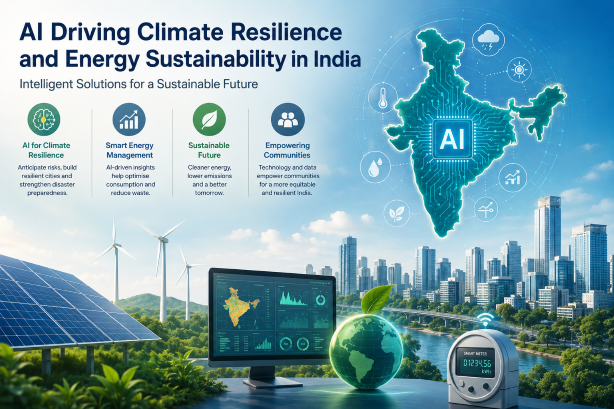
As India grapples with intensifying climate risks, rising temperatures, and record-breaking energy demand, artificial intelligence (AI) is increasingly being positioned as a critical enabler of climate resilience, sustainable urban planning, and smarter energy management.
The growing urgency around climate adaptation and energy efficiency is driving both research institutions and technology companies to accelerate AI-led innovation tailored to India’s unique environmental and infrastructure challenges.
The newly launched Indian AI Research Organisation (IAIRO) is among the institutions aiming to strengthen India’s sovereign AI capabilities with a focus on foundational and applied research aligned to national priorities. Backed by the IndiaAI Mission, the Ministry of Electronics & Information Technology (MeitY), the Gujarat AI Action Plan, and the India Pharmaceutical Alliance (IPA), IAIRO aims to advance frontier AI research, develop domestic intellectual property, and build scalable AI solutions for sectors ranging from climate resilience to urban infrastructure.
According to Prof. Dev Niyogi, key advisor and founding member of IAIRO, as well as William Stamps Farish Chair Professor and UNESCO Chair at the University of Texas at Austin, India is entering a phase where climate disruptions are becoming systemic rather than episodic.
“India is no longer dealing with isolated episodes of extreme weather. We are seeing a structural climate shift that is beginning to affect how our cities are planned, how energy is consumed, and how vulnerable communities experience everyday life,” he said.
Prof. Niyogi highlighted that India’s recent peak power demand crossing 270 GW during the summer is an early warning sign of the mounting pressures climate change could place on energy systems, especially as air-conditioner penetration continues to rise.
He emphasised the need for AI systems capable of integrating local weather, energy, infrastructure, and urban datasets to support city-scale digital twins, heat-risk mapping, disaster preparedness, and real-time decision-making.
“The future of sustainable AI will not be defined only by the largest models, but by systems that are frugal, trustworthy, multilingual, locally deployable and designed for the communities that need them most,” Prof. Niyogi added.
At the same time, companies operating in the energy technology ecosystem are leveraging AI to help utilities and consumers optimise energy consumption and reduce emissions.
Bidgely, an AI-powered SaaS company focused on clean energy transformation, is using AI-driven analytics to help energy providers deliver personalised energy insights to consumers. The company’s UtilityAI platform converts energy consumption data, demographics, and customer interactions into actionable recommendations aimed at improving efficiency and sustainability.
Gautam Aggarwal, Global Chief Revenue Officer at Bidgely, said India’s expanding smart meter infrastructure presents a major opportunity to build a more intelligent and responsive energy ecosystem.
“As India continues to witness record power demand amid rising temperatures and rapid urbanisation, the conversation around sustainability is becoming increasingly action-oriented,” Aggarwal said.
“With over 5 crore smart meters now installed across the country, India is building the foundation for a more connected and responsive energy ecosystem. The real opportunity lies in transforming this data into meaningful consumer action.”
According to Bidgely, its AI-powered energy intelligence solutions have helped utilities globally achieve nearly 150 crore units of energy savings, equivalent to offsetting more than 10 lakh metric tons of carbon dioxide emissions.
Industry experts believe that AI will play a growing role in helping India address climate adaptation, grid resilience, urban planning, and consumer energy efficiency as the country works toward balancing economic growth with sustainability goals.
The convergence of sovereign AI research initiatives, smart infrastructure deployment, and AI-powered energy analytics is expected to become increasingly important as India navigates the long-term impacts of climate change and rising energy consumption.