

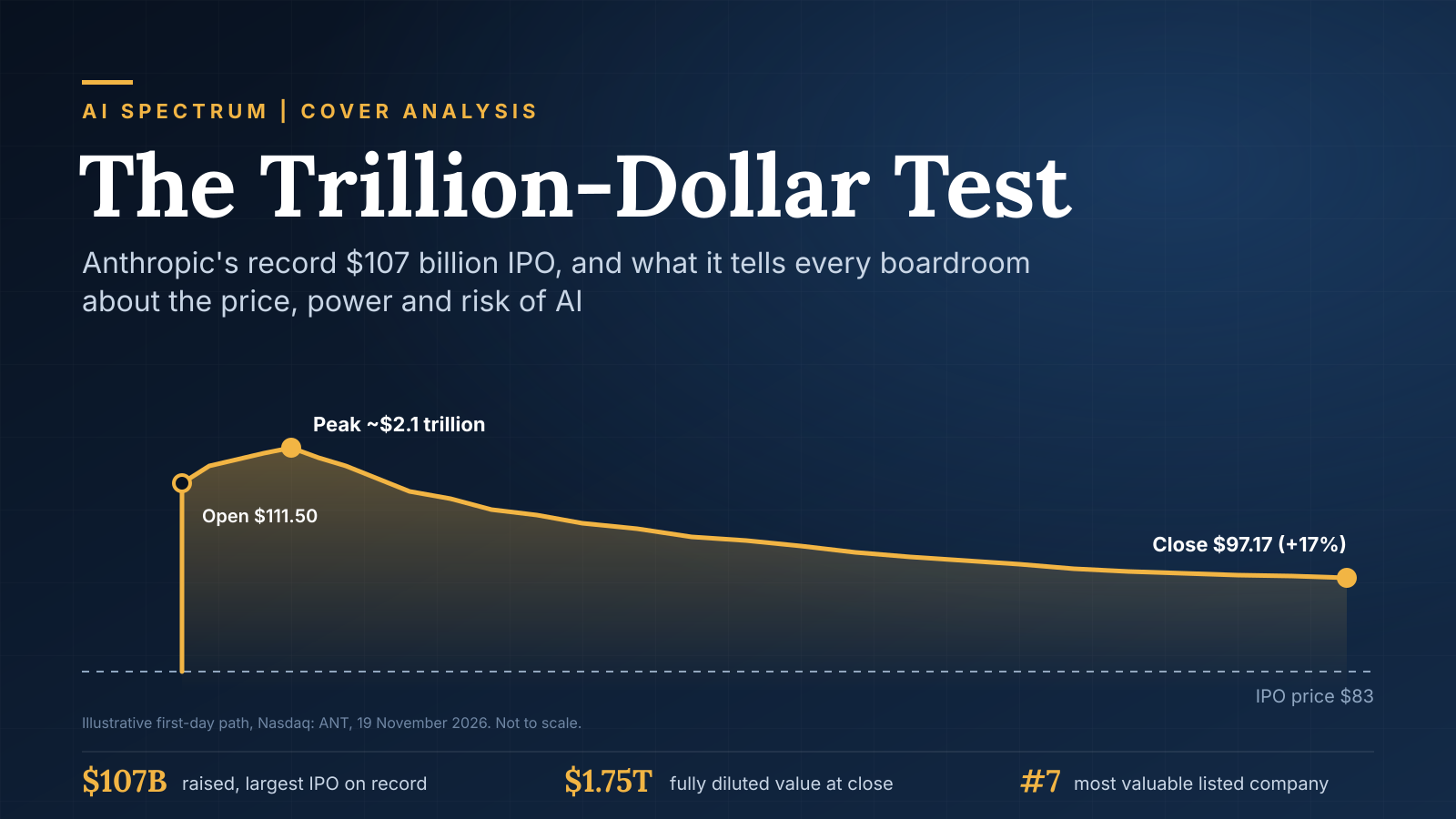
At 9:30 on a cold Thursday morning in New York, the opening bell at the Nasdaq MarketSite rang for a company that, five years ago, was a handful of researchers with a safety thesis and no product. By the time the first ANT shares changed hands, the market had placed a value of roughly $2 trillion on that thesis. By the close, it had walked the number back to $1.75 trillion on a fully diluted basis. That is still enough to rank Anthropic seventh among the world's listed companies, ahead of household names that took a century to build.
Headlines will call it the largest initial public offering of all time, and they will be right. But for the people who run companies, rather than trade them, Anthropic's debut is better read as a stress test. It is the first time a frontier AI lab has opened its books to public investors, submitted to quarterly scrutiny, and asked ordinary shareholders to price what it will be worth once the cost of compute, the speed of competition and the weight of regulation are all counted. The answer the market gave on day one was enthusiastic. The questions it raised will take years to settle.
This feature looks at what happened, what the numbers say, where the bulls and bears divide, and what every chief executive, chief financial officer and chief technology officer should take from it.
A morning in Times Square
Anthropic priced its offering on the evening of Wednesday, 18 November, at $83 a share, above a marketed range of $70 to $78 that it had held firm through a turbulent roadshow. The company sold $81.3 billion of stock to the public, and agreed a further $26 billion private placement of non-voting Class N shares, at the same price, to a group of technology companies that includes Nvidia and Google. Together, the two tranches came to $107 billion. Goldman Sachs served as lead left bookrunner, with Morgan Stanley alongside on the range.
For context, SpaceX raised about $75 billion in its own record-setting listing in June. Anthropic eclipsed that figure before a single share traded.
When trading began, the stock opened at $111.50, a premium of about 34% to the offer price. Market value briefly ran as high as $2.1 trillion, according to Reuters, before the shares drifted back. They closed at $97.17, still up 17% on the day. Brendan McDermid's photographs of Dario and Daniela Amodei on the Nasdaq podium, flanked by co-founders Jared Kaplan and Jack Clark, became the image of the week.
The setting is worth a moment. Unlike the New York Stock Exchange, where most of the decade's big listings rang in, the Nasdaq MarketSite sits in the middle of Times Square. Journalist Hope King, who waited outside for three hours in the cold, observed that the commuters and tourists streaming past seemed barely aware of what was happening inside. It is a useful reminder for boardrooms. The people walking past are already exposed to this company through index funds and pension plans, whether they know it or not, and they will be exposed to its products at work long before they think about its stock.
The debut also landed in a hostile tape. Technology shares had been under pressure for weeks, with anti-AI and anti-data centre sentiment feeding into a selloff around the US midterm elections. That a $107 billion raise cleared, and popped, in that environment is the first signal executives should note: institutional demand for exposure to frontier AI remains deep, even as public patience with the sector grows thinner.
The deal by the numbers
|
Metric |
Figure |
|
IPO price (18 Nov 2026) |
$83 per share (marketed range $70 to $78) |
|
Public offering raised |
$81.3 billion |
|
Concurrent private placement |
$26 billion in Class N shares, incl. Nvidia and Google |
|
Total capital raised |
About $107 billion, the largest IPO on record |
|
Opening trade |
$111.50, about 34% above offer |
|
Intraday peak valuation |
About $2.1 trillion |
|
First-day close |
$97.17, up 17% |
|
Market cap at close |
$1.75 trillion fully diluted; seventh most valuable listed company |
|
Revenue, 2023 vs 2025 |
$41 million to $4.59 billion |
|
Revenue, first half of 2026 |
$16.2 billion, as reported from the S-1 |
|
Future compute commitments |
About $900 billion, per the Financial Times |
|
Employees |
More than 5,000 |
|
Ticker and exchange |
ANT, Nasdaq Global Select Market |
Note for readers: some outlets reported a lower closing market capitalisation of around $1.27 trillion. That figure counts only outstanding shares; the $1.75 trillion figure includes all shares that could be issued from options, units and the Class N placement. Boards comparing valuations should be clear which basis they are using.
How Anthropic got here
Anthropic was founded in 2021 by a group of researchers, most of them former OpenAI staff, who argued that the most capable AI systems should be built by the people most worried about them. That founding idea, that frontier capability and responsible development should move together, has been the spine of its brand ever since. Nasdaq chief executive Adena Friedman used almost exactly those words in welcoming the company to the market.
The commercial curve that followed is the reason the bankers were in the room. Revenue rose from about $41 million in 2023 to $4.59 billion in 2025, roughly a hundredfold increase in two years. The S-1 then showed $16.2 billion of revenue in the first half of 2026 alone. On the podcast circuit this week, analysts estimated that the company is approaching a $100 billion annual revenue run rate with fewer than 6,000 employees. At the same milestone, Google employed about 81,000 people and Meta about 71,000.
Much of that growth has come from the enterprise. Chief Commercial Officer Paul Smith framed the listing as a day that belonged to customers as much as to the company, summing up the strategy in five words: business moves at the speed of trust. The pitch to corporate buyers has consistently been that a model which is predictable, well documented and cautious about misuse is worth paying for when it is plugged into payroll, code bases, clinical records or customer service.
Early backers saw it before the market did. Salesforce Ventures wrote a $50 million cheque in March 2023, when the first version of Claude had just launched and the company was still pre-revenue, and it has followed on in every round since. Bessemer Venture Partners, which wrote its first memo on the company in spring 2024, calls Anthropic the largest bet in its history. The Wall Street Journal estimates that Anthropic's biggest venture backers together hold stakes worth about $150 billion.
Chief Financial Officer Krishna Rao offered the most human account of the journey. Before joining, he recalled, co-founder Tom Brown walked him around San Francisco for hours describing where models and compute were heading, and parts of it sounded like science fiction. If even 10% of it came true, Rao thought, it would change how people live and work. Far more of it came true than he imagined. His closing line has the ring of a corporate motto: "We are at the foothills of what this technology can do."
The bull case: trust as a balance sheet asset
Supporters of the stock make three arguments, and each one matters to corporate buyers as much as to fund managers.
The first is scale with efficiency. A company that can generate the revenue of a mega-cap with the headcount of a mid-sized software firm is, in the bulls' view, proof that AI-native operating models are real. That is not only a statement about Anthropic. It is a benchmark that every board will now be asked to answer for: if a frontier lab can run at a twelfth of the headcount of the last generation of tech giants, what does that imply for your own organisational design?
The second is strategic position. With the S-1 suggesting that its latest frontier model cost roughly $10 billion to train, the number of organisations able to compete at the very top of the market is small and shrinking. Venture investor Rory O'Driscoll and SaaStr's Jason Lemkin, speaking on 20VC, argued that this leaves Anthropic as one of very few American providers of closed frontier models with genuine pricing power, particularly as governments grow wary of open-weight models from China.
The third, and the most distinctive, is that safety has become a selling point rather than a cost. Dimple Thakkar, a former data and AI executive at JPMorgan Chase and Northern Trust, put it plainly in her reaction: in AI, trust is no longer a compliance line item but the asset being valued. For regulated sectors such as banking, insurance, healthcare and pharmaceuticals, that framing carries weight. A model you cannot audit is a liability; a model with a documented approach to risk is something procurement and legal can sign off.
President Daniela Amodei leaned into that positioning in her remarks at the bell. She spoke less about benchmarks than about people: a school principal in São Paulo reclaiming time from paperwork, doctors using AI tools to reach the latest medical evidence faster. Her most quoted line was a direct contrast with the attention economy: "Plenty of technology is built to take up your time. We want Claude to give it back to you." Whether or not the market rewards that philosophy, it is a clear statement of product intent that enterprise buyers can hold the company to.
The bear case: price cuts, power and concrete
Sceptics were just as quick to publish, and their arguments deserve equal attention from any executive negotiating a multi-year AI contract.
The first concern is valuation. Reuters Breakingviews columnist Karen Kwok noted that the stock trades on a sales multiple even richer than SpaceX's, that growth is slowing from its earlier pace, and that turning the IPO proceeds into profitable revenue depends heavily on a decidedly unglamorous question: whether data centres and chips can be delivered on time. The S-1 showed heavy losses alongside the revenue surge; YourStory reported first-half 2026 losses of about $80.7 billion, a figure that reflects the extraordinary capital intensity of frontier model development.
The second concern is pricing power. Anna Wong, chief US economist at Bloomberg Economics, argued in a widely shared note that Anthropic's effective price per million tokens has fallen sharply in recent quarters, while its share of token usage has stayed flat or edged down. Her reading is that the company operates as an oligopolist without durable pricing power, forced to cut prices to drive volume. She went as far as suggesting the IPO may mark the end of the AI trade. For buyers, that is not bad news. It suggests the cost of intelligence will keep falling, and that negotiating leverage sits more with customers than vendor marketing implies.
The third concern is physical. The Financial Times reports that Anthropic has about $900 billion in future compute and infrastructure commitments. Cisco's Jeremy Foster framed the dilemma every CIO now faces in miniature: how do you plan infrastructure years ahead when technology, economics and workloads change almost every quarter? The answer he offered, building for flexibility rather than simply building more, applies equally to Anthropic's own balance sheet. Investors are not just buying a model maker. They are underwriting one of the largest construction programmes in corporate history, exposed to power grids, water supply, chip allocation and local politics.
Yahoo Finance executive editor Brian Sozzi added a list of what he called weird facts for prospective shareholders. Among them: an employee donation-matching programme, under which the company matches staff pledges of equity to charity with Class N shares, cost $2.1 billion in the first nine months of 2026, about 6% of total operating expenses, up from $541 million in 2025. He also flagged water as a disclosed risk factor. Neither item changes the investment case on its own, but both illustrate how differently this company is wired from a conventional growth stock.
A public company with private control
For governance professionals, the most consequential feature of the listing is not the price. It is the structure.
Anthropic is a public benefit corporation, now by far the largest on the US market. Its charter obliges directors to weigh the public interest alongside shareholder returns. More significantly, control sits with a small group. According to the filing, as summarised by former Indeed chief executive Chris Hyams, the seven founders hold 50.1% of the voting power, and a Long-Term Benefit Trust of up to five independent trustees, four of whom are in place today, has a role in shaping the board. Together, these groups can determine the board's makeup without the support of public shareholders.
Hyams put the critique sharply: with this IPO, the public will have a stake but no say. He also pointed out that, of the 11 named individuals in that controlling group, only one, Daniela Amodei, is a woman. Brian Sozzi made a similar observation more briefly: buyers must accept that this is not a normal public company.
Supporters of the structure argue that it is precisely the point. Dual-class arrangements are common in technology, from Alphabet to Meta, and they are usually justified as protecting a founder's vision from short-term pressure. Anthropic's version is justified as protecting a safety mission from the same pressure. The difference is that the stakes the company itself describes are far larger. Its S-1 warns that its technology carries potentially catastrophic or existential risks, and that the scale of harm from a severe AI incident could exceed what any single insurer, or perhaps the insurance industry as a whole, has the capacity to underwrite.
That is an extraordinary disclosure for a company asking the public for money, and C-suite readers should not skim past it. When a vendor tells its own investors that some of its risks may be uninsurable, every enterprise customer should ask the same question about its own exposure: where does liability sit when an AI system acting on our behalf goes wrong?
Safety meets the quarterly clock
The deepest tension in this listing is cultural rather than financial, and several observers named it directly.
The Verge's Hayden Field wrote that there has long been friction between Anthropic's carefully built reputation for safe AI and the way its success accelerates the wider AI race. Going public, she argued, will drag that friction into the spotlight. Hyams went further, predicting that the relentless grind of quarterly earnings will become the single greatest threat to safety, because shareholders will rarely clamour for caution over growth. With OpenAI widely expected to follow with its own listing in 2027, the competitive pressure will only intensify.
Dex Hunter-Torricke, who led executive communications through Facebook's 2012 IPO and later ran communications at Google DeepMind, offered the most personal warning. Public listing, he argued, changes a company deeply. He watched an idealistic team of a few thousand become an organisation of tens of thousands, many with little connection to the original mission, under growth expectations that drove serious strategic mistakes. He also argued that Anthropic has already taken on many traits of an incumbent, including deep ties to the US national security establishment, and that its political posture will face much harsher scrutiny now. Anthropic has defended its government work as consistent with its mission, and readers should weigh his claims as one critic's view.
The policy backdrop amplifies all of this. The New York Times reported that over the past two years Congress has introduced 56 major bills to address AI risks, ranging from new oversight agencies to incident reporting to a kill switch for rogue agents. Only one became law, and it dealt with deepfakes. Bills to retrain and support workers displaced by AI have gone nowhere. Frontier Collective founder Dan Burgar summed up the gap neatly: the technology is moving faster than the institutions meant to prepare for it.
Not every voice was anxious. Veeam chief executive Anand Eswaran offered a more practical frame. In 1858, Hymen Lipman of Philadelphia patented a pencil with an eraser on the end, and people wrote more freely once they knew mistakes could be fixed. Companies, Eswaran argued, will hand serious work to AI agents not because the agents are brilliant, but because they can see exactly what happened and undo it cleanly when something goes wrong. Rubrik's Bipul Sinha struck a similar note, describing his company's work applying frontier models to cyber recovery and resilience. Trust, in this view, is less about nothing ever going wrong and more about being able to recover when it does.
The wealth wave and the talent question
The listing is also about to create one of the largest concentrations of new personal wealth in Silicon Valley's history. The Wall Street Journal reported that a majority of Anthropic's more than 5,000 employees are expected to become millionaires, with roughly 2,800 holding stakes potentially worth at least $10 million and about 600 sitting on more than $100 million. Reuters, citing private-markets research firm Sacra, noted that even early administrative and entry-level staff could hold life-changing equity, since their options carry exercise prices of less than $1.
For other employers, including Indian technology services firms and global capability centres that compete for the same AI talent, this matters in two ways. First, a cohort of newly liquid, highly experienced AI engineers will soon be free to start companies, angel invest or simply leave. Expect a wave of Anthropic alumni start-ups over the next 24 months, much as the Google and Facebook listings seeded a generation of founders. Second, the compensation benchmark for frontier AI talent has been reset again. Boards trying to build in-house AI capability need to accept that they are bidding in a market where the reference point is now a public company worth well over a trillion dollars.
There is a venture capital angle as well. On 20VC, Jason Lemkin predicted that limited partners will now grade fund managers not on how many unicorns they backed, but on how many companies valued at $20 billion or more they held before those valuations were reached. Mohamed El-Erian, meanwhile, pointed to the macro side: a listing of this size changes flows of funds, index weightings and portfolio construction across markets. Joshua Brown of Ritholtz Wealth Management noted that 2026 will be remembered for having delivered two of the largest IPOs in history within five months.
Why it matters for India
For AI Spectrum's readers, the Anthropic listing is not a distant Wall Street event. Indian enterprises are among the fastest adopters of frontier AI models, from banking and insurance to IT services, pharmaceuticals and the global capability centres that now employ well over a million people across Bengaluru, Hyderabad, Pune and Chennai. Anthropic announced plans in 2025 to open an office in Bengaluru, signalling how central the Indian developer and enterprise base has become to its growth.
Three implications stand out. First, as a listed company, Anthropic will now publish quarterly results, giving Indian CIOs and CFOs a far clearer view of the vendor's financial health, pricing trends and capacity constraints than they had when it was private. That is useful procurement intelligence. Second, the price-per-token trend flagged by Bloomberg's Anna Wong is good news for cost-sensitive Indian deployments, where the business case for AI often turns on unit economics at scale. Third, the governance and safety debate will shape how Indian regulators, including those drafting rules under the IndiaAI Mission and the Digital Personal Data Protection framework, think about accountability for models built and controlled abroad.
There is also a sovereign capability question. If training a single frontier model now costs about $10 billion, and the leading lab has committed close to $900 billion to compute, the gap between global frontier labs and national AI efforts is widening in absolute terms. Indian policymakers and corporate leaders will need to decide, with clear eyes, where the country competes directly and where it partners.
Five questions every C-suite should now be asking
Strip away the champagne and the commentary, and the Anthropic IPO leaves executives with a practical agenda. Here are the questions worth putting on the next board or leadership team agenda.
- Is our AI vendor strategy built for falling prices? If the cost of intelligence keeps dropping, long fixed-price contracts may age badly. Negotiate for price reviews, usage flexibility and the ability to switch models.
- Where does liability sit when an AI agent gets it wrong? Anthropic's own filing says some AI risks may exceed what the insurance industry can cover. Review contracts, indemnities, audit trails and, crucially, your ability to roll back automated actions.
- What does an AI-native headcount model mean for us? A company approaching $100 billion in run-rate revenue with fewer than 6,000 people is a benchmark your investors will notice. Have a clear, honest answer on productivity, reskilling and workforce design.
- How exposed are we to the infrastructure squeeze? Frontier AI depends on chips, power and data centres arriving on schedule. Map your critical AI workloads against vendor capacity and build redundancy where outages would hurt.
- How do we keep our AI talent? With a new wave of wealth and start-up formation coming, retention plans, equity structures and the quality of AI work you offer will matter more than ever.
The road from here
Day one is the easy part. As tech writer Emil Protalinski observed, engineering a first-day pop is what Wall Street bankers do best; the real question is where Anthropic trades next month, next year and next decade. Mega-listings from Facebook to Alibaba to Arm have shown that the first close is rarely the best guide to long-term value, and SpaceX's own debut has cooled since June.
What Anthropic has secured is time and capital: $107 billion of it, at a moment when building frontier AI has become one of the most expensive undertakings in corporate history. What it has given up is the privacy to make hard choices out of sight. From now on, every model release, every safety decision, every large customer win and every price cut will be read through the lens of a quarterly earnings call.
That transparency may prove to be the most valuable outcome of all, for investors and for the companies that depend on this technology. Hope King made the point well: public companies report regularly, and for a structural change as important as AI, it is better for everyone to see how its leaders are building and what they plan next.
For the C-suite, the lesson is clear enough. The world's most valuable AI pure play has just told the public markets, in writing, that its technology is both enormously valuable and potentially dangerous. The companies that thrive in the next phase will be the ones that take both halves of that statement seriously, capturing the productivity while building the controls, contracts and recovery plans that let them move fast without losing their footing. Anthropic's leaders say they are only at the foothills. So, for that matter, is everyone else.