

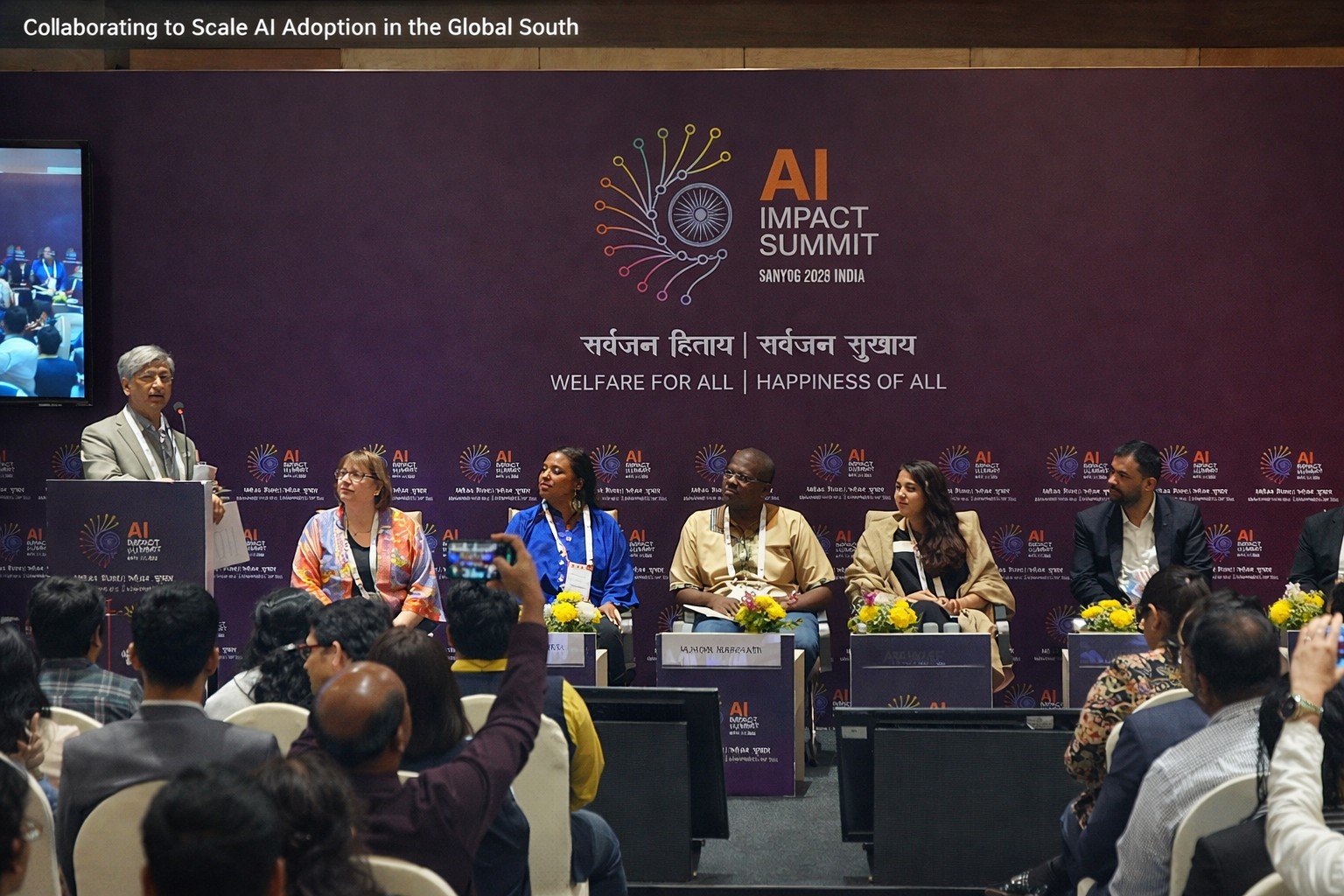
At the AI Impact Summit 2026 in India, a high level panel brought a practical question to the room: if responsible AI adoption in the Global South needs multistakeholder collaboration, what does that actually look like in real deployments, real languages, real budgets, and real public trust.
The session was moderated by Hemant Pande, CEO, Centre For Responsible AI (CeRAI), IIT Madras, who framed the discussion around shared responsibility and collective action. Setting the tone early, he emphasised that collaboration must extend across research, policy, industry, and communities to ensure AI adoption remains inclusive and responsible.
Hemant Pande, CEO, CeRAI, IIT Madras:
“Responsible AI adoption in the Global South cannot be driven by technology alone. It requires governments, researchers, industry, startups, and communities to work together from design to deployment. Collaboration is not a side conversation, it is the foundation that ensures AI remains inclusive, context aware, and truly beneficial for society.”
An Eminent Panel Built For The Theme
The panel brought together global governance, research leadership, applied social impact, enterprise adoption, and community centred innovation.
-
Hemant Pande, CEO, Centre For Responsible AI (CeRAI), IIT Madras, Moderator
-
Professor Dame Wendy Hall, Regius Professor of Computer Science, University of Southampton
-
Dr Aisha Wal Bryant, Senior Staff Research Scientist and Head, Google Research Africa
-
Professor Vukosi Marivate, Professor of Computer Science and ABSA Chair of Data Science, University of Pretoria
-
Safia Hussein, Chief Impact Officer and Co founder, Karya
-
Dr Makran Tapaswi, Principal ML Scientist, Wadhwani AI
-
Dr Nyati Chaya, AI Lead and Co founder, Hyperbots Inc
Together, the panel reflected the very principle it explored: collaboration across governments, academia, industry, startups, and social impact organisations.
Governance And The Global Conversation
Professor Dame Wendy Hall highlighted the urgency of inclusive AI governance, sharing insights from her work advising governments and the United Nations. She stressed that global conversations around AI must include the Global South, warning that public misunderstanding and hype could deepen divides unless AI literacy becomes widespread.
Her message centred on education as a critical enabler so citizens, policymakers, and institutions can engage responsibly with emerging technologies.
Building AI From Africa For The World
Dr Aisha Wal Bryant demonstrated how innovation rooted in local realities can scale globally. From weather forecasting systems designed around limited infrastructure to open speech datasets supporting African languages, her examples showed how multistakeholder collaboration helps research translate into measurable societal impact.
Languages, Communities, And Sociotechnical Design
Professor Vukosi Marivate stressed that language inclusion is not purely a technical problem. Community expectations, cultural context, and governance frameworks all play a role. Responsible AI, he argued, must move beyond rapid scaling and instead consider community agency, equitable licensing, and ethical participation.
Data Workers And Ethical Participation
Safia Hussein brought attention to the human layer behind AI systems. She highlighted how data labour is often sourced from the Global South while ownership and economic power remain concentrated elsewhere. Moving forward, she argued, collaboration must ensure representation, fair participation, and local benefit rather than extractive models.
Deployment In Low Connectivity Environments
Dr Makran Tapaswi addressed infrastructure realities, explaining how compressed models running offline on affordable smartphones can deliver AI capabilities in healthcare, education, and agriculture. These deployment strategies make adoption practical for frontline workers operating in bandwidth constrained environments.
Enterprise Adoption And The Trust Equation
Dr Nyati Chaya provided the enterprise lens, showing how AI adoption in finance depends on trust, security, and domain accurate reasoning. As AI enters operational workflows, collaboration between technologists and domain professionals becomes essential to ensure solutions are usable, compliant, and commercially viable.
Audience Dialogue: Impact And Future Talent
Audience questions explored two central themes: impact evaluation and preparing future talent.
Panelists agreed that impact evaluation must be contextual and closely tied to real world outcomes rather than purely technical benchmarks.
On student readiness, the consensus was clear. The future workforce must combine technical ability with critical thinking, questioning mindset, and interdisciplinary collaboration to build responsible AI systems.
The discussion reinforced a simple but important reality: scaling AI adoption in the Global South is not about technology alone. It is about governance, inclusion, trust, ownership, and continuous collaboration across stakeholders.
Under the moderation of Hemant Pande, the session offered a grounded roadmap for how responsible AI can move from ambition to action, ensuring innovation serves societies fairly and sustainably.