

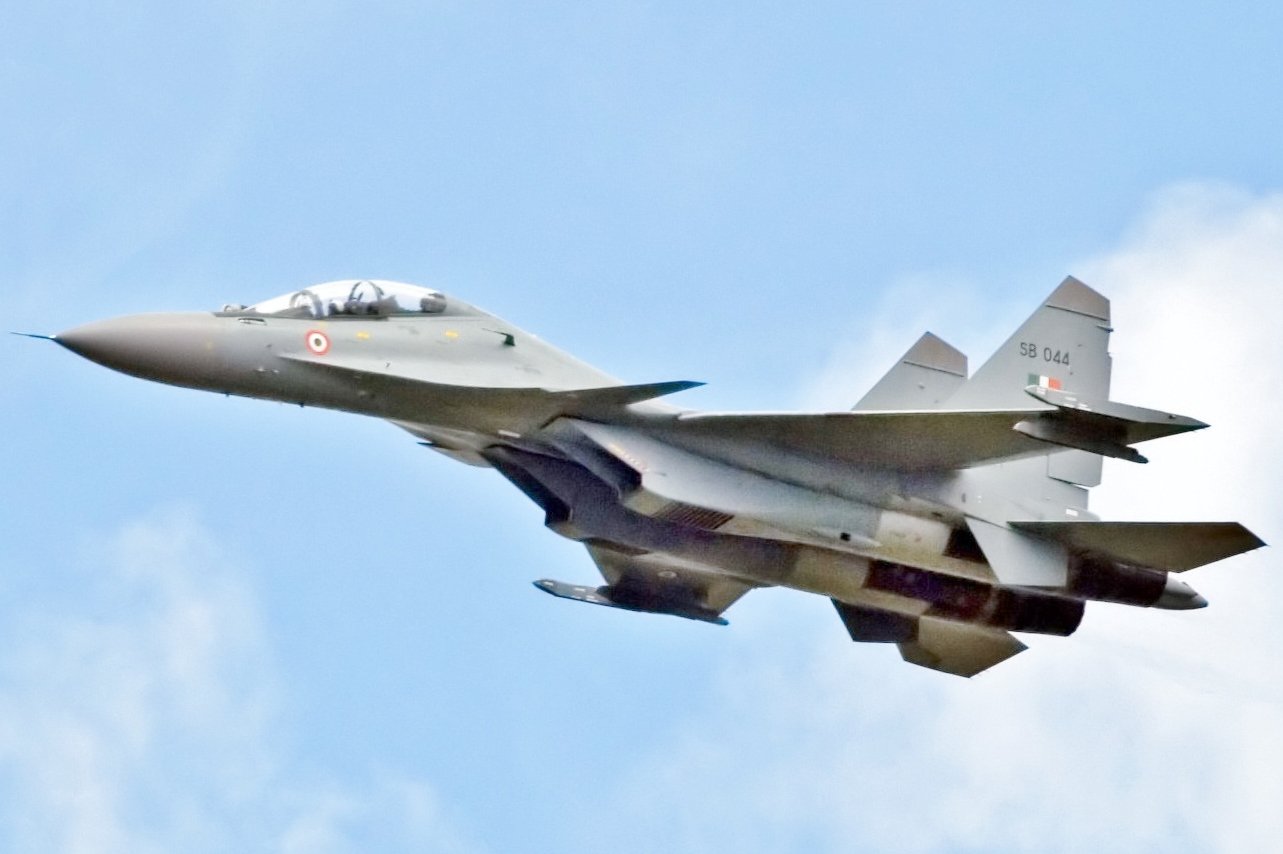
The Indian Air Force (IAF) is turning to artificial intelligence (AI) to make one of its most important fighter fleets smarter, more reliable and easier to maintain. A new collaboration between the IAF and IIT Bombay aims to develop an indigenous predictive-maintenance system for the Su-30 MKI.
As the IAF seeks to sustain combat readiness amid a limited number of fighter squadrons, using AI to identify equipment problems before they develop into failures could become an important force multiplier.
According to an issue brief by the Manohar Parrikar Institute for Defence Studies and Analyses (MP-IDSA), the IAF signed three agreements with IIT Bombay recently to develop an indigenous predictive-maintenance capability for the Su-30 MKI. The programme seeks to move maintenance beyond predominantly reactive or scheduled approaches towards a data-driven system capable of predicting faults, assessing component health and recommending maintenance actions.
The project is being undertaken by IIT Bombay’s Centre for Machine Intelligence and Data Science (C-MInDS) and its Mechanical Engineering Department. A key objective is to develop an AI-driven health index for gas-turbine engines undergoing mid-life maintenance.
Su-30 MKI: The backbone of India’s fighter fleet
The Su-30 MKI is a twin-seat, long-range fighter designed for multirole and air-superiority missions. First inducted into the IAF in September 2002, the Russian-origin aircraft combines heavy firepower with super-manoeuvrability. With in-flight refuelling, its range can be significantly extended beyond the approximately 3,200 km available on internal fuel.
With more than 270 aircraft in the fleet, the Su-30 MKI forms the backbone of the IAF and makes India the world's largest operator of the type. Its central role has made maintaining and modernising the fleet a strategic priority.
India has been pursuing several initiatives to extend the aircraft’s operational relevance and improve its combat capabilities.
In 2024, the Ministry of Defence advanced the ‘Super Sukhoi’ modernisation programme, estimated at around Rs 60,000 crore, to be undertaken by Hindustan Aeronautics Limited (HAL) with support from the Defence Research and Development Organisation (DRDO). The programme aims to introduce advanced indigenous mission and weapons systems, enhanced electronic warfare protection, new-generation radars for improved air-to-air and air-to-ground detection and engagement, and upgraded avionics.
The modernisation programme has now reached the radar-integration testing stage, according to the MP-IDSA brief.
The propulsion side of the fleet is also receiving attention. In September 2024, the Cabinet Committee on Security cleared the procurement of 240 AL-31FP engines at a cost of about Rs 26,000 crore. The engines are to be manufactured at HAL’s Koraput division with more than 54% indigenous content, supporting the long-term availability of the Su-30 MKI fleet.
The IAF has also been working with private-sector companies and academic institutions, including IIT Bombay and IIT Jodhpur, to automate maintenance using AI and robotics.
The predictive-maintenance initiative with IIT Bombay therefore adds a digital intelligence layer to an already extensive effort to modernise the aircraft.
The initiative has particular relevance for Pune, where Lohegaon Air Force Station has historically played an important role in the Su-30 MKI’s operational journey.
The base was among the first IAF stations to receive the Russian-origin fighter and is associated with No. 20 Squadron and No. 30 Squadron. The Su-30 MKI has since been deployed across multiple IAF bases, including Bareilly, Tezpur, Chabua, Halwara, Jodhpur, Sirsa and Thanjavur, giving the aircraft a wide operational footprint across India.
For Pune, the AI-enabled maintenance initiative is therefore more than an academic exercise. A successful predictive-maintenance architecture could eventually support aircraft operating from Lohegaon and other Su-30 bases by giving engineers earlier indications of engine or component degradation.
From scheduled maintenance to predictive intelligence
Traditional aircraft maintenance relies heavily on scheduled inspections, component life limits and corrective action after faults are detected. While these processes remain essential for aviation safety, they can result in components being serviced before their actual condition requires intervention, while developing problems may remain undetected between inspection cycles.
Predictive maintenance changes this approach.
Instead of asking only when a component is due for maintenance, an AI-enabled system can analyse historical and real-time data to determine whether a component is showing signs of deterioration and when intervention may be required.
The IIT Bombay project seeks to take this concept further through a digital twin of the Su-30 MKI engine. A digital twin is a virtual representation of a physical system. In this case, the model would combine engineering principles, AI and operational data to replicate the behaviour of a real engine.
By continuously assessing key health parameters, the system could identify abnormal patterns, predict potential failures and provide maintenance personnel with actionable recommendations.
The MP-IDSA brief describes the proposed model as physics-informed, combining established engineering knowledge with machine-learning capabilities. This approach is significant for military aviation because it does not depend solely on historical datasets; known engineering relationships and physical constraints can also be incorporated into the model.
Turning maintenance data into operational readiness
For an air force facing a fighter-squadron shortage, aircraft availability is as important as acquiring new platforms.
An aircraft undergoing unexpected maintenance is temporarily unavailable for operations. If a developing fault can be identified early and addressed during planned maintenance, the risk of unscheduled grounding can potentially be reduced.
The benefits of predictive maintenance could include earlier detection of engine and component degradation, fewer unexpected failures, reduced downtime, improved maintenance planning, more efficient use of engineering manpower, better spare-parts planning and faster maintenance turnaround.
The MP-IDSA analysis argues that such capabilities could reduce engine turnaround times, lower maintenance costs and increase engine availability.
At a base such as Lohegaon, where Su-30 MKIs form part of the permanent operational fleet, improvements in serviceability could translate into greater availability for training, air-defence duties and operational tasking.
Data and cybersecurity will determine success
The biggest challenge may not be developing the AI model but preparing the data infrastructure that supports it.
The IAF’s Su-30 fleet has accumulated maintenance records over more than two decades, some of which may exist in paper or inconsistent formats. Digitising, cleaning, validating and structuring this legacy information will be critical to the model’s predictive accuracy.
An AI system trained on incomplete, inaccurate or incorrectly labelled data could produce unreliable recommendations. In military aviation, such errors could affect aircraft availability and potentially flight safety.
Cybersecurity is equally important. A system containing information about the health and readiness of combat aircraft could become a high-value target. Adversaries could attempt to steal information, disrupt the system or manipulate data to influence maintenance recommendations.
The MP-IDSA brief highlights data poisoning as one such risk, where deliberately corrupted information is introduced into an AI system to influence its outputs.
The architecture will therefore require strong access controls, data classification, network protection, redundancy and appropriate offline capabilities.
The IAF-IIT Bombay collaboration also points towards a broader defence-maintenance ecosystem.
IIT Bombay brings expertise in machine learning, data science, mechanical engineering and digital-twin technologies to a practical military requirement. According to MP-IDSA, related AI models are also being developed for radar systems and helicopters.
This could eventually enable AI-based health monitoring across multiple aircraft and defence platforms, providing maintenance personnel and commanders with a more comprehensive picture of equipment availability.
Building indigenous maintenance intelligence
The IAF’s partnership with IIT Bombay represents a shift in how India approaches military aviation maintenance. Beyond manufacturing aircraft, weapons and components domestically, the country is increasingly seeking to build indigenous expertise in the data, software and engineering intelligence required to sustain these systems.
The Su-30 MKI’s modernisation, engine procurement and AI-enabled maintenance initiatives are therefore interconnected elements of a longer-term effort to keep the fleet operationally relevant.
For decades, aircraft operators have relied heavily on original equipment manufacturers for technical documentation, maintenance schedules and engineering guidance. An indigenous AI-driven health-monitoring system could allow India to progressively build its own data-driven understanding of how its aircraft and engines perform under Indian operational conditions.
The success of the predictive-maintenance programme will ultimately depend on data quality, cybersecurity, timely delivery and measurable outcomes such as reduced engine turnaround times, fewer unscheduled removals, improved prediction accuracy and higher fleet serviceability.