

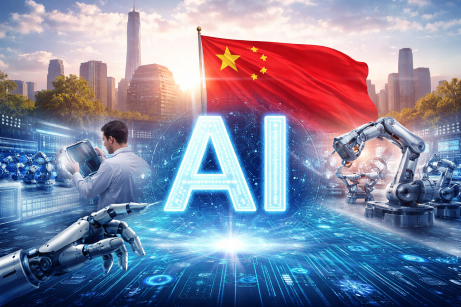
Artificial intelligence is set to play a defining role in China’s next phase of economic transformation, as the country positions advanced technologies at the heart of its newly approved 2026–2030 development roadmap.
China’s national lawmakers have formally endorsed the 15th Five-Year Plan. This comprehensive blueprint outlines priorities for economic and social development over the next five years under the guidance of the Communist Party of China. The plan places strong emphasis on high-quality growth, with artificial intelligence, semiconductors, high-end manufacturing, and new energy emerging as key drivers of future competitiveness.
As the world’s second-largest economy, China continues to rely on its structured planning system to define policy direction and reform pathways. The latest plan underscores a shift away from purely GDP-driven metrics toward a more balanced model that integrates innovation, environmental sustainability, public welfare, and national security.
Industry leaders say the growing focus on AI and advanced technologies is already reshaping global perceptions of Chinese companies. Firms across sectors are accelerating investments in intelligent systems, automation, and data-driven capabilities, reinforcing China’s ambition to lead in next-generation industries.
At the same time, the blueprint highlights the importance of strengthening the real economy. China aims to modernise its industrial base by upgrading traditional manufacturing to higher-value segments, nurturing emerging sectors, and planning for future industries.
The 2026–2030 period is seen as a critical phase in China’s long-term modernisation strategy. It serves as a bridge toward the country’s goal of achieving basic socialist modernisation by 2035, a milestone set by the Communist Party of China as part of its broader national development agenda.
Despite rising global protectionism, China is also signalling continued openness to international trade and investment. The plan calls for improving the quality and balance of foreign trade, positioning the domestic market as a key source of global growth opportunities.
Economic performance during the previous planning cycle has provided a strong foundation. During the 2021–2025 period, China maintained steady growth, with total economic output surpassing multiple trillion-yuan thresholds and outperforming global averages.
Analysts view the new plan’s emphasis on AI and high-quality development as a source of stability amid global uncertainty. By aligning technological innovation with long-term policy consistency, China aims to sustain its trajectory toward becoming a modern, innovation-driven economy.
As emphasised by Chinese leadership, steady progress and strategic focus will remain central to achieving the country’s long-term goals, turning incremental advances into sustained national development gains.