

As artificial intelligence evolves beyond predictive analytics into autonomous decision support, organisations are increasingly seeking AI platforms that can transform fragmented data into coordinated operational action. Addressing this need, TACTICA AI has emerged as one of the region's first mission-layer operational AI platforms, combining geospatial intelligence (GEOINT), open-source intelligence (OSINT), IoT, sensor feeds and agentic AI to deliver real-time, context-aware decision support. Developed with an open, interoperable architecture, the platform is designed to integrate seamlessly with existing systems while keeping humans at the centre of critical decision-making.
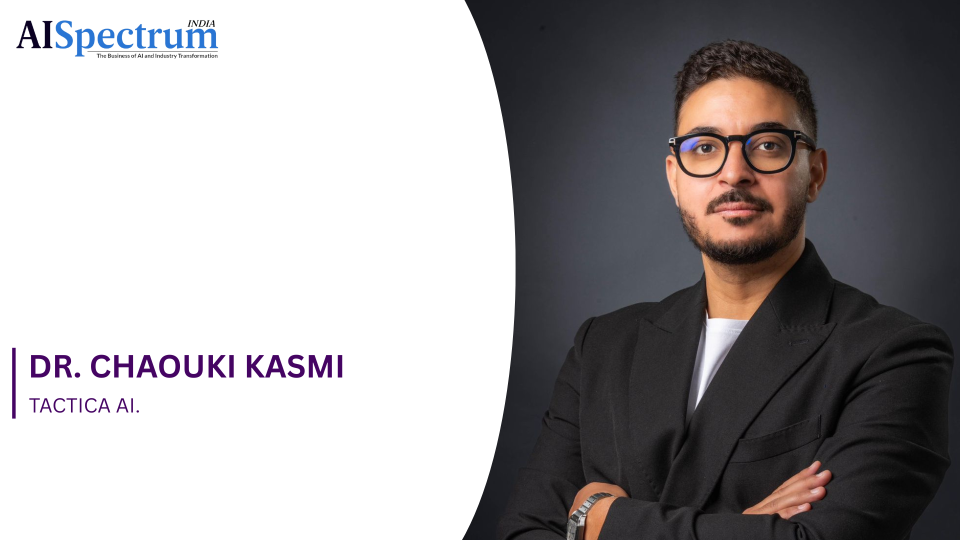
In this exclusive interview with AI Spectrum, Dr Chaouki Kasmi, TACTICA AI, discusses the vision behind the platform, its rapid development and deployment, and the growing role of agentic AI in enabling organisations to move from data analysis to intelligent execution. He also shares insights into AI sovereignty, interoperability, human-AI collaboration, and TACTICA AI's expansion into critical infrastructure, energy, transportation and other industrial sectors, highlighting how operational AI is redefining decision-making across mission-critical environments.
TACTICA AI is positioned as one of the region’s first mission-layer operational AI platforms. What specific market or operational gaps led to its development?
We believe the world has entered a new era where information is no longer the limiting factor. Organizations today have access to more data than at any point in history, yet operational outcomes are not improving at the same pace. Having the data is important. Acting on it effectively is what creates value. The challenge is no longer collecting information. The challenge is transforming information into coordinated action. That belief sits at the core of TACTICA AI. From the beginning, we worked closely alongside end users, continuously refining the platform based on operational feedback. This revealed a recurring challenge: operators were spending more time connecting systems and coordinating actions than making decisions. TACTICA AI was developed as a mission-first decision layer that helps organizations move from awareness to execution by contextualizing information, prioritizing actions, and improving coordination across teams.
The platform was reportedly developed in less than 35 days and is already being deployed in mission-critical environments. Could you share insights into the development process and the technological capabilities that enabled such rapid deployment?
Our vision was never to build another AI platform. Our vision was to create the operational layer capable of connecting people, systems, intelligence, and decisions in real time. Once that vision was clear, development became an execution challenge rather than a technology challenge. A key enabler was our open architecture approach. TACTICA AI was designed to integrate with existing infrastructures rather than replace them. Whether integrating sensors, cameras, drones, radars, command-and-control systems, existing software platforms, or third-party AI models, the objective is the same: rapid integration without disruption. The platform was deliberately designed without vendor lock-in. If a better capability becomes available tomorrow, our partners should be able to adopt it seamlessly. The challenge is no longer collecting more data. Most organizations already possess the information they need. The challenge is helping them contextualize it, coordinate around it, and act on it.
TACTICA AI combines GEOINT, OSINT, IoT, sensor feeds, and agentic AI orchestration. How does this integration improve decision-making compared to conventional analytics platforms?
We believe the next generation of AI will not be defined by bigger models or larger datasets. It will be defined by its ability to understand context and help organizations execute more effectively. Most organizations are not suffering from a lack of information. They are suffering from fragmentation, complexity, and cognitive overload. TACTICA AI creates a unified operational picture where intelligence, operational, and environmental inputs can be interpreted together in context. The platform continuously correlates events, assets, locations, actors, and objectives to help users understand not only what is happening, but why it matters. Context is often more valuable than data. This contextualization improves tasking, prioritization, coordination, and execution. The platform does not simply answer questions. It helps ensure the right questions are being asked in the first place.
You describe TACTICA AI as enabling a shift from “show me the data” to “help me decide what to do next.” How does the platform’s agentic AI architecture support this transition while ensuring human oversight in high-stakes scenarios?
Our philosophy is simple: AI should not stop at answering questions. The real value emerges when AI helps organizations understand priorities, coordinate actions, and move from awareness to execution. TACTICA AI is designed around outcome-driven tasking. AI agents continuously assess information, identify relevant workflows, and propose prioritized courses of action aligned with operational objectives. At the same time, human oversight remains fundamental. The objective is not to replace decision-makers, but to augment their ability to act with greater speed, consistency, and confidence. We believe the future of operational AI is human-machine collaboration, where AI accelerates understanding and coordination while humans remain responsible for judgment and execution.
How does TACTICA AI reflect Abu Dhabi’s broader ambitions in building indigenous, sovereign AI capabilities for critical national and industrial applications?
While we cannot speak on behalf of Abu Dhabi’s broader strategy, we believe our vision is strongly aligned with the direction consistently articulated by the UAE leadership around innovation, technological sovereignty, resilience, and globally competitive capabilities. In our view, sovereignty and openness are not opposing concepts. The most resilient systems combine local control with global collaboration. Organizations increasingly want control over critical capabilities while maintaining access to the best technologies and partners available globally. TACTICA AI reflects that philosophy. We are building advanced operational AI capabilities locally while collaborating internationally and integrating best-in-class technologies regardless of origin.
Beyond defense and national security, which commercial or industrial sectors represent the strongest near-term growth opportunities, and what is your roadmap for international scaling?
Our ambition is not to deploy TACTICA AI everywhere. Our ambition is to deploy it where it can create meaningful operational impact. We have deliberately chosen a focused go-to-market strategy because long-term success comes from solving real operational problems rather than maximizing short-term market presence. One area where we are seeing particularly strong engagement is critical infrastructure, including energy, utilities, transportation, maritime, and industrial operations. Internationally, our strategy is built around openness, interoperability, and partnerships. We do not believe organizations should be forced into closed ecosystems. TACTICA AI acts as an operational layer capable of orchestrating existing technologies while preserving previous investments. While our roots are in Abu Dhabi, our outlook has always been international. We are building locally, partnering globally, and expanding where there is strong alignment between operational needs, trusted partnerships, and long-term value creation. The organizations that will outperform tomorrow are not those with the most data. They are those that can turn information into action the fastest.