

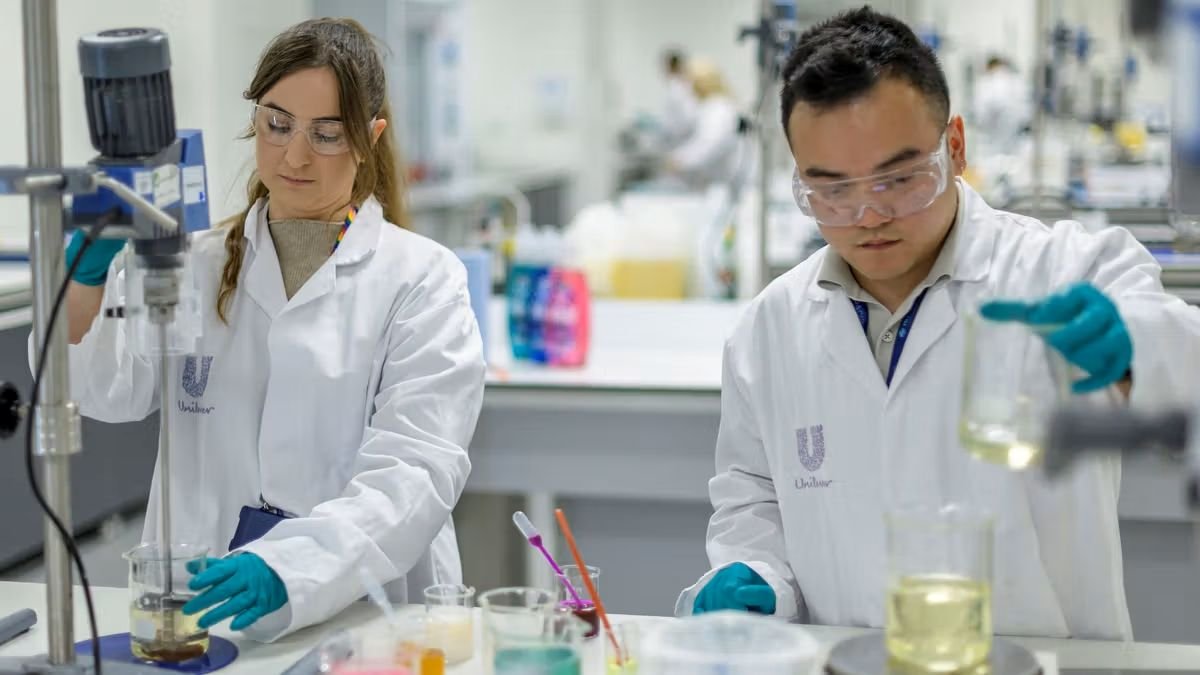
Unilever has partnered with protein design company Arzeda to develop an AI-designed enzyme that combines cleaning performance, fabric care and long-lasting fragrance in a single technology. The innovation will be incorporated into its Surf Excel liquid detergent, with India selected as a key launch market for the company's laundry business.
According to Unilever, more than 90 per cent of laundry detergent users in India want products that deliver powerful cleaning performance alongside longer-lasting fragrance. Traditionally, achieving these benefits would require multiple enzymes and separate fragrance technologies, increasing formulation costs and supply chain complexity.
The newly developed AI-designed enzyme is intended to deliver all three benefits through a single technology. In pre-trials, the formulation recorded the best consumer test results Unilever has seen in the past five years.
“This is a major scientific breakthrough,” said Neil Parry, Head of Biotechnology at Unilever, highlighting the ability to combine three consumer benefits within one technology. He added that the innovation, alongside other developments in the pipeline, could transform the formulation of laundry liquids.
The collaboration marks a shift from conventional enzyme discovery methods towards AI-driven computational design. Traditionally, enzyme development involved creating extensive libraries of new molecular structures and screening millions of variants to identify promising candidates.
However, enzymes that perform well in laboratory conditions may not necessarily deliver the desired results on fabrics under real-world washing conditions.
By applying AI tools, Unilever and Arzeda can explore the vast enzyme design space, identify a manageable number of promising candidates and prioritise those for experimental testing. According to Unilever, this approach can accelerate enzyme development by tens to hundreds of times compared with conventional methods.
The platform also incorporates learnings from successive design-build-test cycles, enabling continuous improvements in enzyme design and performance.
The approach allows researchers to design enzymes around specific consumer requirements from the outset, including stain removal, fabric brightness and fabric care under modern washing conditions.
India represents a significant growth opportunity for Unilever's laundry business, particularly as washing machine ownership increases and consumer preferences evolve towards premium laundry products.
Washing machine ownership across urban and rural households in India nearly doubled from 16 per cent in 2018 to almost 29 per cent in 2025. It is projected to exceed 37 per cent by 2030.
The expansion of washing machine ownership is also supporting the growth of laundry liquids, as consumers increasingly shift towards premium formats and adopt more frequent washing practices.
Unilever stated that India's laundry liquid segment, in which it holds a leading position, has recorded double-digit growth over the past four years, outpacing the broader laundry detergent category.
Parry said the introduction of the AI-designed enzyme in Surf Excel would bring the scientific innovation and its consumer benefits to one of Unilever's most important laundry markets, while supporting the company's future growth.
The development highlights the growing role of artificial intelligence and biotechnology in consumer product innovation, demonstrating how computational protein design can help accelerate research and development while creating differentiated product performance.