

AgriGuru has developed an AI-powered market intelligence platform that combines commodity price forecasting, freight analytics and automated trade documentation to help agricultural traders and exporters make data-driven decisions and streamline export operations.
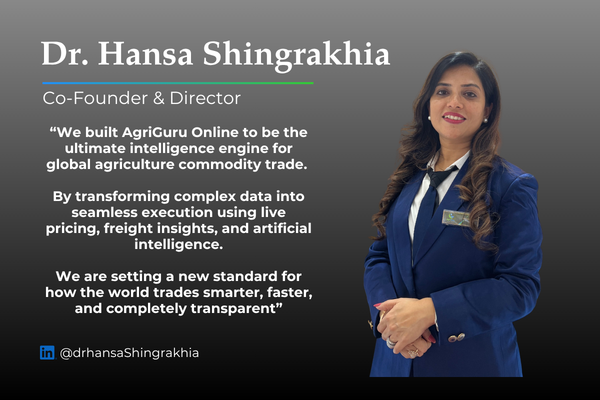
Speaking to AI Spectrum, Dr Hansa Shingrakhia, Director, AgriGuru, said the platform currently covers rice, sugar and pulses, providing users with commodity prices based on origin, product specifications and shipping terms.
For rice, the platform tracks prices across major exporting countries, including India, Pakistan, Thailand and Myanmar. Users can select commodities, specify product varieties and define shipping terms such as free on board (FOB), cost and freight (CNF), or cost, insurance and freight (CIF). Commodity prices are updated every 24 hours, enabling traders to monitor market movements through a centralised dashboard.
A key capability is its AI-powered price prediction model, which analyses historical commodity prices alongside geopolitical developments, currency movements, weather conditions, crop factors and trade-related risks. The system generates market intelligence reports outlining prevailing conditions, supply constraints, potential risks and projected price ranges.
By incorporating multiple market variables, the platform aims to help traders assess price trends and make more informed procurement and export decisions. Its freight analytics capabilities extend this intelligence to logistics, allowing users to track container and vessel freight rates between specified ports. Freight rates are updated every 24 hours, while forecasting tools and configurable price alerts help users monitor changes in commodity prices and shipping costs.
AgriGuru also integrates AI-enabled document generation to simplify export workflows. The platform can prepare trade confirmations, contracts, purchase orders and shipping instructions using transaction details entered by users, reducing repetitive data entry.
A change-tracking mechanism records modifications to transaction parameters and identifies discrepancies across documents, helping users detect inconsistencies before they affect trade execution.
According to Shingrakhia, the integrated documentation process can reduce tasks that traditionally take several hours to approximately five minutes, depending on the transaction and documentation requirements.
As agricultural exporters navigate commodity price volatility, geopolitical disruptions, freight fluctuations and currency risks, integrated AI platforms can help improve visibility across procurement, logistics and documentation. AgriGuru's approach brings these functions together to support more efficient trade operations and data-driven decision-making in global agricultural markets.