

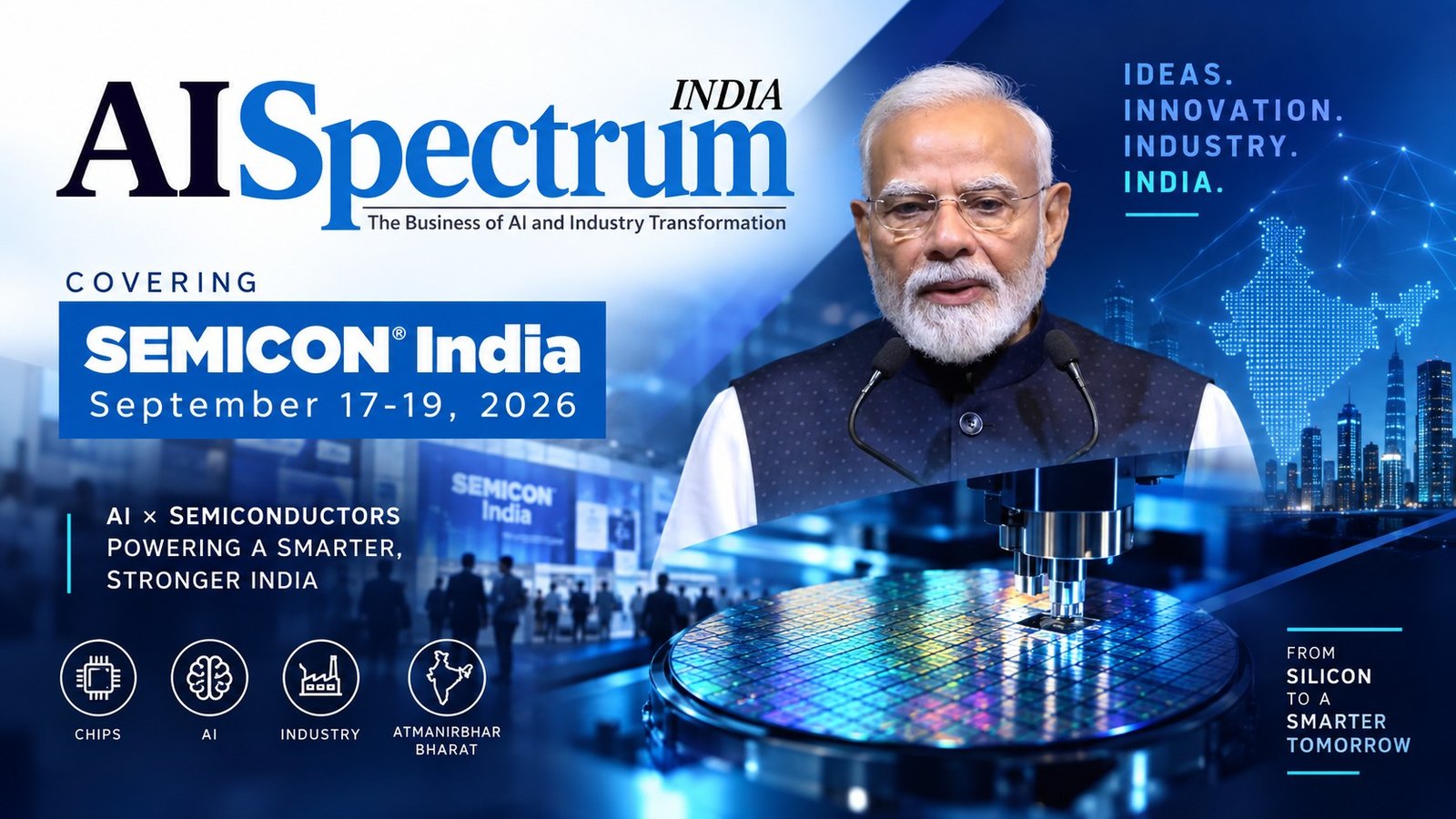
Prime Minister Shri Narendra Modi inaugurated SEMICON India 2026, the fifth edition of the country’s flagship semiconductor conference and exhibition, at Yashobhoomi, the India International Convention and Expo Centre in Dwarka, New Delhi. The Prime Minister addressed the gathering at the inaugural session at around 10 am, setting the tone for three days of high-level deliberations, industry engagement and a full showcase of India’s rapidly expanding semiconductor and electronics ecosystem. The event runs from 17 to 19 September 2026.
SEMICON India 2026 is jointly organised by the India Semiconductor Mission (ISM), the Ministry of Electronics and Information Technology (MeitY) and SEMI, the global industry association representing the semiconductor and electronics design and manufacturing supply chain, in partnership with industry associations. Held under the theme “Silicon to Systems: Building the Ecosystem”, and aligned with SEMI’s global “Transform Tomorrow” banner uniting its eight SEMICON events worldwide, this edition reflects India’s effort to build a complete semiconductor value chain: chip design, materials, manufacturing equipment, fabrication, advanced packaging, testing, electronic systems and workforce development.
This year’s edition is projected to be the largest since the event’s inception, expanding nearly 30 per cent over the previous edition. The 2025 edition drew more than 35,000 registrations and over 20,000 exhibition visitors, and 2026 is expected to surpass those numbers comfortably.
From the inaugural session
Addressing the gathering after the inauguration, the Prime Minister said India’s semiconductor ecosystem is opening new opportunities for innovation and investment, and placed the moment within India’s centuries-old tradition of building and creation. Speaking on Vishwakarma Jayanti, which coincided with the inauguration, he extended greetings to citizens and observed that in Indian tradition “Lord Vishwakarma is considered a symbol of the power of creation and construction”, drawing a parallel with the nation’s effort to build its semiconductor future.
The Prime Minister also interacted with students at the event. Alongside Indian companies, policymakers, investors, researchers and startups present at Yashobhoomi, thousands of students from more than 650 educational institutions across the country participated virtually in the inaugural session, reflecting the strong talent and skilling dimension of this year’s edition.
The inauguration followed the Prime Minister’s roundtable with global semiconductor CEOs on 16 September. According to the Prime Minister’s Office, he emphasised close collaboration between the Government and the semiconductor industry in shaping India’s technology future, highlighted India’s strong foundation of talent, technology adoption and infrastructure, and called for greater industry participation in skilling, innovation and emerging technologies such as AI and quantum computing. Referring to the national target of training one crore people in AI, he noted that India’s talent pool, combined with the experience of global industry leaders, can create significant opportunities, and said India should aspire to be among the early leaders in emerging technologies. Noting the significant progress made in the sector, he observed that the ecosystem is now moving from foundational efforts to a phase of greater scale and opportunity, reiterated the Government’s commitment to a predictable and responsive policy environment, and invited industry leaders to share suggestions on policy and administrative measures. Participants at the roundtable described India’s semiconductor journey as a Test match rather than a T20, underscoring sustained, long-term commitment.
The roundtable was attended by CEOs, heads and senior representatives of leading organisations including SEMI, Micron, Infineon, Applied Materials, ASML, Merck, Tokyo Electron, Fujifilm, AMD, Intel, Tata Electronics, Lam Research, Rapidus, NXP, Foxconn, Advantest, Celesta Capital, CG Power and IBM Research, among others.
Industry leadership on India’s moment
Announcing the Prime Minister’s inauguration ahead of the event, Mr Ajit Manocha, President and CEO, SEMI, said India is “well positioned to thrive with its blend of speed, ambition, talent and long-term vision”, noting that SEMI has empowered the rise of semiconductor hubs around the world for more than five decades and that, through SEMICON India 2026, it brings the collective strength of its global network to India’s journey. India’s opportunity, he observed, is to become integral to the global supply chain, not merely to join it.
Mr Ashok Chandak, President, SEMI India and IESA, said the theme reflects India’s evolution towards a comprehensive and globally competitive semiconductor value chain, and that the strong interest from global and Indian corporates in this year’s event is a testament to the confidence industry leaders place in India’s semiconductor journey. He described SEMICON India as the annual convergence point where industry leaders, policymakers, researchers, startups and investors come together, collaborations take shape and partnerships are forged, adding that the new Value Chain Experience shows India progressing from building credibility to demonstrating capability.
Shri S. Krishnan, Secretary, MeitY, said the Government of India has given a clear indication of the importance of the semiconductor sector through progressive policies and extended support, with participation around the SEMICON India conference and exhibition growing significantly each year. He noted earlier that the Prime Minister’s inauguration would once again reiterate the Government’s commitment to the sector.
Ahead of the event, Union Minister for Electronics and Information Technology Shri Ashwini Vaishnaw had described semiconductors as a foundational industry, noting that chips power products from cars and mobile phones to drones, aircraft and MRI machines, within a global electronics industry estimated at 4.3 trillion US dollars. He noted that twelve units have been approved under the Semicon India programme with a cumulative investment of about 20 billion US dollars, three of which have begun commercial production, that more than 320 universities and startups have received electronic design automation tools under the Chips to Startup programme, and that Indian designers are now working on advanced 2 nanometre and 3 nanometre process nodes.
A landmark edition in scale and ambition
SEMICON India 2026 marks a significant expansion over previous editions. Key highlights include:
- More than 600 exhibiting companies, including over 300 international companies, filling 15,000 square metres of exhibition space across Halls 1 and 2 at Yashobhoomi
- Delegations from 52 countries, more than 400 senior government and industry officials, over 150 speakers, and approximately 50,000 visitors expected across the three days
- Six international country pavilions representing Japan, South Korea, Malaysia, the Netherlands, Singapore and Sweden, alongside 12 State Government pavilions showcasing state-level semiconductor opportunities and policies
- The first-ever “Sand to Silicon to Systems” Value Chain Experience, an immersive exhibition journey presenting the semiconductor value chain in its natural sequence, from materials and chip design to advanced manufacturing, packaging and electronic systems
- A dedicated Startup Pavilion, Innovation Showcase, Startup Pitch Competition, Student Hackathon and Workforce Development Pavilion
- Conference tracks spanning semiconductor manufacturing, AI and digital transformation, supply chains, chemicals and materials, policy, sustainability and product design, along with sessions on the display industry, international country roundtables and a forum on women’s leadership
India’s semiconductor and electronics momentum
The event comes at a defining moment for India’s technology economy. According to government figures released ahead of the event, India’s electronics production has grown from about Rs 1.9 lakh crore in 2014-15 to Rs 13.11 lakh crore in 2025-26, a sevenfold jump, while electronics exports have risen elevenfold, from around Rs 38,000 crore to Rs 4.24 lakh crore. Mobile phone production has grown 33 times over the same period, from Rs 18,000 crore to Rs 6.27 lakh crore, with mobile exports up 165 times.
On the semiconductor front, twelve projects were approved under the first phase of the Semicon India programme, of which three have commenced commercial production, with the first made-in-India chips already rolling out of approved facilities. The Union Cabinet has approved Semicon 2.0, built on six pillars to accelerate ecosystem development and reported to carry an outlay of Rs 1.27 lakh crore. India’s semiconductor demand, currently estimated at around 50 billion US dollars, is projected to reach approximately 103 billion US dollars by 2030. India’s participation in the Pax Silica coalition, joined during the India AI Impact Summit in February 2026, further anchors the country in international efforts to build trusted, resilient supply chains across semiconductors, AI and critical minerals.
Officials expect the opportunity to widen sharply. Shri Amitesh Kumar Sinha, Additional Secretary, MeitY and CEO, ISM, has projected that global semiconductor demand will rise from 1 trillion to 2 trillion US dollars, with India’s own demand growing from 100 billion to 200 billion US dollars. “Our policy supports domestic manufacturing as well as global manufacturing,” he said, pointing to a demand pipeline designed to draw companies into the country. With India currently importing close to 90 per cent of the chips it uses, at an estimated 30 billion US dollars a year, the push to build domestic capacity is central. The Tata and Powerchip fab at Dholera, built at Rs 91,000 crore for 50,000 wafers a month on the 28 nanometre node, targets its first chip in December. Kaynes shipped India’s first commercially produced multi-chip modules in late 2025, and Micron operates an assembly and test plant built with a 2.75 billion US dollar investment.
Over the next three days, Yashobhoomi will host keynotes, panel discussions, country roundtables and exhibition showcases, giving policymakers, investors, researchers, students and industry leaders a single platform to compare requirements, meet suppliers and close the remaining gaps in India’s chip supply chain. The Prime Minister, who marked his birthday with today’s inauguration, is also expected to visit the exhibition and interact with global executives during the event, continuing the practice of previous editions.