

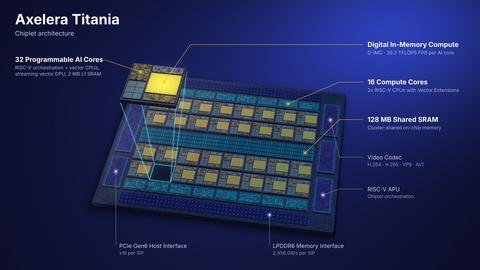
Axelera AI, the leading provider of purpose-built AI hardware acceleration technology, unveiled the details behind Titania, its third-generation silicon architecture in a chiplet design. Titania is highly programmable and energy-efficient and will deliver high performance at interactive speeds, all within the power and cooling limits of existing data centers, rather than the 100-kilowatt-plus liquid-cooled racks that today’s highest-density GPU systems require.
Performance expectations for Titania are up to 7x the throughput per watt compared to the best data center grade servers available, and up to a 20x better TCO. Each Titania-based system-in-package (SiP) will contain two Titania chiplets, which are then packaged in a range of form factors, including standard PCIe cards as well as OCP-compliant UBB baseboards with eight Titania OAM modules connected in a scale-up network. In support of over $300 million in confirmed Titania commitments, these form factors will be available via OEM partners in an inference server configuration in both air- and liquid-cooled configurations.
Titania builds on the programmability, performance and efficiency of its shipping predecessors, Metis and Europa, and further expands the product line from embedded, edge and enterprise AI into large-scale data center inference. Designed for interactive and highly variable AI workloads of enterprises, sovereign clouds, decentralized and modular data centers, telcos and AI factories, Titania combines Axelera AI's high-performance, energy-efficient Digital In-Memory Computing (D-IMC) architecture with a new chiplet-based design, high-capacity LPDDR6 memory, high-bandwidth scale-up connectivity and programmable RISC-V compute in one package. Available in multiple form factors, including industry-standard PCIe cards as well as OCP-compliant boards, Titania offers customers the flexibility to solve for their inference needs. Supported through the Voyager toolchain, Titania deployments will support tensor, expert and pipeline parallelism, as well as speculative decoding, KV cache offloading and disaggregation out of the box. In practice, that means large models use every card in the servers, each user gets tokens faster and operators get more useful work per kilowatt from the rack they already own.
“The biggest challenge most organizations face as inference becomes the dominant AI workload is the tokenomics of their infrastructure,” said Fabrizio Del Maffeo, co-founder and CEO of Axelera AI. “For enterprises, it’s becoming impossible to own their own AI infrastructure due to high CAPEX expenditures, including rebuilding their data center footprint. So they choose between a server that can only compute small or medium models and paying over one million dollars for a data center server that requires specialized infrastructure. Titania solves this problem and gives enterprises, neoclouds, telcos and sovereign clouds alike the opportunity to take advantage of owning and controlling their own inference infrastructure.”